dailynewsnblog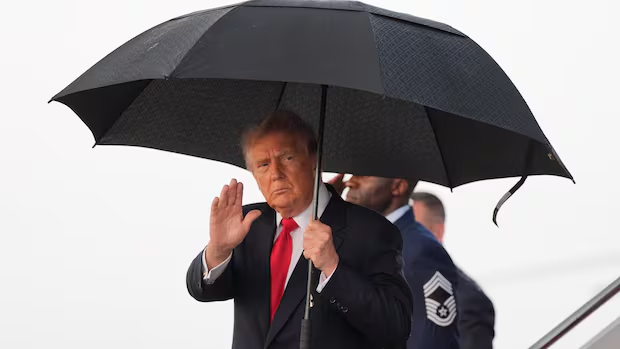

Listen to this article
Estimated 3 minutes
The audio version of this article is generated by AI-based technology. Mispronunciations can occur. We are working with our partners to continually review and improve the results.
Canada-U.S. Trade Minister Dominic LeBlanc is back in Washington this week where he’s continuing his search for a breakthrough in trade negotiations with the U.S. administration.
LeBlanc’s office confirmed to CBC News that chief trade negotiator to the U.S. Janice Charette is with the minister as they try to hammer out a deal.
That task continues to look challenging as U.S. President Donald Trump continues to claim he doesn’t care about reviewing the Canada-U.S.-Mexico Agreement (CUSMA) or striking a broader deal with his northern and southern neighbours.
Asked by Fox News Tuesday if he was looking to update the continental trade deal he said:
“I don’t care. I mean I don’t really want to.”
“I’d rather be independent,” he said. “Mexico and Canada need us, we don’t need them. The deal is important for them, it’s not important for us.”
Prime Minister Mark Carney said last week that while CUSMA is important, he is pursuing an overall trade agreement with the Trump administration rather than looking only to settle trade disputes on the CUSMA file.
Smoke and other irritants
Carney said that along with settling irritants in CUSMA, he wants to see tariffs on critical Canadian sectors like steel, aluminum, lumber and the auto industry lifted.
These discussions are taking place against a ticking clock as newly announced 50 per cent U.S. tariffs on some Canadian goods remain scheduled to kick in on Aug. 19.
The 50 per cent rate is being imposed in response to what a senior administration official described as Canada’s retaliation against U.S. trade policy and its discrimination against U.S. motor vehicles, dairy and alcohol.
Last week the White House provided details, in three presidential proclamations, for why each of those trade irritants are considered discriminatory to the U.S.
While energy, potash, critical minerals and fish would be exempt, other products that until now have been allowed into the U.S. tariff-free under CUSMA would be hit.
Trump has also mused that he will impose another level of tariffs on Canadian goods over wildfire smoke drifting south.
“We’re going to put a big tariff on Canada because of the smoke,” Trump said last week.

The U.S. has declined to extend CUSMA beyond 2036 after a Canada Day meeting with Canadian and Mexican officials. Canada-U.S. Trade Minister Dominic LeBlanc explains why the decision wasn’t surprising and what comes next in the review of the trade agreement.
Carney responded to those remarks saying he had “made very clear” in recent conversations with the U.S. president that Canada was doing its utmost to control the wildfires.
Carney said that discussion included explaining the size of the problem, including “the scale of the forest that Canada is blessed with — eight times the size of Texas — [and] the fact that we have effectively drought conditions that have extended from the equivalent of Texas all the way to Minnesota, to put it in American terms.”