dailynewsnblog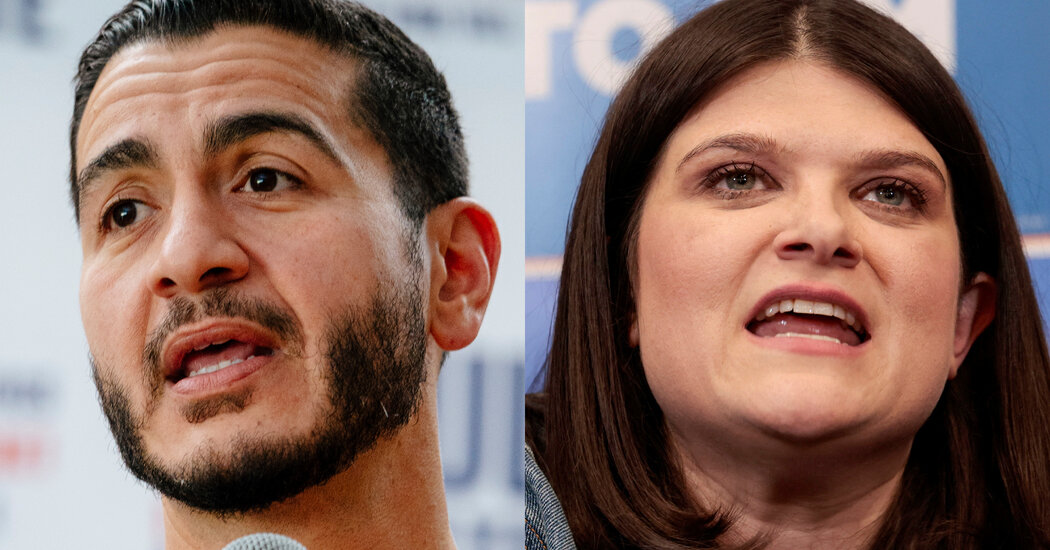
A week before Michigan’s primary contest for Senate, the two Democrats seeking the nomination spent much of their final debate hitting out at each other over campaign finance and who would focus more on helping their state.
Dr. Abdul El-Sayed, a progressive former public health official, repeatedly accused Representative Haley Stevens, a moderate, of being a tool of corporate interests. She declared that he would use the Senate as a steppingstone to political celebrity and would not put the needs of their state first.
Their ideological and stylistic divide, starkly illuminated in the debate on Monday and in the final weeks of the campaign, is as broad as any in a major primary campaign this year. The Michigan seat is seen as crucial in the race for Senate control. The winner of the Democratic primary will face former Representative Mike Rogers, a Republican, in the general election in a race to succeed Senator Gary Peters, a Democrat who is retiring.
On Monday, the candidates’ divergent visions presented Michigan Democrats with a stark choice: Do they want a senator who will work with Democratic leaders in Washington and occupy a middle lane? Or one who will push for progressive causes like “Medicare for all” and ending U.S. aid to Israel?
Here are six takeaways from the debate:
El-Sayed repeatedly hit Stevens over AIPAC money.
The Senate primary in Michigan has become the showpiece fight between Democrats who want to fundamentally alter the nation’s relationship with Israel by cutting U.S. military aid and those who back continued American support for the Jewish state.
It has also become a central battle over money in politics. The main super PAC for the American Israel Public Affairs Committee, the nation’s leading pro-Israel group, has so far spent $30.6 million on advertising backing Ms. Stevens, according to data from AdImpact, a media tracking firm. Six other super PACs that have not disclosed their donors have spent a collective $29.4 million on her behalf.
Throughout the hourlong debate, Dr. El-Sayed reminded viewers that Ms. Stevens was heavily backed by super PAC money. He argued that it would influence her conduct in the Senate.
“Just last week, our friend here voted to send 3.3 billion of your tax dollars to a foreign government,” he said, referring to Ms. Stevens’s House vote against cutting off U.S. aid to Israel. “That is the pro quo that comes with the quid of $30 million spent by AIPAC.”
Ms. Stevens, as she has throughout the campaign, did not engage with questions about AIPAC support. She declared herself “transparent” and sought to pivot to “the affordability crisis here in Michigan.”
Stevens criticized her rival as a celebrity candidate.
There is little doubt that Dr. El-Sayed is a smoother talker than Ms. Stevens. While she sometimes meandered through thoughts and injected buzzwords into her debate responses, he spoke in the smooth cadence of a veteran podcaster — a role she attacked him for once having.
“My opponent here, Abdul, he is such a talented guy,” Ms. Stevens said. “He’s written three books, he’s had 300 podcasts. You know, he’s had all this attention, but the deal is, is we don’t need a celebrity candidate. We don’t need a celebrity senator. We need somebody who is committed to six years of hard, unglamorous work.”
At one point, she accused Dr. El-Sayed of using the Senate race as a way station en route to running for president. And indeed, he has articulated big ambitions about changing the Democratic Party from a perch in the Senate, starting with the party’s relationship with Israel.
El-Sayed assured voters, ‘I’m not a socialist.’
Dr. El-Sayed is not a democratic socialist, and he is not endorsed by the Democratic Socialists of America. And yet the debate’s moderator asked him about accusations that he was a socialist — “not that that’s a bad word.”
Dr. El-Sayed parried the question and said that a larger threat than socialism was capitalism run amok, dominated by corporate monopolies and oligarchs.
“I’m not a socialist,” he said. “I’m just a capitalist who understands how capitalism works.”
Only one candidate would abolish ICE.
Much of the debate was conducted on Dr. El-Sayed’s terms. Discussion about AIPAC-tied funding and U.S. support for Israel left Ms. Stevens defending positions that have become broadly unpopular among Democratic primary voters.
When it came to an exchange about Immigration and Customs Enforcement, Ms. Stevens spoke about her efforts — which were ultimately futile — to redirect funding for the agency that Republicans in Congress had approved.
Dr. El-Sayed’s message was more unequivocal. He would abolish ICE altogether — and he thought more Democrats should praise immigration in general.
“We need Democrats who are going to stand up and actually talk about the great good that immigration has done for our country in the first place,” said Dr. El-Sayed, whose parents immigrated to Michigan from Egypt. “The idea that somehow we can’t say ‘abolish ICE’ because we’re so afraid of what they’re going to say, when we’ve seen ICE terrorize people in our streets, to me, it is exactly the kind of cowardice that we don’t need from Democrats.”
Stevens repeatedly made appeals to Black voters.
Ms. Stevens is counting on Black voters in Michigan to carry her to victory in the primary. Polls show her leading among them, and AIPAC-tied advertising features footage of former President Barack Obama praising Ms. Stevens at a rally when she first ran for Congress in 2018.
Throughout the debate on Monday, she sought to emphasize her connection with and appeal to Black voters.
She slipped a reference to her support for “equity and inclusion” into a response to a question about a recent rally that Senator Bernie Sanders of Vermont and Representative Alexandria Ocasio-Cortez of New York held in Michigan for Dr. El-Sayed. And she sought to dismiss Dr. El-Sayed’s populist appeal and large crowds by suggesting that she was spending her campaign time — which has included far fewer advertised public events — dropping in to speak with Black business owners.
“I know it’s great to hold, host rallies and have these fun events,” she said. “But everywhere I have gone in Michigan, I have taken the time to visit a minority-owned business.”
Stevens thanked El-Sayed for not calling her an ogre.
In the final weeks of the primary, as some of Dr. El-Sayed’s online supporters mocked Ms. Stevens for her accent and her speech patterns, he made a plea for kindness in the campaign.
But his own colorful language in a leaked audio recording reported by Politico, in which he suggested that if “you put one ogre on a pike, and then everyone else gets the message,” briefly put him on the defensive during the debate. Dr. El-Sayed said that he had been speaking about a primary challenge to Senator John Fetterman of Pennsylvania, the towering Democrat whose politics have swerved to the right.
Ms. Stevens responded by reciting Dr. El-Sayed’s attacks against Gov. Gretchen Whitmer and former Senator Debbie Stabenow, who have both endorsed her. When Dr. El-Sayed then suggested that the debate should be less about their personalities and more about their politics, Ms. Stevens offered a mocking appreciation for his clarification.
“Well, thank you,” she said, “for clarifying that you didn’t call me an ogre.”


![Emirates Suspends Flights To These 6 Global Destinations: See All Routes Now [Map]](https://dailynewsnblog.com/wp-content/uploads/2026/07/339-emirates-boeing-777-300-emirates.jpg)