dailynewsnblog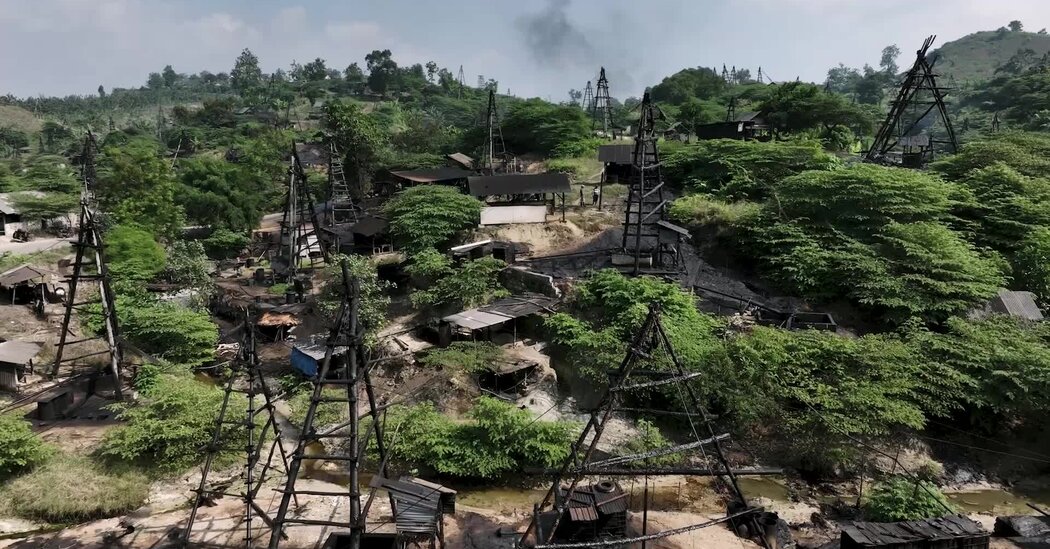
The old red truck’s engine was jury-rigged to control a pump tied to a three-legged tower cobbled together from teak logs and rope. Sujiyanto sat in the cab of the vehicle, cigarette in hand. He released the gas pedal, sending the pump hundreds of feet underground before hauling it back up filled with crude oil.
“This is how we extract oil from the ground,” said Mr. Sujiyanto, 51, who, like many Indonesians, goes by one name.
Around him on a recent Wednesday, smoke rose over the hills, which were dotted with teak derricks. The smell of oil lingered in the air and the ground was slicked black. Nearby, a group of men used their bare hands to crank out a pump stuck into the ground.
This is the Wonocolo oil field in East Java, Indonesia, where subsistence oil drilling has endured for decades. It was discovered by troops digging for water in 1893, when Indonesia was a Dutch colony. Reaching depths of about 1,600 feet, it is considered one of the world’s shallowest oil fields, allowing the community to extract oil without heavy machinery.
Big oil companies have long considered the field, which covers about 120 acres, commercially insignificant. Nonetheless, community drilling here has survived through the booms and busts of the oil market. Many here have welcomed the energy shock from the Iran war, even as the Indonesian government has looked to Russia to shore up oil supplies.
“We are actually happy when oil prices rise, because our income increases,” said Mr. Sujiyanto, who has been working here for around 15 years.
Next to his truck, three other men worked at separate stations. One sat inside a hut beside the pump, maneuvering it with a long wooden stick. Two others, equipped with buckets, scooped oil that had pooled around the well at the base of the derrick. For an hour, they worked in sync to collect the oil that totaled up to 200 liters, or a bit over a barrel. Then, they moved onto another well.
These are not the only community-run oil wells in Indonesia. There are about 34,000 of these, not counting the few hundred in Wonocolo, according to government data. But Wonocolo stands out for its history and some savvy marketing. It is also known as Little Texas because the local government christened it Teksas Wonocolo, which is a nod to the U.S. state and stands for Tekad Selalu Aman dan Sejahtera, or “Always Safe and Prosperous.”
But like most community-run wells, those at Wonocolo are not registered with the government, said Afftaudin, the acting head of the East Java Energy and Mineral Resources Department. As a result, they are not subject to safety regulations and operate in a gray area.
Five years ago, a miner was caught in a pulley rope while inspecting a well and died instantly, said Heri, a distiller who has worked in the field for 15 years.
“This is a scary job,” said Mr. Heri, who also uses one name.
Many in the area work as distillers, boiling the crude in a furnace to separate out water and to sell the resulting unrefined diesel. Environmentalists worry about air and soil pollution, as well as the long-term effects on the health of the drillers.
Pradipta Indra Ariono, the director of WALHI East Java, an environmental nonprofit group, said the oil industry at Wonocolo was a sign of the lack of jobs in the region.
“They dig for oil because there is no better option,” Mr. Pradipta said.
For decades, Suwoto, 73, has scraped residual oil from the river, gutter or puddles near the field. He collects crude remnants and boils them to separate oil and water. The oil is then skimmed off with a spatula and transferred into barrels. In a day, he can gather up to two jerrycans, or about 40 liters, which he sells for around $25.
At night, Mr. Suwoto works as a security guard in the field. He said, “I guard the mine from oil and machinery thieves.”
For Mujiyono, 70, the wells have been a source of income for three generations of his family. He grew up in the area, brought here by his parents as a child. Before old truck engines were introduced, he recalled, miners operated most pumps manually, with at least 10 people working together to pull the mechanism from underground.
“Around the 1990s, one well could produce up to 38 barrels of oil per day and run 24 hours,” he said.
About 800 wells are scattered across two villages, Wonocolo and Hargomulyo, with at least 200 still producing oil. Most of the crude drilled here is sold to the state oil company, Pertamina.
But the oil reserves have been depleted over the years, Mr. Mujiyono said. Today, it can take a week to extract seven to eight barrels of crude from a single well, which sells for about 7.2 million Indonesian rupiah, or about $400, which is below the market rate. Most men here typically work across five to six wells and, in a good month, can earn up to $400.
Over a decade ago, Sumanta, 64, began investing in abandoned wells. Now, he said, he can dig up oil to fill as many as 300 barrels a week, which he sells to Pertamina. He remains optimistic about Wonocolo’s prospects.
“We need to dig deeper,” he said.
Worried about the wells running dry, the government began an effort about a decade ago called Petroleum Geoheritage Wonocolo to promote tourism in the area. It built an observation tower, a museum and a hall for food vendors, but the initiative has largely languished.
“We had visitors before — most of them were university students or researchers,” Mr. Suwoto said. The museum remains open, but it is also used as a rest stop by researchers and other travelers. The observation tower, when I visited, offered an arresting overview of the Wonocolo field paired with blue skies and black smoke coming from the wells. The food hall lay abandoned and the area was covered with weeds.