dailynewsnblog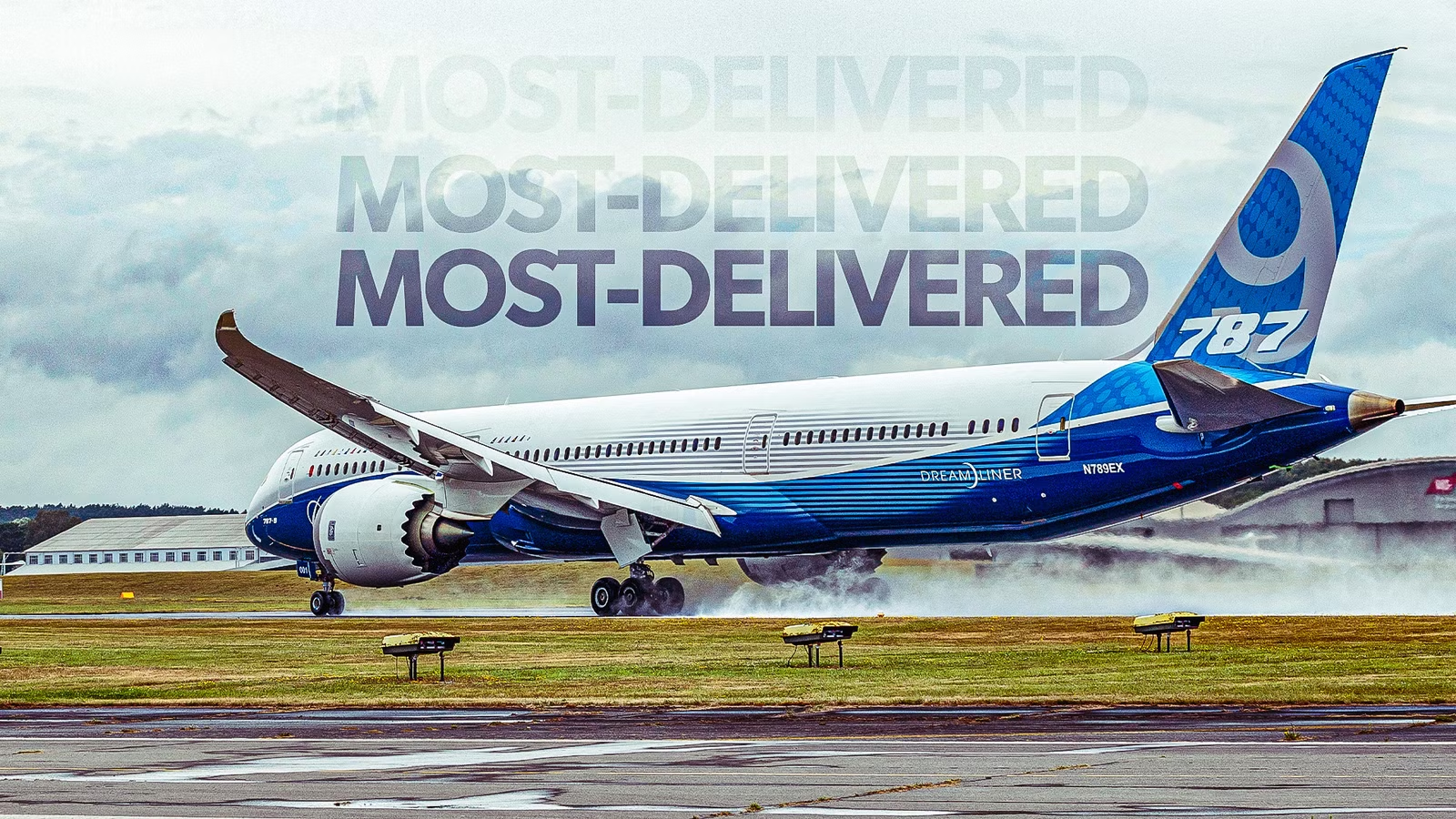
Air travel demand continues to rise. The International Air Transport Association (IATA) recently forecast global passenger demand to double by 2050. Airlines are actively responding to the growing demand by adding capacity and opening new routes, while manufacturers are working through substantial order backlogs to deliver the aircraft needed to support that growth. In fact, manufacturers are finally beginning to catch up on aircraft deliveries that were delayed during the pandemic.
According to aviation analytics provider Cirium, total delivery volumes in the first half of 2026 (H1 2026) reached their highest level since 2018; both Airbus and Boeing recorded sustained increases in their shipment rates. The two manufacturers delivered nearly 650 commercial passenger and freighter aircraft during H1 2026, which is only 5% below the industry’s H1 record of 681 deliveries set in 2018.
The Boeing 787-9 Dreamliner Is 2026’s Most-Delivered Widebody

The two manufacturers had completed around 43% of the projected full-year commercial aircraft deliveries by the end of June 2026. Cirium expects Airbus and  Boeing to deliver around 1,510 aircraft in total this year. Notably, the delivery recovery was led primarily by the single-aisle sector, with both the A320 family and 737 MAX recording solid growth. Widebody deliveries, meanwhile, remained broadly flat compared with the single-aisle segment.
Within that relatively stable twin-aisle market, the 787-9 Dreamliner was the most-delivered widebody by unit count, with the manufacturer handing over 35 aircraft. For the full year, 52 787-9s are scheduled to be delivered to 13 airlines, according to Modern Business Travel. Indeed, the aircraft has become a core part of the long-haul fleets of many major airlines since entering commercial service in 2014.
The aircraft offers outstanding fuel economics and the range needed for long-distance operations. This has made the aircraft increasingly popular among airlines that are looking to replace their aging widebodies with more efficient aircraft. Interestingly, we are currently seeing the 787-9 gradually replace older-generation widebodies such as the 767, 777-200, and A340 at multiple airlines, specifically four airlines.
United’s 787-9 Is Replacing Older Widebodies

 United Airlines is one of the airlines actively phasing out its older widebodies, such as the 767 and 777-200, and replacing the routes they operate with 787-9s as the economics of operating the older aircraft have become increasingly difficult to justify. Indeed, the 787 is not simply another aircraft type in United’s fleet. The airline was an early adopter of the Dreamliner; it took the delivery of its first example in 2012, and has since built the type into the foundation of its long-haul fleet. United now operates all three Dreamliner variants: the 787-8, 787-9 and 787-10.
According to planespotters.net, it currently has more than 80 787s in its fleet, including 12 787-8s, 56 787-9s and 21 787-10s. It is also expected to take delivery of up to 20 more Dreamliners during 2026. Undoubtedly, the 787-9 is the most important variant within the fleet. Its combination of range and capacity allows the airline to use it for a wide range of long haul operations, from services to Europe and the Middle East to routes across the Asia-Pacific region, Australia and South America. At the same time, United is also using the 787-9, particularly its newly delivered aircraft, to target the growing demand for premium long-haul travel.
Each “Elevated” 787-9 features Polaris Studio, the airline’s latest ultra-premium suite. Each aircraft features eight Polaris Studio suites at the front of the Polaris cabin. Each suite is around 25% larger than a standard Polaris seat and includes a sliding privacy door, a 27-inch 4K OLED touchscreen, Bluetooth audio, wireless charging, and a companion ottoman that allows passengers to dine with a guest.
The Polaris Studio suites entered service in April on the San Francisco-Singapore route, followed by San Francisco-London Heathrow from April 30. United expects to operate around 20 “Elevated” 787-9s by the end of this year, with the number expected to grow to 47 by 2028.
Air India Expands Its 787-9 Operations

Furthermore,  Air India is also actively replacing some of its older widebodies with the 787-9. The Indian carrier has been making several changes to its aircraft deployments this year, with the new Dreamliner gradually taking over routes previously operated by other aircraft. For instance, from July 1, the airline started deploying 787-9 on the Mumbai-London Heathrow route, replacing the 777-300ER. It will deploy the brand new 787-9 on its Delhi-Toronto route from August 1 as well.
Seven of the route’s ten weekly flights will be operated by the first line-fit 787-9. The remaining three weekly flights will continue to be operated by Air India’s legacy 777-300ER. In addition, for a brief period, the carrier deployed the 787-9 on its Delhi-Tokyo Haneda route, replacing the 787-8. The aircraft operated the route from mid-February until the end of May, adding 2,408 seats between Delhi and Tokyo Haneda each month during the period.
The airline also used the 787-9 on its Mumbai–Frankfurt route between February and July. Air India has operated the 787 family for more than a decade. The airline took delivery of its first Dreamliner in the early 2010s, and the widebody has since become an important part of its long-haul network, operating routes across Europe, Asia, Australia and North America. The airline did not initially operate the 787-9, but inherited several examples from Vistara following the merger between the two airlines.
Since the beginning of 2026, Air India has started taking delivery of its first line-fit 787-9 aircraft. These aircraft feature a three-class cabin with 30 Business Class suites, 28 Premium Economy seats and 238 Economy seats. These new aircraft are now being used on some of the routes where Air India is replacing older widebodies.
Lufthansa’s 787-9s Are Replacing Its A340-600s

Besides, the German flag carrier  Lufthansa is phasing out its aging A340-600s and increasingly moving towards more efficient widebodies such as the 787 and, in the future, the 777X. The 787-9 has already started taking over some of the A340-600’s routes. During the latest Northern Winter schedule, Lufthansa deployed the type on several routes from its Frankfurt hub to the United States, including Atlanta, Detroit and Newark Liberty, where the A340-600 had previously been used.
The A340s have been gradually disappearing from the fleet for years. Lufthansa operated 24 A340-600s at its peak, but this number has steadily declined since the first retirements began in 2016. Lufthansa has been trying to complete the retirement of its remaining A340-600s for some time, and the timeline has been pushed back several times. The airline was originally expected to retire the type completely by the end of 2025, but Boeing’s delivery delays have forced it to continue operating some of the aircraft to cover capacity gaps.
Lufthansa Current Widebody Fleet | |
|---|---|
Aircraft Type | Examples |
Airbus A330 | 5 |
Airbus A340 | 16 |
Airbus A350 | 31 |
Airbus A380 | 8 |
Boeing 747 | 26 |
Boeing 787-9 Dreamliner | 18 |
Lufthansa has a substantial order book for new widebodies, including more than 50 Boeing 787-9s and 777Xs, but delays affecting the 787 program (related to issues regarding its Allegris cabin) and the certification of the 777X have disrupted its fleet plans. The A340-600 is now expected to finally leave Lufthansa’s fleet after the summer. According to scheduling data from Cirium, the aircraft’s final scheduled passenger flight is set to operate on October 25 from Riyadh to Frankfurt.
JAL Is Using The 787-9 To Expand Its Long-Haul Network

Japan Airlines (JAL) is also counting on the 787-9 as it expands its long-haul operations and renews its widebody fleet. The Japanese carrier is one of the largest operators of the 787 Dreamliner family, with 23 787-8s and 22 787-9s currently in its fleet. It is also awaiting deliveries of ten more 787-9s as part of its fleet renewal plans.
Currently, the airline is working towards a major expansion of its international network. It is aiming to expand its long-haul network by as much as 50% by 2030, with a particular focus on North America and Asia. When announcing its fleet plans, the airline said that the new aircraft would be used to enhance and expand its international operations, particularly in regions such as North America, Asia and India, where it expects future growth.
Furthermore, the 787-9 will also help JAL replace some of its older widebodies. On its North American network, the aircraft is already one of the airline’s most frequently used widebody types, while the carrier continues to operate older 767-300ERs and 777-300ERs. The 787-9s that JAL is scheduled to receive from 2027 will provide additional capacity for the airline’s long-haul expansion while also allowing it to gradually move away from its older widebodies.
The 787-9 Is Replacing Three Legacy Widebodies

Besides the airlines mentioned above, several other carriers have also added the 787-9 as part of their long-haul strategies and fleet modernization plans. When Boeing introduced the 787 family, it took a very different approach. At that time, the industry was focused on larger aircraft and more capacity, but the US planemaker instead developed a smaller, more efficient aircraft with a clean-sheet design.
It identified the 200- to 300-seat market as the area with the greatest potential, and launched the 787 as a successor to the 767. Boeing also placed trust in the future of the point-to-point operating model, which allowed airlines to connect more city pairs without relying on the larger aircraft traditionally used on hub-and-spoke networks. That decision has turned out to be the right one.
This year, the 787-9 has become the most-delivered widebody and is playing an important role in the fleet modernization plans of several airlines. Indeed, it is quietly contributing to the retirement of three legacy widebody types: the 767, 777-200, and A340, and now sits alongside aircraft such as the 777-300ER and A330-300 in the long-haul market.