dailynewsnblog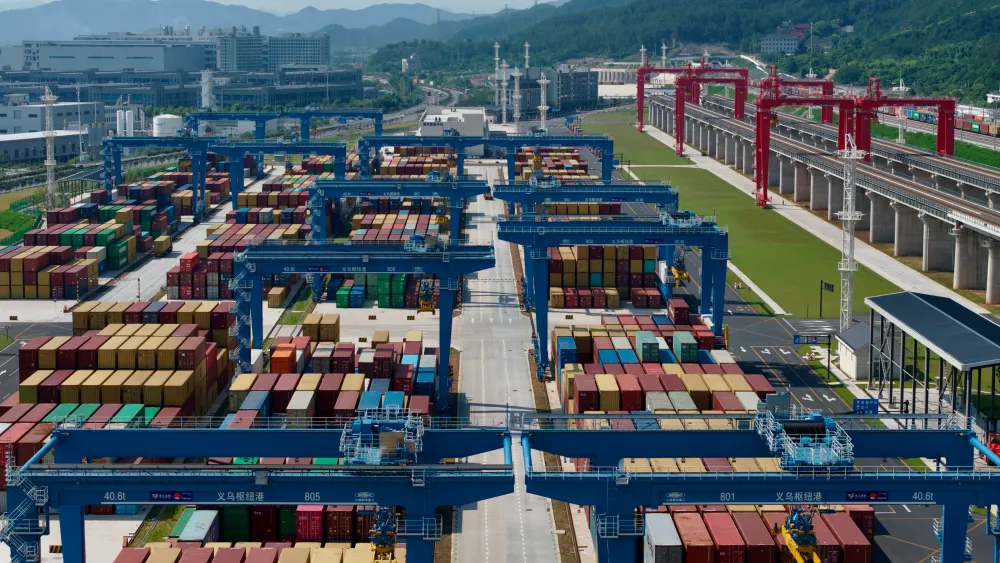
China is betting on artificial intelligence (AI) to modernize its port network, unveiling a five-year plan that calls for smarter customs operations, upgraded infrastructure and expanded cargo capacity across dozens of ocean, air, rail and land gateways.
The country has designated 43 key ports of entry for its “Smart Port Construction Project,” members of China’s General Administration of Customs (GAC) said at a press conference last Wednesday.
The project is aimed at leveraging artificial intelligence, big data application services and intelligent equipment to fast-track customs clearance, storage and transportation capabilities across the hubs.
Customs officers at various ports have already been using AI smart glasses and large CT scanners to aid in the clearance process. The department is now seeking to accelerate the deployment of intelligent scanning equipment and inspection robots to more quickly screen containers, which would reduce on-site manual operations such as opening and unpacking, and minimize the time goods spend at the port.
AI models will collect data to create a “smart brain” aimed at automatically identifying and capturing risky cargo, as well as enabling data sharing that connects customs operators with businesses’ production, warehousing and logistics systems.
By 2030, more than 90 percent of ports are expected to be equipped with intelligent inspection equipment.
“The future smart port scenario is promising: modern unmanned terminals will operate busily and orderly; at passenger inspection channels, inbound and outbound passengers will pass through customs conveniently and smoothly under the guidance of intelligent robots,” said Zhang Baofeng, deputy director-general of the GAC. “Land ports will achieve unmanned driving, intelligent inspection, and efficient passage.”
The plan is jointly issued by the GAC and the country’s central economic planning department, the National Development and Reform Commission.
Beyond the Smart Port plan, Zhang said China expects to upgrade infrastructure at 57 ports, as well as expedite the construction of the Torugart and Ganqimaodu railway ports to bolster cross-port traffic along its southbound, westbound and northbound corridors. In an effort to help support the growth of dedicated cargo airports, the GAC will promote the separate opening of passenger and freight transport operations across hubs.
Across the board, the plan is aimed at expanding cargo handling infrastructure, including unloading areas, storage facilities and transshipment corridors, as well as building designated customs supervision sites at eligible specialized ports. These are dedicated inspection facilities for certain cargo types.
Under the plan, China also expects to expand multimodal transport infrastructure, including larger transshipment facilities designed to better connect ships, rail, trucks and inland waterways. Additionally, the scheme aims to standardize cargo handling equipment so cranes, containers and other equipment are more interoperable across transport modes.
By the end of the five-year period, China expects “significant progress” in the modernization. The country expects port upgrades to be mostly finalized by 2035.
The modernization effort is a recurring institutional practice as part of China’s national planning system.
In March, China approved its 15th five-year plan for economic and social development for the 2026-2030 period. The plan sets the top-level goals for the Chinese Communist Party related to the economy, the environment, national security and public health.
Wait times elevated at Chinese ports
The anticipated upgrades come as seaports throughout China remain congested due to delays driven Typhoon Bavi, which briefly forced container terminals at major hubs including Shanghai, Ningbo and Qingdao to shutter.
In the two weeks since the storm passed, congestion across east Asia remains “elevated,” according to a Monday update from container shipping research firm Linerlytica. The company attributes the congestion to the continued clearing of ships that were initially delayed due to the storm, with new arrivals resulting in further vessel bunching.
Hapag-Lloyd’s Monday operational update indicated wait times are still higher than usual.
The average time to berth at Shanghai’s Yangshan Deepwater Port is 72 hours for services shared with Maersk via the Gemini Cooperation. That wait expands to 144 hours for non-Gemini services.
On July 9, the average waiting time at Yangshan was approximately 48 hours for Gemini services, and 96 to 120 hours for non-Gemini services.
To dock at Ningbo, the average waiting time is the same for Gemini and non-Gemini services at 48 hours, expanding from the range 24 to 48 hours documented earlier in the month.
As of Monday, the average waiting time at Qingdao was 72 hours for all vessels. The prior range identified by Hapag-Lloyd was 24 to 36 hours to berth.
According to Sun Meijun, director of the GAC, an average of 400,000 containers, 15 million tons of cargo, 22 million express parcels, and 2 million people pass through China’s port system daily.