dailynewsnblog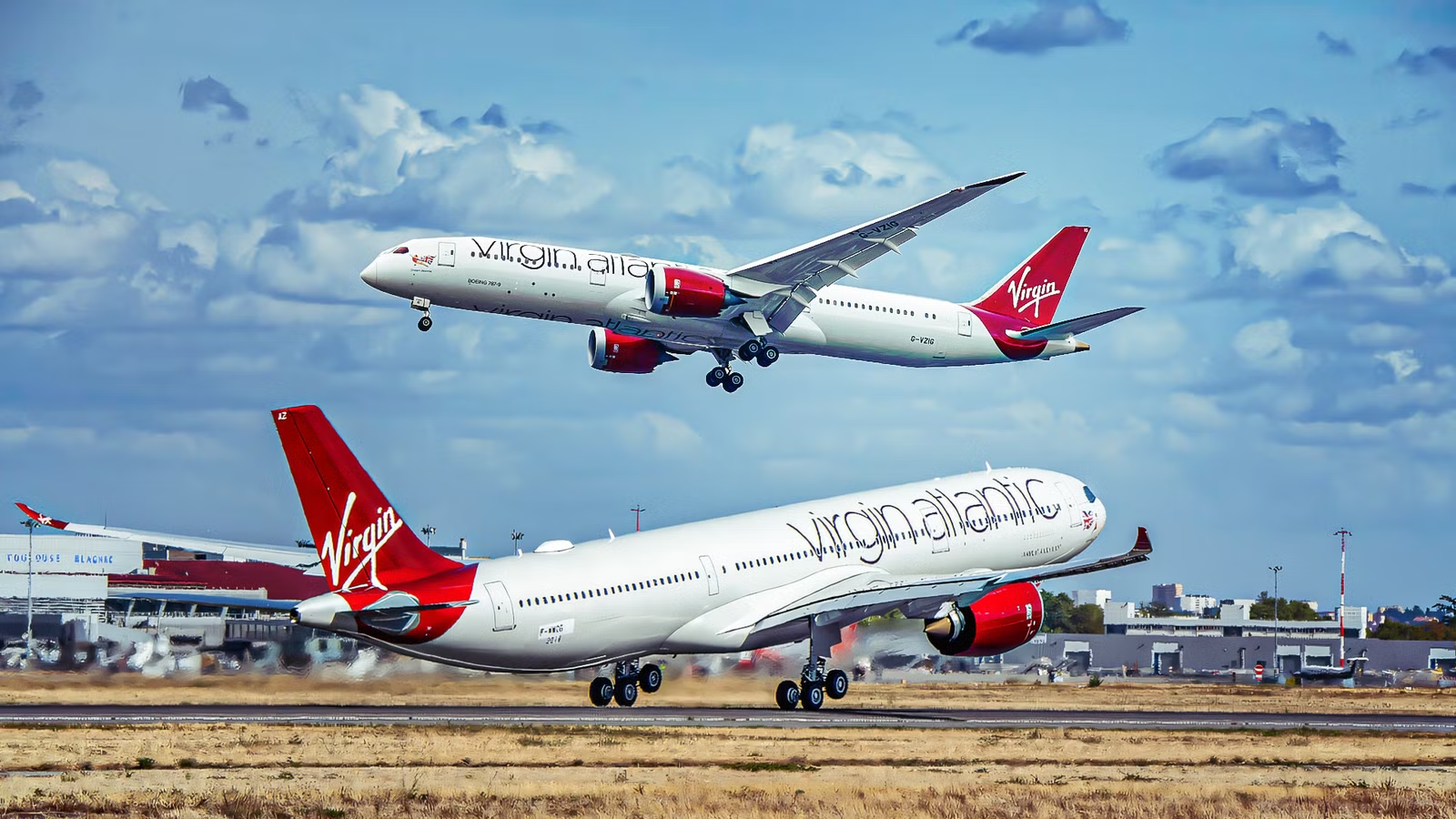
The Airbus A330neo and Boeing 787-9 Dreamliner have become important parts of many airlines’ long-haul strategies. Both aircraft are popular with operators and passengers, and they compete for many of the same routes. Boeing launched the 787 Dreamliner program, which includes the 787-8, 787-9, and 787-10 variants, in the early 2000s. The 787-9 entered commercial service with Air New Zealand in 2014. The aircraft and the 787 program in general quickly attracted interest from airlines and gave Boeing a strong new competitor in the long-haul market.
In response, during the 2014 Farnborough Airshow, the European manufacturer launched the A330neo (consisting of A330-800neo and A330-900neo variants), an updated version of its legacy A330 family. Indeed, the two aircraft represent different design philosophies. One was developed as a clean-sheet aircraft, while the other is based on an airframe that had already been in service for decades. As a result, the two aircraft have several noticeable differences, including their wings.
Airbus & Boeing Used Different Materials In Their Wings

With the A330neo, Airbus introduced several changes. As its name suggests, one of the biggest changes was the introduction of new engines, but the manufacturer did more than simply replace the aircraft’s powerplants. The manufacturer also introduced updated avionics and cockpit systems, made changes to the cabin, improved the aircraft’s range by up to 1,500 nautical miles, and worked to reduce maintenance requirements, noise, and emissions. In addition, it also redesigned the A330neo’s wings.
This was an important part of its efforts to keep the A330 competitive with aircraft such as the 787. Notably, the new wing uses lightweight carbon-fiber-reinforced plastics (CFRP), which helps reduce its weight and makes the wing lighter and more flexible. Boeing similarly made extensive use of carbon-composite materials in the 787. In fact, it was the first commercial airliner to be constructed primarily out of carbon-composite materials, with composites accounting for roughly 80% of the aircraft by volume.
The fundamental difference, however, is that the A330neo remains an evolution of an existing design, rather than a clean-sheet aircraft like the 787. Updating an existing airframe can be faster, less expensive, and less risky than developing an entirely new aircraft, but it also means that engineers must work within the limitations of a design whose basic architecture dates back decades. Airbus has used composites for selected structures, such as the sharklets and outer wing skin, but has retained a mostly aluminum wing box on the A330neo.
How Manufacturers Designed Their Wings Differently

The use of carbon-composite materials is just one of the differences between the wings of the A330neo and 787-9. The most noticeable difference, however, is their size. Previous-generation A330 aircraft shared a common wing design with the four-engined A340, but Airbus significantly changed the wing for the A330neo.
The manufacturer increased the aircraft’s wingspan from 197.8 feet (60.3 meters) to 210 feet (64 meters), close to that of the A350, which measures approximately 212.4 feet (64.8 meters). Indeed, this longer wingspan has provided Airbus with several aerodynamic benefits, including reduced fuel burn and extended range. Longer wings generate more lift, which enables the aircraft to carry more payload and fly longer distances. Another benefit is improved climb performance.
Besides this, Airbus gave the A330neo a higher aspect ratio of 11, which is the highest of any commercial aircraft currently in production. In aviation, aspect ratio refers to the comparative measurement of a wing’s length, or span, to its width, or chord. A higher aspect ratio generally reduces wingtip vortices, allowing a wing to generate lift with less induced drag, which benefits long-distance cruising. The 787-9, by comparison, has a wingspan of approximately 197 feet (60 meters) and has an aspect ratio of approximately 9:59.
Manufacturers Took Different Approaches To Reduce Wingtip Drag

Furthermore, the two aircraft also use different designs at the ends of their wings. Airbus fitted the A330neo with blended sharklets, while Boeing opted for raked wingtips on the 787-9. Indeed, both designs are intended to reduce the drag created by wingtip vortices, but they achieve this in different ways. As noted earlier, the older A330 and A340 shared a common basic wing design, even though the A330 was a twin-engined aircraft and the A340 was a four-engined aircraft. This created some compromises for the A330, as its wing had originally been designed around the requirements of the larger four-engined aircraft.
For the A330neo, the European planemaker therefore needed to improve the wing’s aerodynamic performance if the aircraft was to remain competitive with newer-generation widebodies. Thus, it fitted the A330neo with sharklets, those large, curved structures you see at the ends of the wings. They add approximately 3.7 meters to the aircraft’s wingspan without taking it beyond the Code E airport gate limits. The concept draws on the manufacturer’s work on the A350 and A320neo.
It helps reduce the spiral-shaped vortices that form at the wingtips during flight, thereby reducing induced drag and improving aerodynamic efficiency. According to Airbus, the sharklets improve the aircraft’s aerodynamic performance by around 4%. Boeing, on the other hand, took a different approach with the 787-9. Rather than fitting a separate winglet, the manufacturer designed the ends of the 787’s wings to be more swept back than the rest of the wing. These raked wingtips extend roughly five meters and have a similar effect on wingtip vortices to conventional winglets.
Different Designs, Similar Efficiency Gains

Indeed, Airbus and Boeing took different approaches with the A330neo and 787-9, but both achieved significant efficiency gains. The A330neo gained efficiency through a combination of new engines and aerodynamic improvements. The aircraft is powered by Rolls-Royce’s Trent 7000 engine, which was developed as a significant advancement over the Trent 700, which powered earlier versions of the A330.
The 787, however, started from a different position. Boeing made extensive use of carbon composite materials throughout the aircraft (about 80% by volume compared to just 14% in the A330neo), including the fuselage, wings, and tail. In fact, according to its By Design resources, this shift alone contributes to the Dreamliner’s ability to burn up to 25% less fuel than the airplanes it replaces.
Composites are lighter than aluminum and are also more resistant to fatigue and corrosion. This helped Boeing reduce the aircraft’s weight and gave engineers greater freedom to develop the 787’s long, flexible, high-aspect-ratio wings. Its engines also contribute to its efficiency. Depending on the airline’s choice, the aircraft is powered by either the Rolls-Royce Trent 1000 or the General Electric GEnx. Both engines were developed with improvements in fuel efficiency and performance compared with earlier-generation powerplants.
Two Aircraft With A Strong Market Position

Indeed, on paper, the A330neo and 787-9 are two very similar aircraft, with comparable specifications and similar roles in airline fleets. However, there are some differences that can influence how airlines use them. Regarding range, both aircraft offer long ranges. The 787-9 has a range of approximately 7,565 nautical miles (14,010 kilometers), which allows it to operate some of the longest direct routes in the world.
These include routes , such as Tokyo to Boston, Los Angeles to Melbourne, and the long connection between London and Perth. The A330neo variants also have comparable ranges of approximately 12,000 to 15,000 kilometers, depending on the variant. Apart from that, the A330neo, specifically the A330-900neo, has a slightly higher passenger capacity, partly because of its marginally greater length.
Specification | Boeing 787-9 Dreamliner | Airbus A330-800neo | Airbus A330-900neo |
|---|---|---|---|
Length | 206 feet, 1 inch (62.81 meters) | 191 feet, 6 inches (58.36 meters) | 208 feet, 11 inches (63.66 meters) |
Wingspan | 197 feet, 3 inches (60.12 meters) | 210 feet (64 meters) | 210 feet (64 meters) |
Cabin Width | 18 feet (5.49 meters) | 17 feet, 3 inches (5.26 meters) | 17 feet, 3 inches (5.26 meters) |
MTOW | 560,000 lb (254,011 kg) | 553,360 lb (251,000 kg) | 553,000 lb (251,000 kg) |
Cruise Speed | Mach 0.85 | Mach 0.82 | Mach 0.86 |
Range | 7,635 nautical miles (14,140 km) | 8,100 nautical miles (15,000 km) | 7,200 nautical miles (13,334 km) |
Cargo Capacity | 36 LD3 or 11 pallets | 27 LD3 or eight pallets | 33 LD3 or nine pallets + five LD3 |
The 787-9, on the other hand, offers more cargo capacity below the passenger cabin. The 787 also has a slightly wider cabin, which can give airlines more flexibility when deciding how to arrange the interior. Depending on the airline, this can mean wider economy seats, different business-class layouts, or more space between seats and along the aisles.
Two Different Engineering Approaches

Indeed, both aircraft have their own advantages and compromises, but both have secured strong positions in the long-haul market and continue to support the long-haul ambitions of airlines around the world. Of course, the differences between them are not always immediately obvious.
Both aircraft serve similar markets, offer long ranges, and have been designed to improve efficiency, but they arrived at those goals through different approaches. Airbus developed the A330neo around an established airframe, while Boeing had the opportunity to develop the 787 as an entirely new aircraft. The wings perhaps provide the clearest way to see that difference.
The A330neo received a longer, redesigned wing with blended sharklets and a high-aspect-ratio, while the 787-9 was designed around a lighter composite structure, wing, and distinctive raked wingtips. The two manufacturers approached wing design quite differently, but both achieved the efficiency gains they were targeting.