dailynewsnblog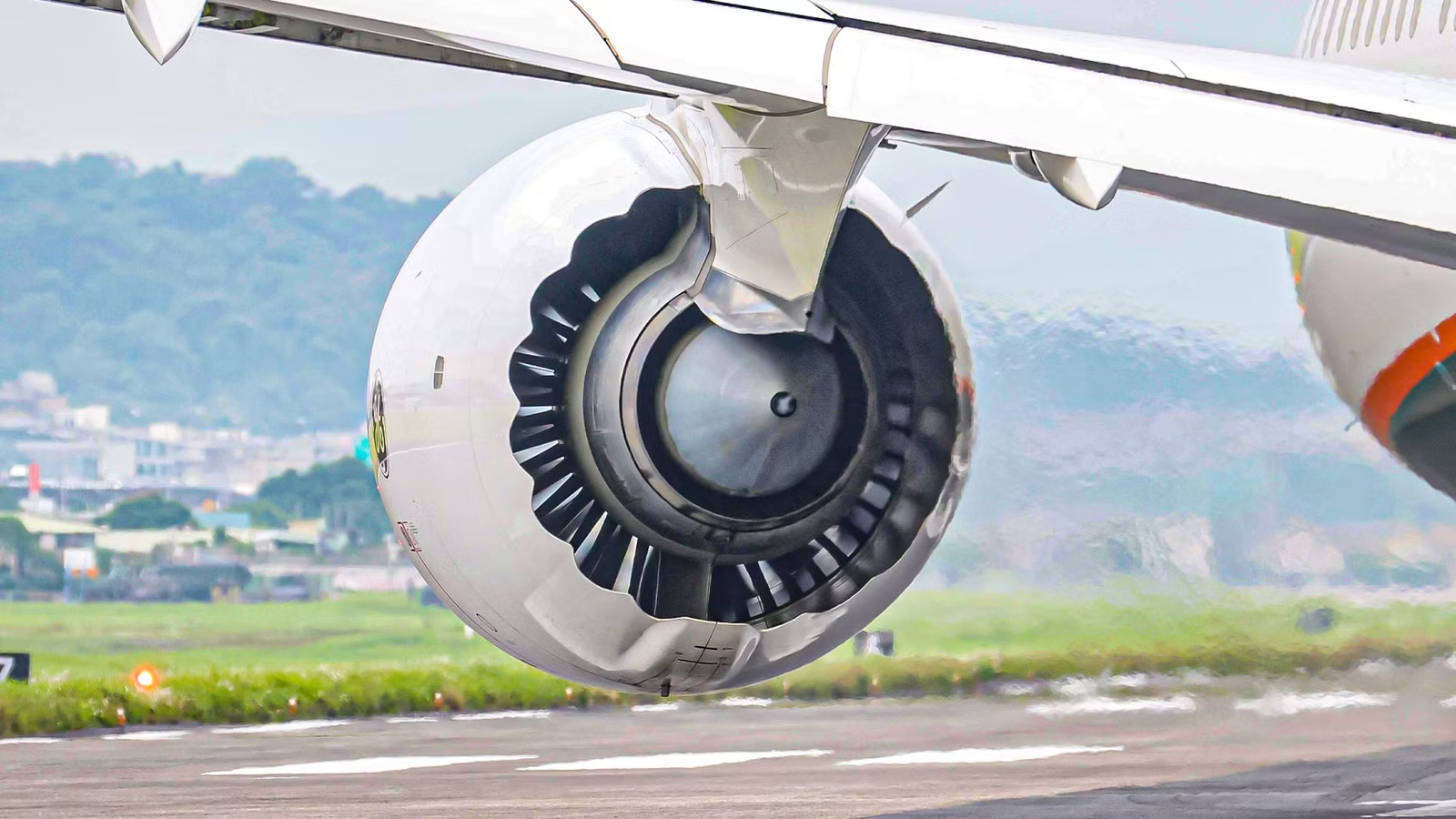
Modern commercial aircraft engines are expected to deliver far more than raw thrust. Airlines demand lower fuel consumption, airports require reduced noise, regulators continue tightening environmental standards, and passengers increasingly expect quieter cabins. Meeting every one of those requirements simultaneously has become one of the greatest engineering challenges facing aircraft manufacturers, particularly as newer engine designs grow larger and more efficient while operating under increasingly strict certification rules from the likes of the US Federal Aviation Administration (FAA).
For Boeing, these competing priorities created several unexpected complications during the development of its newest aircraft families. From pioneering the use of engine chevrons on the Boeing 787 and later the Boeing 737 MAX to ultimately abandoning the concept for the Boeing 777X, Boeing repeatedly found itself balancing noise reduction against aerodynamic performance, weight, and long-term operating efficiency. The resulting engineering decisions illustrate how even seemingly minor design features can have significant consequences across an aircraft’s entire operational life.
Developing A Quieter Engine For A New Generation

When  Boeing began developing the 787, one of its primary goals was reducing the aircraft’s environmental footprint. Fuel efficiency received most of the attention, but community noise became another major focus as airports around the world introduced increasingly restrictive limits on aircraft operating near populated areas. Boeing partnered with GE Aerospace and NASA to investigate ways of reducing engine noise without requiring entirely new engine architectures.
The solution became one of the most recognizable visual features on modern Boeing aircraft. Engineers developed sawtooth-pattern serrations along the trailing edges of the engine nozzles, known as chevrons, and rather than simply changing the appearance of the nacelle, these carefully shaped structures altered the way exhaust gases left the engine.
Normally, the hot exhaust from the engine core meets the cooler bypass airflow at high speed, producing significant turbulence that generates much of the characteristic jet noise heard during takeoff and landing. The chevrons create controlled vortices that encourage the two airflow streams to mix more gradually. By reducing the intensity of this turbulent interaction, the engines produce noticeably lower external noise levels while maintaining overall engine performance that remains suitable for airline operations.
The technology proved successful enough that Boeing incorporated chevrons across every engine option offered on the 787. Later, the feature also appeared on the Boeing 747-8 and eventually every member of the 737 MAX family, making it one of the defining characteristics of Boeing’s latest generation of commercial aircraft.
The Unexpected Performance Penalty

Shutterstock | Simple Flying
Although the chevrons successfully reduced engine noise, they introduced a complication that became impossible to ignore. The same vortices responsible for smoothing the exhaust flow also disturbed the engine’s overall aerodynamic efficiency.
Because the serrated edges protrude permanently into the exhaust stream, they increase drag and slightly reduce the amount of thrust each engine can generate. Aviation analyst Petter Hörnfeldt of Mentour Pilot has estimated that the thrust reduction is approximately 0.5%. At first glance, that figure appears almost insignificant, but commercial aviation operates on remarkably small performance margins where fractions of a percentage point translate into meaningful operational costs.
Modern airlines spend enormous sums optimizing fuel burn across thousands of flights every year, as even a minor decrease in available thrust can require slightly higher fuel consumption to achieve the same performance. For aircraft flying multiple sectors every day, particularly short-haul aircraft, those additional costs accumulate steadily throughout an airline’s fleet.
Catch what other flight trackers miss
Emergency squawks, holds, NOTAMs — live signals, no signup.
Open tracker
Catch what other flight trackers miss
Emergency squawks, holds, NOTAMs — live signals, no signup.
Open tracker
The challenge was that Boeing had successfully solved one engineering problem while creating another. The engines became quieter, satisfying airport communities and regulatory requirements, but the aircraft sacrificed a small amount of aerodynamic efficiency throughout every phase of flight. Engineers therefore faced a classic compromise in aerospace design, where improving one characteristic almost inevitably affects another. Simple Flying has reached out to Boeing for comment.
Why The Trade-Off Was Difficult To Escape

The fundamental difficulty with chevrons was not simply the slight loss of thrust but when that penalty occurred. Aircraft noise regulations primarily apply during take-off, initial climb, approach, and landing, when engines operate close to surrounding communities. Those phases represent only a relatively small portion of a typical flight.
Once an aircraft reaches cruising altitude, external engine noise becomes far less important. However, the chevrons cannot be switched off or retracted because they are fixed components of the engine nozzle. They continue protruding into the exhaust stream for the entire journey, including the many hours spent cruising where their noise reduction provides virtually no operational benefit.
As a result, the aerodynamic penalty remains present from departure to arrival. Every mile flown includes the slight reduction in efficiency created by the modified exhaust flow, and for airlines operating long-haul services, that means carrying the performance penalty across thousands of miles simply to satisfy noise requirements that matter for only a few minutes near airports.
This permanent compromise became one of the defining engineering complications associated with Boeing’s decision to adopt chevrons. While the technology achieved exactly what it had been designed to accomplish, it highlighted how solving localized operational problems can create continuous efficiency penalties elsewhere in an aircraft’s operating profile.
Why The Boeing 787 Could Still Benefit

Despite those drawbacks, the 787 represented a unique case where Boeing managed to recover some of the lost efficiency through an entirely different part of the aircraft’s design. Because the engines were significantly quieter, Boeing no longer needed as much acoustic insulation inside the fuselage to shield passengers from engine noise. Engineers were therefore able to remove as much as 600 lb, or approximately 272 kgs, of sound insulation that would otherwise have been required throughout the cabin structure.
Reducing structural weight directly improves aircraft efficiency because every pound removed lowers the amount of lift and fuel needed during flight. While the chevrons imposed their own aerodynamic penalty, the reduction in cabin insulation helped offset some of that disadvantage by making the overall aircraft lighter.
The result was a more balanced engineering solution than might initially appear, and rather than evaluating the chevrons in isolation, Boeing considered their effect across the complete aircraft. The quieter engines enabled secondary design changes that partially compensated for the performance losses generated by the nozzle itself. Although this did not eliminate the aerodynamic compromise entirely, it made the overall package attractive enough for the Boeing 787 program, particularly given the aircraft’s emphasis on efficiency and passenger comfort alongside compliance with increasingly demanding airport noise standards. The latest data from ch-aviation shows that All Nippon Airways is currently the world’s largest operator of the 787:
Ranking | Airline | Boeing 787-8 | Boeing 787-9 | Boeing 787-10 | Total |
|---|---|---|---|---|---|
1 | All Nippon Airways | 36 | 44 | 10 | 90 |
2 | United Airlines | 12 | 52 | 21 | 85 |
3 | American Airlines | 37 | 33 | – | 70 |
4 | Qatar Airways | 31 | 20 | – | 51 |
5 | Etihad Airways | – | 37 | 10 | 47 |
Airbus Chose A Different Direction

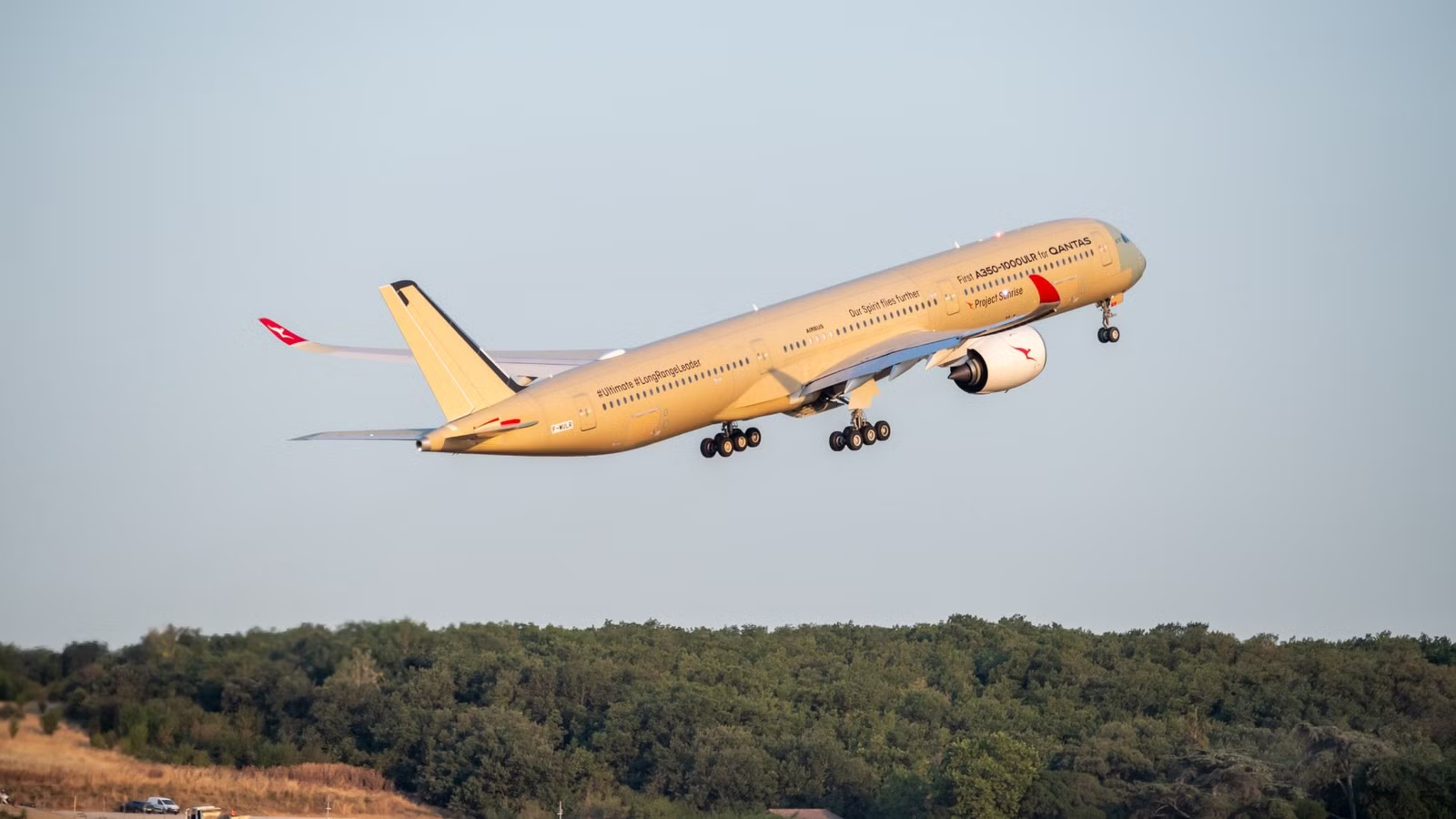
Interestingly, Boeing’s principal competitor never followed the same path, as during the years when Boeing’s chevron design remained protected by patent, Airbus could not simply adopt the technology even if it had wanted to. However, when that patent expired in 2021, Airbus still showed no interest in incorporating chevrons into its newest aircraft.
Instead, Airbus pursued alternative methods of reducing engine noise. Rather than modifying the exhaust nozzle with serrated edges, engineers concentrated on improving nacelle acoustic treatments while taking advantage of increasingly large high-bypass-ratio engines that naturally generate lower noise levels than older powerplants.
According to Airbus A350 Chief Engineer Dougie Hunter, Airbus concluded that chevrons offered no meaningful overall advantage. He explained that the manufacturer did not achieve additional noise benefits from the design while recognizing that it introduced a specific fuel consumption penalty. From Airbus’ perspective, the drawbacks outweighed the potential gains.
This contrast demonstrates that aircraft manufacturers can often reach similar certification standards through entirely different engineering philosophies. Boeing accepted a small performance penalty in exchange for improved noise reduction, whereas Airbus invested in alternative technologies intended to avoid that compromise altogether. Both approaches ultimately achieved compliance with modern environmental requirements, but through distinctly different design strategies.
The Boeing 777X Moved Beyond Chevrons

Perhaps the clearest indication of Boeing’s evolving thinking came during the development of the 777X. Rather than continuing with chevrons, Boeing and GE Aerospace designed an entirely new nozzle system for the General Electric GE9X engine that achieved comparable noise reduction without relying on serrated exhaust edges. The breakthrough came through the use of ceramic matrix composite materials capable of withstanding much higher operating temperatures than previous nozzle designs. Their exceptional heat resistance allowed engineers to develop a more compact mixed-flow exhaust system that naturally reduced friction and generated fewer vortices without requiring external chevrons.
According to Terry Beezhold, chief project engineer for the B777X, the new nozzle technology delivers equivalent cabin and community noise performance while being lighter and producing less aerodynamic drag. The redesigned nozzle is also approximately 20% lighter than earlier systems, providing another meaningful efficiency improvement alongside the elimination of the chevron-related thrust penalty.
The evolution of the Boeing 777X illustrates how aerospace engineering rarely stands still. A solution that represented a major innovation during one aircraft program may eventually be replaced by superior technology as materials science, manufacturing techniques, and engine design continue advancing. Chevrons helped Boeing meet ambitious noise targets on the 787, 747-8, and 737 MAX, but the manufacturer ultimately developed a more refined approach for its newest flagship widebody, demonstrating that the search for greater efficiency never truly ends.