dailynewsnblog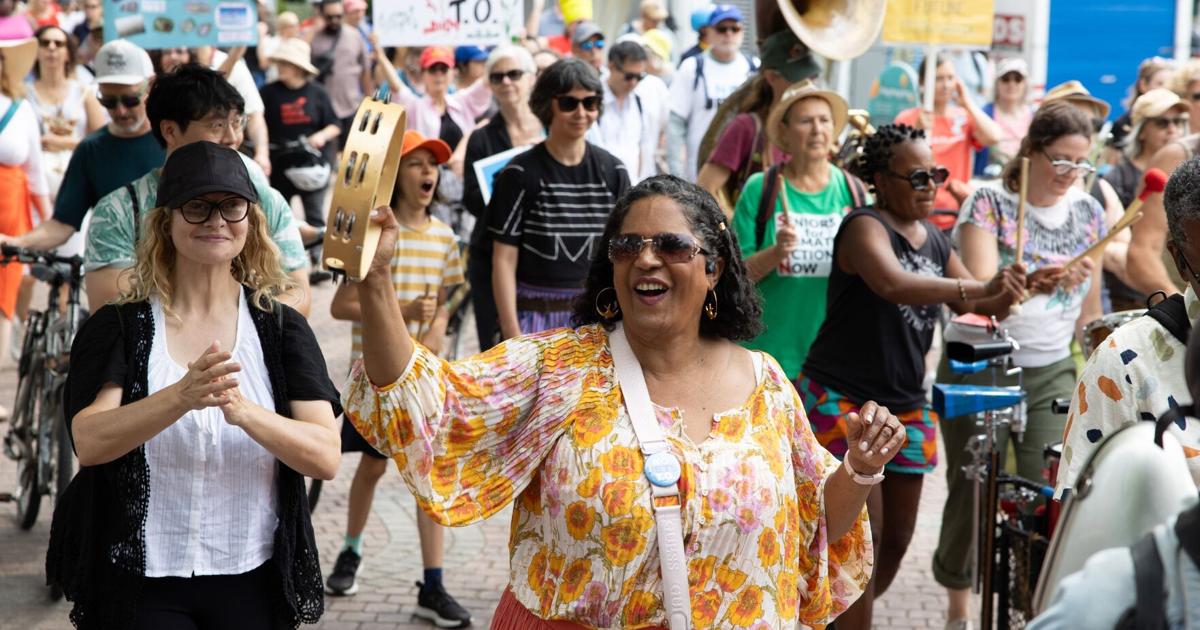
Melinda Montgomery arrived with her chocolate Labrador, Otis. Baye Hunter paddled her kayak over from her home on the Island. Sequoia Erickson, a waterfront resident who has been stilt walking for 20 years, arrived on four-foot-tall stilts.
And Norm Di Pasquale, the program manager of NoJetsTO, was all smiles Sunday, as opponents of the expansion of Billy Bishop airport marked a weekend of victory.
Four months ago, this celebration — a marching band, a flotilla in the harbour, signs emblazoned with “Birds: 1, Jets: 0” — seemed unlikely.
Premier Doug Ford had reignited a contentious Toronto debate — announcing plans to expand the runway and bring jets to Billy Bishop Airport.
“Toronto is very closed-minded. They don’t want economic growth, they don’t want more jobs, they’d rather keep everything status quo,” Ford told reporters in an aircraft hangar at Billy Bishop in March. “We want to create jobs and economic opportunities for the people of Canada, Ontario and Toronto.”
It wasn’t clear what had set Ford on a course to push for jets at Billy Bishop, but things seemed to start in his favour — from internal polling suggesting weakening opposition to, if not tepid support for, the project from residents, to a seemingly open reception from the prime minister.
After quickly passing legislation to take over the city’s place in the agreement governing the airport, the only hurdle left to clear had been federal approval.
Today, the plan is in shambles.
Late Friday, as first revealed by the Star, federal Minister of Transport Steven MacKinnon announced Ottawa would not pursue expansion “at this stage.”
And so it was that a vision for an expanded airport serving 10 million passengers a year (requiring jets landing every two and a half minutes) that had barrelled down the runway came to a screeching halt.

Boat flotilla at HTO Park on July 26.
Sophie Bouquillon/Toronto Star
Been there, done that
Toronto has been here before.
When Porter Airlines unveiled its proposal to fly larger jets out of Billy Bishop back in 2013, public opinion varied widely.
Proponents, arguing it would benefit the city’s economy, and opponents, highlighting noise and health concerns, flooded and clashed at town halls.
The proposal to extend the runway by 168 metres on each end was ultimately killed by the federal government in 2015 — a key promise Justin Trudeau’s Liberal party pledged and delivered once elected.
Advocacy group NoJetsTO formed out of that first public battle. They partnered with other civic resident associations and community groups to later form Waterfront For All.
Thirteen years later, the stakes were even clearer.
Di Pasquale said in 2013, when the debate lasted 2.5 years, “We were working with people’s imaginations. We didn’t have a revitalized waterfront.
“Now we do, and I think people have fallen in love with it.”

A decades-long restoration project opened Toronto’s largest green space in a generation last year, Biidaasige Park. Creating a massive waterfront park out of land once so polluted it drove away wildlife required a marvel of engineering: carving out a $1.4-billion river valley in the Port Lands to reconnect the Don with Lake Ontario.
Andrew Williamson/Waterfront Toronto
Those in favour, meanwhile, saw an opportunity for airline competition, job creation, making travel easier for business and tourists, and economic growth and post-pandemic economic recovery.
During the renewed debate, neither the provincial government nor the Toronto Port Authority would release a detailed business case, a comprehensive environmental assessment or a plan. Questions such as how the $5-billion project would be paid for remained unanswered. All of these things drew criticism and became points of contention.
Toronto’s federal Liberal caucus, which holds nearly all of the seats in the city, was facing persistent criticism for months for treading carefully on the controversial debate while its cabinet considered the issue.
A ‘power grab’ gets council up in arms
Ford first made public that he was setting his sights on the island airport at an unrelated February event with the Toronto Region Board of Trade.
“We have to bring jets in, smaller jets, whatever, until people can hop on there,” the premier said.
At the time, and often after, he cited internal polling that reportedly showed overwhelming support for the idea.
City council, residents and advocates — some of whom were involved in the 2013 fight against jets — immediately questioned the internal poll’s findings and slammed the Ford government on its ”land grab.”
“I’ve seen countless polls on this issue over the years. Generally, it’s split,” said Di Pasquale, who was involved in the 2013 debate.
Quickly, some of the previous opponents mobilized.
“The very day he announced it, we had our website up an hour later,” Di Pasquale said. “It was 80-hour weeks for the first month and a half for me. Relentless. Because we had our email up, we had petitions up, we had people calling, emailing, asking for signs, shirts, brochures. And I had to refresh all of our materials from 2015.”

Norm Di Pasquale, project manager of NoJetsTO addresses the crowd gathered at HTO Park for their Waterfront Celebration Rally and march on July 26.
Sophie Bouquillon/Toronto Star
The federally mandated Toronto Port Authority quickly backed Ford’s idea, and warned that the airport’s governance — which involved the port authority, the federal government and the city — needed to be streamlined, because major changes required agreement from all parties, including at city hall, where there could be opposition.
In late March, Prime Minister Mark Carney described Ford’s idea as a ”very interesting vision” with “big possibilities there,” around the same time MacKinnon highlighted the airport’s value when speaking to the Empire Club.
“That was devastating to hear,” Di Pasquale said, remembering some MPs releasing early statements that seemed to be in favour.
A subsequent poll conducted by Liaison Strategies, in collaboration with the Star, in April found Torontonians were fairly evenly split on the idea, but a strong majority thought residents should get a say — with most of the opposition coming from downtown residents.
“That is what a power grab looks like,” Chow had said. “A province that doesn’t like the answer we gave … so it changes the rules and takes what it wants.”
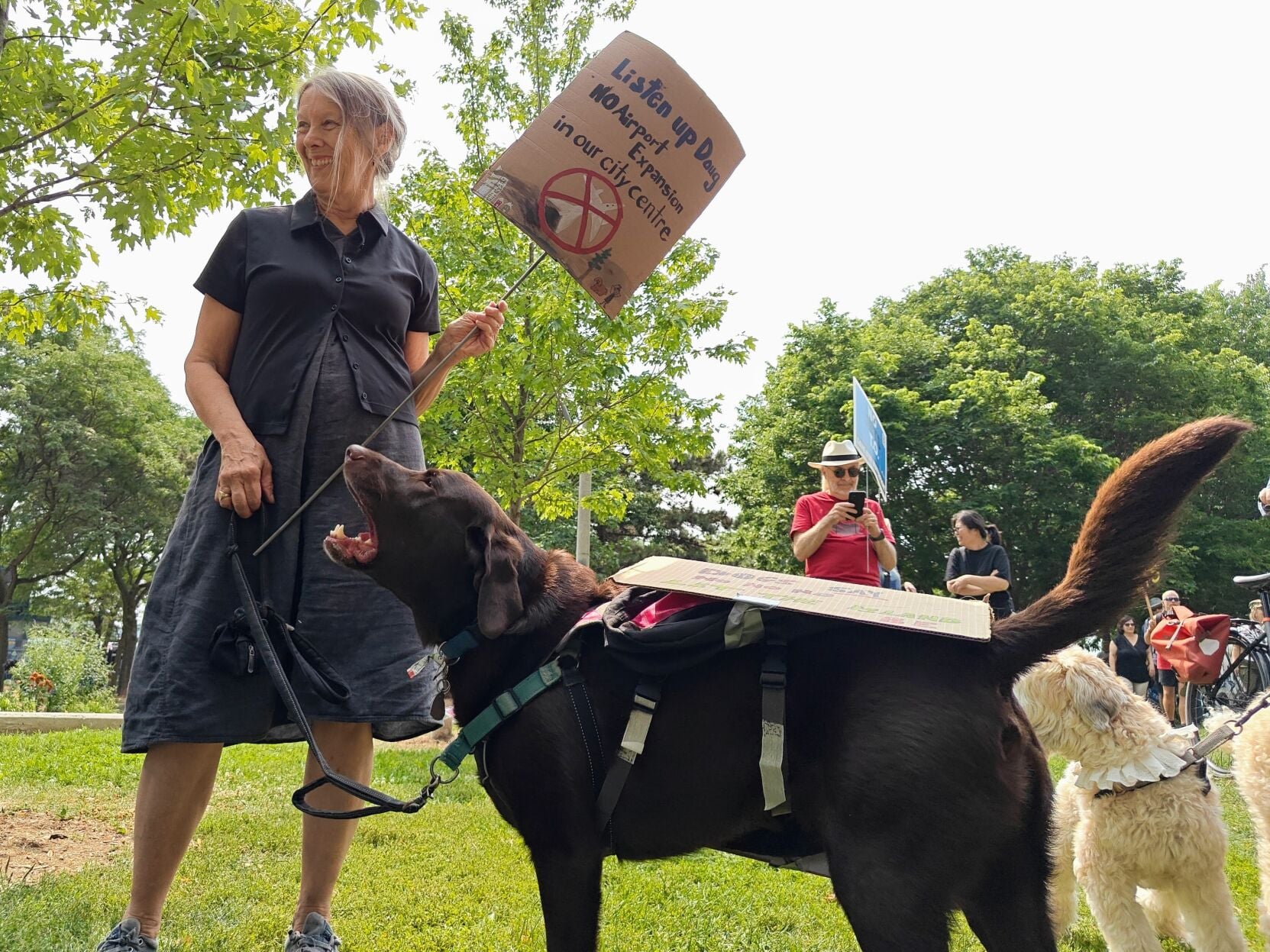
Melinda Montgomery with her chocolate Labrador, Otis, at Sunday’s rally to celebrate Toronto’s waterfront and the “win” over the Billy Bishop debate.
Mark Colley/Toronto Star
Various councillors tore into the move and players. Some even tried to get a referendum onto this October’s ballot.
Coun. Paula Fletcher was curt with MPs, telling them to: “Speak up!” Coun. Josh Matlow called Ford’s idea “bombastic and reckless.” Coun. Dianne Saxe called the jets fight “this generation’s Spadina Expressway,” referring to the acrimonious fight over a superhighway in Toronto intended to connect downtown to northern suburbs. Coun. Brad Bradford noted “backroom deals and negotiations” keep resulting in “decisions made for us but without us.”
Shortly after, the federal government opened an online survey and engagement sessions for seven weeks. It drew flak from critics as a “waste of time” without a detailed plan.
“What they underestimated was the amount of pushback, I think, from their own constituents,” Di Pasquale said. “We made it clear to people that the federal government holds all the cards here.”
Between various groups’ petitions, emails, letters, phone calls and visits to MPs’ offices, Di Pasquale estimated about 40,000 pieces of correspondence to MPs opposing the expansion.
A public debate about infrastructure
“It is a fascinating example of infrastructure discussions happening in public,” said Toby Lennox, a former executive at the Greater Toronto Airports Authority, which operates Pearson Airport, in an interview.
Lennox tipped his cap to advocacy groups Environmental Defence, NoJetsTO, Parks Not Planes and Waterfront For All “because they mobilized very quickly,” but also said the vision, scale and costs weren’t good ideas.
“And as I say that, the one thing that drove me crazy … was we never saw the plans they were talking about,” Lennox continued. “I kept scratching my head and saying, ‘Well, where are they going to put all this stuff and could you even start doing that at any cost that makes it remotely viable?’”

Boat flotilla at HTO Park for NOJetsTO Waterfront Celebration Rally and march, Sunday, July 26, 2026.
Sophie Bouquillon Toronto Star
Lennox explained that even a more modest runway expansion requires making sure the terminal building can accommodate aircraft and passengers, which means massively expanding ground access and all the utilities (storm and sanitary sewers, electrical supply, de-icing facilities) that serve it.
“You are left with a huge piece of infrastructure, and you have to feed the beast.”
A turn of the tides
Pressure was mounting, in the form of public petitions, town halls, waterfront rallies, Queen’s Park protests and spilled ink.
Citizen watchdogs filed complaints with all three levels of government accusing Nieuport Aviation, the owner of the Billy Bishop airport terminal, of breaching lobbying rules by failing to disclose its relationship with multitrillion-dollar American investment group, J.P. Morgan.
Prominent Torontonians launched an online information campaign as “ammunition” for the public to use in their responses to Ottawa’s consultation.

The city is opening more of Biidaasige Park in the Port Lands to the public on Friday, but
Meanwhile, the port authority was creating its plan, promising to release details by sometime next year.
Chow accused the port authority of “hiding” its “secret plans” after meeting with her, given its CEO had said the provincial and federal governments had already seen preliminary drafts. Key details did emerge — a more than 600-metre expansion, a price tag of up to $5 billion to quintuple passenger count to 10 million a year, and that J.P. Morgan could have a stake in it — revealed in “drips and drabs through the media,” Chow said.
On Friday, Torontonians noticed the federal government’s survey closed early. Some thought it was a technical error.
As it turned out, the federal government had already made its decision. Its public consultations showed Torontonians were solidly against the idea: roughly 87,000 people participated, with 80 per cent of responses coming from Toronto. Among those who participated, 87 per cent opposed any changes to the airport.
“You spoke. We listened,” wrote MP Julie Dzerowicz, chair of the federal Liberal Toronto caucus.
Di Pasquale was only a few minutes into watching “The Odyssey” in a theatre when his phone started buzzing. The first text was from a friend: “Wow, Norm. We won. It’s over.” For nearly three more hours, he said, his phone rang non-stop.
“It was just an incredible relief and elation,” he said.

A crowd marches along Queens Quay from Harbour Square Park to HTO Park for NoJetsTO’s waterfront celebration rally and march.
Sophie Bouquillon/Toronto Star
Sunday’s rally, planned before the news broke, turned into a party.
Hundreds of attendees marched along the Martin Goodman Trail to HTO Park, where dozens of kayaks, canoes and sailboats waited just offshore to join in the celebration.
A marching band gleefully played and sang “Down by the Riverside,” only with new lyrics: “We’re going to kick Doug Ford … out of the waterfront.”
Jennifer Materne, who wore a red “Don’t Mess With Our Waterfront” shirt and paper crown to Sunday’s waterfront rally, asked: “How could anybody even think about doing this to our public park, to our cottage in the city?”
The fight for Toronto’s waterfront may not be over
For most, the celebration came with a caveat: the fight for control over Toronto’s waterfront might not ever be over.
Ontario Transportation Minister Prabmeet Sarkaria interpreted Friday’s rejection as a delay rather than a cancellation.
John Gradek, a former Air Canada executive who teaches aviation management at McGill University, said he expects “a lot more political pressure” to be put on the federal government.
“This is the latest salvo. Never say never,” said Gradek.

A decades-long dream to restore the Don River to its original natural route through the Port
Lennox, the former Greater Toronto Airports Authority executive, said this version of the island airport expansion was always aspirational and questionable.
“Contrast that to Pearson’s expansion, where what you’re doing is you are satisfying capacity,” Lennox said. “You’re saying, ‘This is what we need, because this is what’s coming.”
“But to do it the backwards way (at Billy Bishop), you just continually have to feed the beast.”
There isn’t any data out there showing the facility needed an expansion to meet demand, Gradek said.
Lennox said, however, it’s reasonable to ask how governments should modernize and sustain the island airport.
“If jets was the wrong answer, then it leaves the question: Well, what are you going to do now?”