dailynewsnblog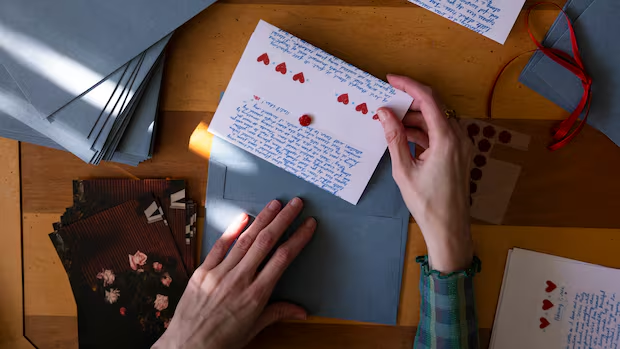
Day 66:58Snail mail subscription clubs are a growing trend as people delight in receiving physical letters
If your mail contains nothing but utility bills, takeout flyers and an endless stream of marketing material from local realtors, there’s a subscription for that.
Creative entrepreneurs are finding their way into people’s hearts — and mailboxes — by offering snail-mail subscriptions. For a modest fee, subscribers receive monthly or quarterly letters along with some combination of art, photography, stickers, pressed flowers or other mementos.
Data provided to CBC by Pinterest showed that Canadian searches for “snail mail” were up 169 per cent on July 23 compared to a year earlier. That’s in keeping with the platform’s annual trend-forecasting report, which said to “expect a letter writing renaissance in 2026, as Gen Z and Millennials turn snail mail into performance art.”
Indeed, there are hundreds of snail-mail clubs around the world with a wide variety of aesthetic styles and subject matter.
And it’s good business for some. Kiki Klassen, who runs Toronto-based Lucky Duck Mail Club, told CBC in an email her side hustle now earns more than her day job as a social media manager.
Creators, subscribers and academic experts alike say snail-mail clubs are tapping into a desire to seek healthier relationships with technology and more personal, tangible — and tactile — ways of communicating.

An offline experience
“I think the number one thing I hear about it is they like how it’s sort of an analog activity,” said Shawn Jones, who started his wildlife-themed snail mail club, Tales of Oak, in August 2025.
“People are kind of getting more and more horrified by their screen time, myself included,” said Jones, who lives in a cabin in the woods in the Outaouais region of Quebec, near Shawville.
“We’re all just trying to look for ways to do things offline, like putting the phone down to write a letter instead of an email and picking up a camera instead of a smartphone.”
Richard Lachman, a professor of digital media at Toronto Metropolitan University, says he sees a lot of desire among Gen Z for offline experiences like the kind a snail-mail subscription provides.

“They are realizing that doomscrolling for four hours in bed makes them feel badly,” said Lachman, who is also the author of Digital Wisdom: Searching for Agency in the Age of AI.
He likens it to some other movements to embrace tangible and in-person experiences, such as taking up watercolour painting or scrapbooking, or attending meetups where people knit or read quietly together.
Lachman says it’s also interesting to note how the entrepreneurs behind snail-mail clubs use Instagram and TikTok to get the word out, then move the communication off those platforms.
“It’s a little bit of a return to the old internet, in a way,” said Lachman, contrasting with the way many influencers rely on business models tied to the whims of a social platform’s algorithm.
“These mailouts are a way of reaching people through the internet, but then moving the actual business to something you have control over.”

The nostalgia element
Toronto photographer Angela Lewis says her snail-mail club, Bloom Strolling, came about after she posted on Instagram about how exchanging letters with her grandmother as a child shaped her.
“I always loved that feeling of checking the mailbox to see if she’d written me,” Lewis told Day 6. “It was like getting a gift from my best friend.”
Her Instagram post asked if other people were craving that nostalgic feeling of snail mail. She was soon overwhelmed by the affirmative response.
Though Lewis says she does get people in their 60s and 70s who are nostalgic for real mail, many of her subscribers are people in their 20s who use the materials they get from mail clubs for “junk journaling” — a more whimsical and less formal take on ’90s-era scrapbooking.

Clay Routledge, a psychologist who studies nostalgia as part of his work at the Washington, D.C.-based think-tank Archbridge Institute, says the interest in snail mail — even among people born long after it was replaced by email — fits with his research findings.
The results of a national survey the institute conducted in May 2025 indicated that historical nostalgia was widespread.
Routledge, who is also the author of Past Forward: How Nostalgia Can Help You Live a More Meaningful Life, says the vast majority of participants reported they were “nostalgic for a time before they were alive.”
Additionally, his research found that this kind of nostalgia helps people manage the stress of current challenges and anxiety about the future.

“So a young person might be like, ‘Oh cool, people used to get stuff in the mail. Handwritten cards have neat stationery.’ And they might start doing that, not because it’s in their own personal past, but they were inspired through more cultural nostalgia.”
In Edmonton, Steve Stred subscribed to Tales of Oak for his nature-loving nine-year-old son, Auryn.
“It’s neat to see him open it up and then to actually see what the art cards are,” said Stred. “It’s just that joy of the unknown.”
“He’s made a little shelf in his room where he keeps all the prints and he displays them.”
Finding connection
Beyond the nostalgia aspect, snail-mail clubs can also provide a sense of community.
For artist Michelle Clark, launching her snail-mail club Love Yours in January was a natural extension of both Love YoursCA, her Etsy shop for her art, and the blog she started years ago to share her struggles with mental illness.

Clark, who is based in Chilliwack, B.C., says her mail-club letters often address “how I used to be in such a dark place where I felt like I would be stuck there and I wouldn’t be able to do anything productive or do something that I could commit to.”
By writing about how she continued to develop her creative pursuits while dealing with her mental illness, Clark says she tries to convey to her mail-club members that they too can do positive things with their lives, even if they’re still struggling.
And sometimes, they write back.
“One of the letters I got was definitely someone opening up about their mental health struggles, and it was really nice because I don’t think she had the chance to do that prior to that.”
Jennifer Horner, another Tales of Oak subscriber, says that connection is part of the appeal for her, too.
It’s almost like it’s coming from a friend.– Jennifer Horner, snail-mail club subscriber
Horner, who is 55, often finds herself scrolling TikTok — which is where she first learned about Tales of Oak. Being part of the club “brought back that nostalgia of receiving an old-fashioned letter in the mail,” she said. “It’s almost like it’s coming from a friend.”
For Jones, who created Tales of Oak, it’s been surprising to see his subscribers connect with each other in the comments of social media posts he makes to promote the club.
He says it’s especially cool to see given the long history of snail mail as the main way people stayed in touch.
“The act of writing a letter or painting a picture, packaging in an envelope, placing a stamp on it and then putting that faith into the postal system that it will arrive, it’s something that technology cannot and has not been able to replace yet,” Jones said.
“And hopefully it doesn’t.”