dailynewsnblog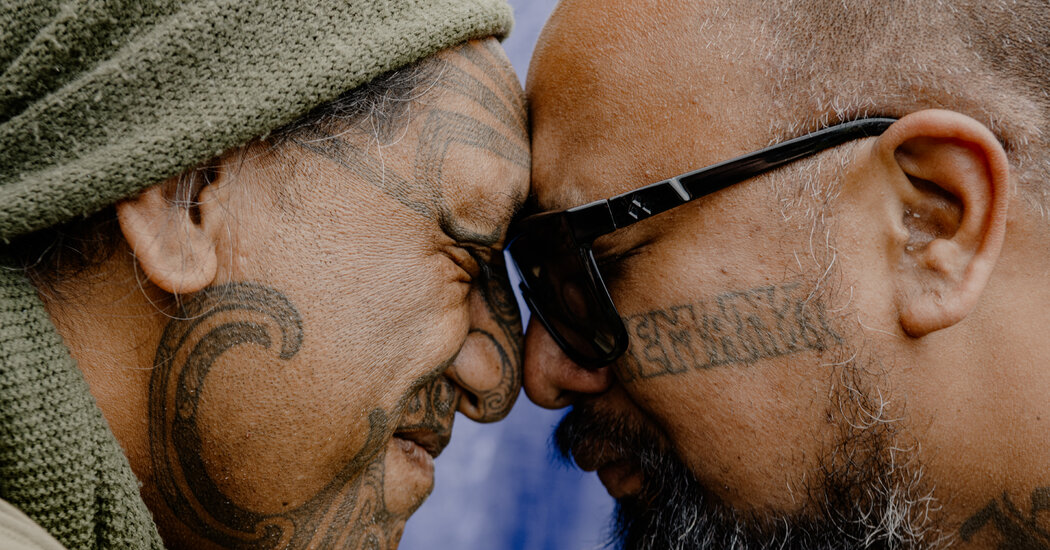
Mark Kopua pressed his face close as he drew on his nephew’s arm with a felt-tip marker. From memory, he sketched patterns and motifs that had been in their family for generations. Finally satisfied, he pulled on rubber gloves and a needle gun buzzed to life.
This was no regular tattoo. This was tā moko, the ritual body art practiced for centuries by the Māori, the Indigenous inhabitants of New Zealand. Half a dozen of Mr. Kopua’s relatives observed the ritual in February, squeezing into his small studio in Gisborne, on the east coast of New Zealand’s North Island.
Mr. Kopua, 64, and his nephew, Desmond Horomia, 56, grew up in a Māori community that had lost all its tohunga tā moko, or ritual tattoo artists. The craft had been traditionally handed down from parent to child, but in 1907, New Zealand’s British colonial rulers banned tā moko and other Indigenous art forms. Māori people began hiding their tattoos and stopped teaching younger generations.
More than a century later, the facial tattoos known as moko kanohi are being seen again, on television, on the streets and in the halls of New Zealand’s Parliament. Maori teens and young adults have taken to documenting their tā moko ceremonies on social media. Some have convinced their elders to be tattooed, helping the art form make a jubilant comeback after decades of stigma.
“I’ve been involved with this for well over 30 years now, but our culture is still relearning because they’ve been immersed and overwhelmed by Western culture,” Mr. Kopua said.
Mr. Kopua and a small group of other artisans began tattooing faces after a Māori nationalist movement gained ground in the 1970s.
“Moko was asleep at the time. We decided we want to wake this thing back up again,” he said.
A moko kanohi is the work of a lifetime. A person’s history can be gleaned from the tattoos on their face, signifying their ancestry and marking their coming of age, the birth of a child or the death of a relative.
Women are marked on their lips and chin with moko kauae. Men receive mataora, which starts on the chin and grows outward to mark personal milestones. Family trees can be traced through recurring patterns on different faces.
“It’s a thumbprint of your genealogy,” said Ruihana Smith, 32, a woodcarver who is an adviser on Māori relations to the Marlborough District Council in the South Island town of Blenheim.
He received a mataora in 2023 to honor his great-grandmother after her death. It took four and a half hours to tattoo Mr. Smith’s chin, nose and cheeks as family members watched.
In some tā moko ceremonies, relatives sing blessings and hold the person’s hands and arms as they undergo the ritual. While today’s tā moko artists use modern tattoo machines, traditionally the tohunga would use blades carved from shark teeth or the wing bones of an albatross, Mr. Kopua said.
Without forebears to teach them, Mr. Kopua — a tohunga whakairo, or a master woodcarver — learned tā moko from the patterns he used in carving and weaving. They studied moko kanohi patterns on decapitated heads that were under the care of New Zealand’s national museum.
Māori warriors believed that decapitation severed their enemies’ connection to the gods. In the 19th century, British settlers collected the heads as curiosities and trophies and offered guns and gold in exchange — prompting some Māori people to hunt down those who wore mataora and moko kauae.
“That was one thing that stopped our ancestors from wanting to get their faces tattooed,” Mr. Kopua said.
Māori who converted to Christianity at the time were also discouraged from getting tattoos. The ultimate blow, however, came with the Tohunga Suppression Act in 1907, which outlawed Māori experts, including priests, healers, teachers, woodcarvers and tattoo artists. The legislation, aimed at prohibiting practices that the authorities deemed exploitative, suffocated Māori culture for decades.
New Zealand’s Parliament repealed the law in 1962. But for years afterward, moko kanohi was seen as the sign of a criminal or a gang member, Mr. Smith said.
“None of the art forms are illegal any more, but we have to undo the damage,” he said.
Tame Iti, one of the leaders of the 1970s Māori protest movement, has moko that spiral across his face, from his forehead, past his neck and over his ears. The 74-year-old recalls growing up at a time when hotels and other public venues barred anyone with facial markings. He ran for Parliament four times, none of them successful, but became a national figure.
Mr. Iti’s last attempt to enter Parliament was in 2014. Two years later, Nanaia Mahuta became the first woman to wear moko kauae in the House of Representatives, the sole chamber of New Zealand’s Parliament. She served as foreign minister under Prime Minister Jacinda Ardern.
“Now you’ve got politicians, judges, all kinds of people with moko. It’s beautiful that it’s out there,” Mr. Iti said.
Young Māori have been quicker to embrace tā moko than their elders, said Ed Harawira, 50, a tā moko artist. A New Zealand government survey in 2018, the most recently available, found that more than a quarter of Māori people ages 25 to 44 had traditional tattoos, the most of any age group, compared with 8 percent of those 55 and older.
“Our older people were the ones who initially opposed receiving moko because they had been oppressed for so many years,” Mr. Harawira said, adding: “They were brought up thinking that Māori culture wasn’t going to get us anywhere in today’s civilization.”
After the birth of her fourth child, Huirangi Law, 34, decided to become the first person in her family in three generations to receive moko. Though she considered how the outside world might perceive her differently, “I knew wholeheartedly in my soul that this is who I was, and this is what I wanted to do,” she said. “The spaces, jobs, careers, anything like that — they would come naturally.”
Children can start receiving moko kanohi from age 13, Mr. Smith said. Younger children, like his 9-year-old daughter and 5-year-old son, wear temporary tattoos to copy their parents. Mr. Smith said he started to learn tā moko with the goal of giving his children tattoos someday.
Mr. Kopua said he has been training students to pass tā moko down to future generations.
“That’s how we maintain it,” he said. “Not just to wake the art up, but to keep it awake.”