dailynewsnblog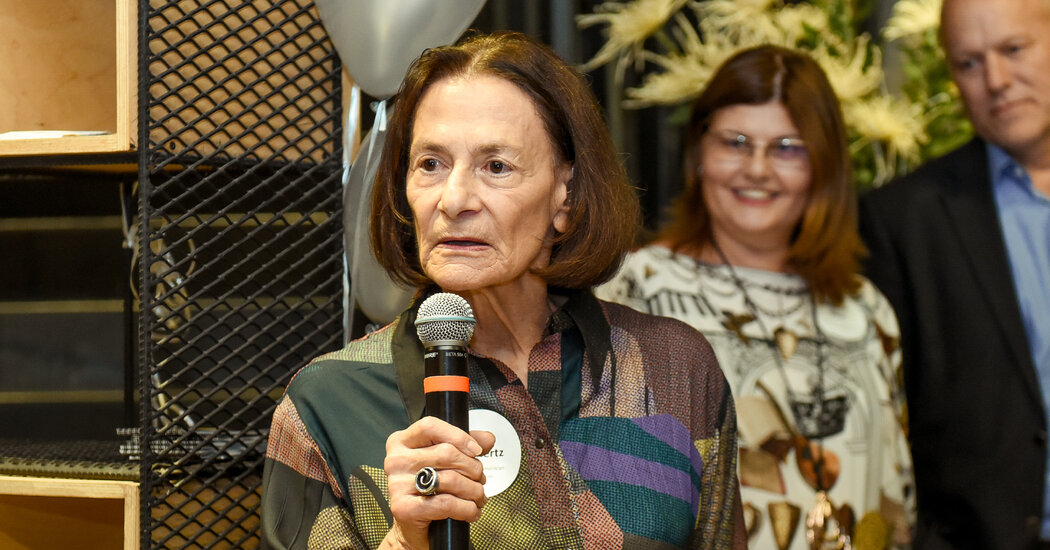
Ida Schmertz, an influential behind-the-scenes feminist and corporate executive who was a founding director of the first academic research center devoted to American women and politics, and who helped women advance in workplaces as varied as the dockyard and the C-suite, died on July 2 in Manhattan. She was 91.
Her death, at a hospital, was caused by kidney failure, her daughter, Lexy Schmertz, said.
Ms. Schmertz, who described herself as “a feminist before I knew the word,” had worked in Democratic politics and on gun control issues when she got a tip from a Rutgers University dean about the formation of a new research unit on campus: the Center for American Women and Politics at the Eagleton Institute of Politics.
Along with Ruth Mandel, an English professor at Rutgers, she became, in 1971, a founding director of the center, widely considered the premier research and educational institution in the country for the study of women in politics.
Despite a surging second wave of feminism — set off, in part, by Betty Friedan’s 1963 book “The Feminine Mystique” — Ms. Schmertz and Dr. Mandel knew of no other research organization like it. Neither they nor anyone else, they said, had any idea how many women were serving in political office beyond the dozen or so in Congress.
Donald Herzberg, then the head of the Eagleton Institute, took a risk in supporting the creation of the center, Ms. Schmertz and Dr. Mandel said, at a time when many academics, including some at Rutgers, didn’t see the need to explore the topic.
The subject “of women and politics — it did not exist,” Ms. Schmertz said in 2014 in a video interview with Dr. Mandel about the center’s creation. “It did not exist in political science.”
In 1972, Ms. Schmertz and Dr. Mandel organized the first national conference for female state legislators.
“They really captured a moment when electoral politics and the women’s movement met,” Debbie Walsh, the center’s current director, said in an interview. “It was about, ‘How do we change the face of political power so that women are speaking in their own voices inside these male-dominated institutions?’”
Ms. Schmertz commissioned a book-length study of the conference, written by the political scientist Jeane Kirkpatrick, who later became the U.S. ambassador to the United Nations. The volume, “Political Woman” (1974), “established the subject as a legitimate one for political science inquiry,” Ms. Schmertz said.
After leaving the center in 1975, she became an adviser on women’s issues to Gov. Hugh L. Carey of New York. In that role, she later said, she was involved in successful efforts to hire the first female dockworkers in New York in 1979.
Also in 1979, she was hired by American Express, as the corporate community sought to work with local and state governments to revitalize New York City in an era of financial crisis and urban decay. Five years later, she became the head of corporate affairs at the company, making her one of its first female senior vice presidents, a role she remained in for nearly a decade.
“Ida was the mentor and sponsor for the first generation of women leaders in business and politics in New York and beyond,” Kathryn Wylde, the recently retired chief executive of the nonprofit Partnership for New York City, said after her death. “She was among the most senior women in corporate America in the 1980s, consciously smoothing the way for the women seeking to move up the corporate ladder.”
Ida Frederika (or Frederieke) Schaap was born on Feb. 24, 1935, to upper-middle-class Jewish parents in Amsterdam. The family fled Europe at the beginning of World War II, moving to the Dutch East Indies (now Indonesia) in 1939, and then to the United States.
They settled near Philadelphia, where her father, Adolf Schaap, was an executive at the cigar company he had been working for since they lived in the Netherlands, and her mother, Ella (Sanders) Schaap, an expert on Dutch floral tiles, became a curator at the Philadelphia Museum of Art.
Ida (pronounced EE-da) graduated from Wellesley College in 1956 with a bachelor’s degree in political science and a minor in Russian and French. Her early attempts to find an overseas position with the U.S. government were thwarted because she was a woman, she later said.
The men who interviewed her, she recalled, said she would be a wasted hire because she would likely marry and get pregnant — and even if she didn’t, it would be unseemly for her to travel to places like Africa with male colleagues.
Instead, she worked on Adlai Stevenson’s unsuccessful 1956 presidential campaign; was employed briefly with the C.I.A.; and, in 1960, earned a master’s degree in international relations and Russian studies from Columbia, as one of three women studying at what was known as the school’s Russia Institute.
A year earlier, she had served as one of 70 Russian-speaking guides at the American National Exhibition in Moscow. It was a first-of-its kind exposition in the Soviet Union, best remembered for the so-called kitchen debate that took place there — an impromptu argument between Vice President Richard M. Nixon and the Soviet premier, Nikita S. Khrushchev, on the merits of capitalism versus communism.
Her interest in Russia centered on its literature, as well as her hope that relations might improve between the two countries. But she was also concerned about the Cold War and the nuclear uncertainty that came with it, the writer Madeleine G. Kalb, a Russian studies classmate from Columbia, said in an interview.
“It was the most important issue facing the United States,” Ms. Kalb said, because both countries “could blow up the world.”
In the years after the collapse of the Soviet Union in 1991, Ms. Schmertz returned to Russia, this time to a town outside St. Petersburg with a female mayor. Ms. Schmertz was working as an investment consultant, and her team assisted women in starting businesses by providing micro-leases for items like refrigerators and small trucks.
In 1994, President Bill Clinton appointed her as the founding chairwoman of the Romanian-American Enterprise Fund — later spun off into Romania’s largest nonprofit foundation — to assist the former Communist nation in adopting a market economy. She helped oversee the foundation until 2018, when she retired.
Ms. Schmertz was diagnosed with chronic lymphocytic leukemia in the mid-1990s, complicated by two autoimmune diseases. Later, she would testify and write in support of legislation in New York State that would allow terminally ill patients to end their lives with a lethal prescription.
“Should a ZIP code really matter when someone is dying of a terminal illness and suffering at the end of their life?” she wrote in a 2019 guest essay for The Times Union of Albany.
New York’s governor, Kathy Hochul, signed the Medical Aid in Dying Act into law in February; it goes into effect on Aug. 5.
Ms. Schmertz’s marriage to Herbert Schmertz, a public relations executive, ended in divorce in 1976. In addition to their daughter, she is survived by their son, Anthony; four grandsons; and two sisters, Martina Yamin and Aletta Schaap.
“I was in perpetual admiration at all she was accomplishing in this quiet, behind-the-scenes way,” Ms. Kalb said. “She did not throw her weight around. She did not need to. People simply responded to her energy and her marvelous sense of organization.”