dailynewsnblog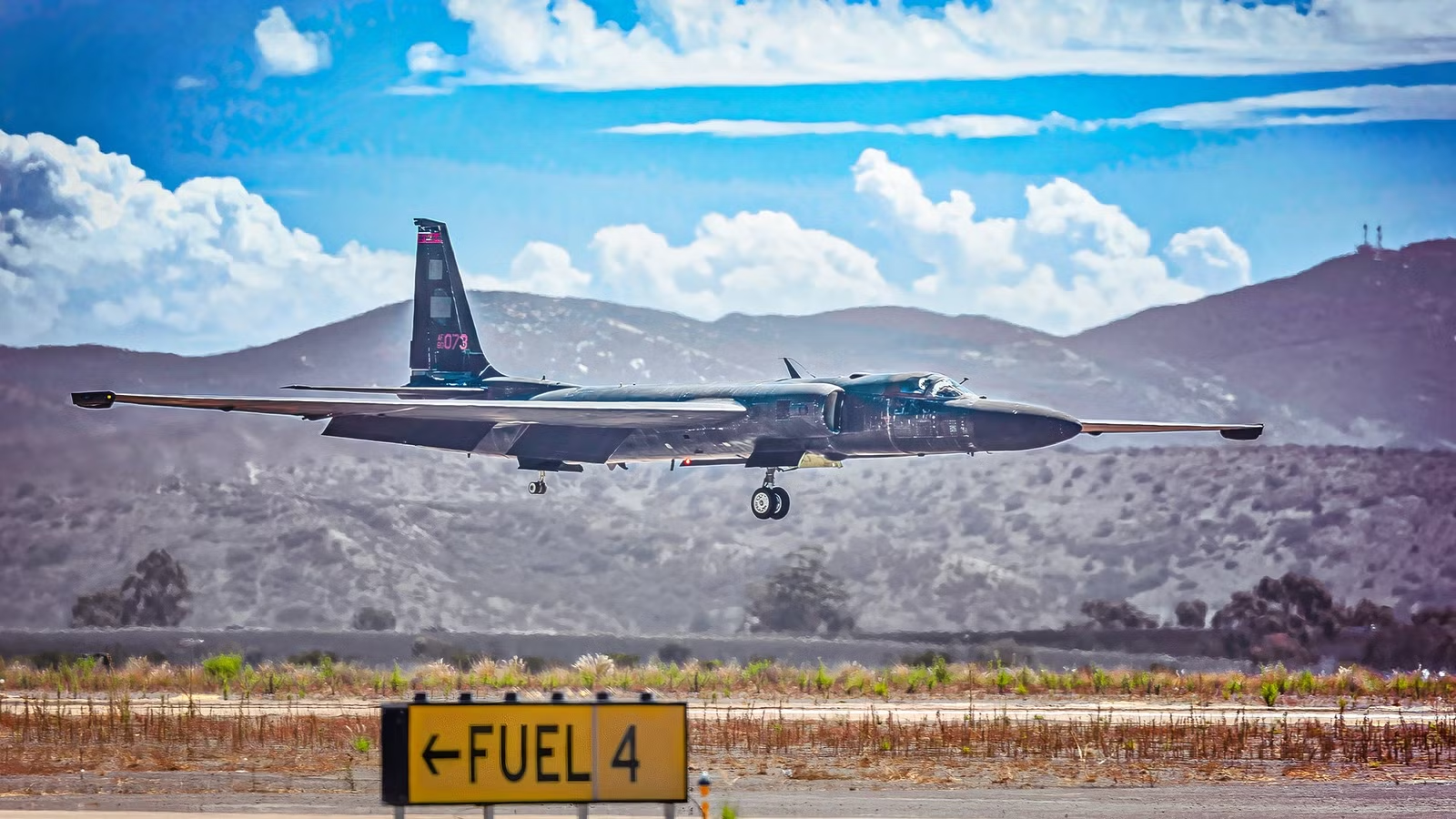
While the Lockheed Martin U-2 spy plane, also affectionately known as the “Dragon Lady,” is set to begin retiring shortly, its replacement, the Northrop Grumman RQ-4 Global Hawk, has been in operational service for more than two decades. Although both have provided exceptional intelligence, surveillance, and reconnaissance (ISR) capabilities to the United States (US) Militaryand its allies, the RQ-4 has, contrary to what one might expect, proven more expensive over its life cycle than its predecessor.
This has proven to be the case for several reasons. While the Global Hawk is unmanned, it still requires a human in the loop, with pilots operating the aircraft from the Mission Control Element during each mission. Additional factors that contribute to the overall cost include the drone’s persistent operational tempo, the duration of its missions, and its comparatively high attrition rate. Even so, the US Air Force (USAF) continues to view the Global Hawk as an indispensable ISR platform and is expected to operate the aircraft well into the future.
What Makes The RQ-4 Global Hawk So Effective?

The Global Hawk has been manufactured in Block 10, 20, 30, and 40 variants, with the latter now the only operational long-range, high-endurance unmanned ISR aircraft in service with the USAF. The aircraft has a range of approximately 10,000 nautical miles (18,520 km), an operational service ceiling of 65,000 feet (19,812 meters), and an endurance in excess of 30 hours. Block 40 entered Early Operational Capability in September 2013, and 11 aircraft are currently fielded to support combatant commanders.
The RQ-4 is equipped with the Multi-Platform Radar Technology Insertion Program (MP-RTIP) active electronically scanned array (AESA) radar, which provides Moving Target Indicator (MTI) and Synthetic Aperture Radar (SAR) capabilities. The former detects and tracks moving vehicles and other ground targets, whereas the latter produces detailed, photo-like radar images regardless of weather or lighting conditions. Together, these systems provide commanders with persistent, near-real-time ISR capabilities over large geographic areas, enabling them to track enemy movements, identify key targets, and make faster, better-informed operational decisions.
According to Northrop Grumman, the Global Hawk has amassed more than 320,000 flight hours in support of US military operations in Iraq, Afghanistan, North Africa, and the greater Asia-Pacific region. As revealed during a 2013 congressional hearing, the Global Hawk requires $640,000 per 20-hour single-intelligence mission. While costly to operate, the platform’s ability to remain airborne for more than 30 hours enables commanders to maintain persistent surveillance over vast areas without the need for frequent aircraft rotations. How does the RQ-4 compare to the U2, in terms of cost and capabilities?
The Displaced High-Flying Spy

The Dragon Lady officially entered service in 1956, and with 104 aircraft built over the years, it has been one of the most successful ISR aircraft ever to fly for the USAF. To carry out its essential missions, the air service states that the Dragon Lady is equipped with an “…electro-optical infrared camera, optical bar camera, advanced synthetic aperture radar, signals intelligence, and network-centric communication.”
Presently, the 31 remaining U-2s are home-based at Beale Air Force Base, California, where the 9th Reconnaissance Wing operates and maintains the fleet. From there, the aircraft routinely deploy to forward operating locations worldwide in support of US and allied ISR missions. Although the U-2s remain immensely capable assets, the Air Force will begin divesting the remaining U-2s on October 1 of this year. While this retirement program will be underway this fall, Congress has proposed slowing the divestment process with recent legislative language limiting how many of the spy planes can be retired through FY2027 until the USAF can demonstrate that full replacement capabilities are in place.
Although the U-2 is set to retire, a typical 20-hour Global Hawk mission costs approximately $640,000—twice the cost of the 10-hour U-2 mission cited by the Air Force. However, according to the 2013 congressional testimony referenced above, both aircraft had an estimated operating cost of approximately $32,000 per flight hour. This demonstrated that the Global Hawk’s higher mission cost was primarily a function of its significantly longer endurance rather than a higher hourly operating expense.
The Hidden Costs Of Operating The Global Hawk

Although drones are often assumed to be significantly less expensive to operate than crewed aircraft, the life cycle, operational, and sustainment costs are more complex in the case of the RQ-4 Global Hawk. According to a 2021 report by the Congressional Budget Office (CBO), the RQ-4’s recurring operating cost averaged approximately $18,700 per flight hour between 2014 and 2018. However, when acquisition costs, expected service life, and fleet attrition are incorporated, the Global Hawk’s life-cycle cost rises to around $35,200 per flight hour.
The CBO found that the Global Hawk’s sophisticated mission systems and operational profile offset many of the anticipated savings associated with removing the pilot from the cockpit. Unlike smaller unmanned aircraft, the Global Hawk is equipped with an advanced suite of ISR sensors, relies on satellite communications and ground control stations (and teams), and routinely conducts missions with durations exceeding 30 hours. While these capabilities allow a single RQ-4 to provide persistent surveillance over vast geographic expanses, they also contribute to higher operating and sustainment costs than would otherwise be expected.
Another factor affecting the Global Hawk’s overall cost is the longevity of the fleet. The CBO assumed a 20-year service life for the RQ-4, compared with 50 years for the crewed P-8 Poseidon used in its comparison. In addition, the RQ-4 fleet has experienced a higher rate of attrition, averaging 23 RQ-4s destroyed per 1 million flight hours between 1994 and 2019. These factors mean acquisition costs must be spread over fewer flying hours, thus reducing the cost advantage typically associated with drones.
As the CBO has concluded, although the Global Hawk remains less expensive to operate than some comparable crewed ISR platforms, its overall life-cycle savings are considerably smaller than was previously anticipated. Despite the costs, the Global Hawk is continuing to serve and has just been permanently deployed to Japan.
Japan Recently Welcomed The RQ-4 Due To Increased Regional Tensions

With tensions rising across several Indo-Pacific flashpoints, the USAF, as announced on June 15, has permanently deployed three Block 40 Global Hawks from Andersen Air Force Base, Guam, to Yokota Air Base near Tokyo. To facilitate operations, 150 personnel from the 4th Reconnaissance Squadron have also been deployed to the base.
This move is intended to strengthen ISR operations across the region following a 40-day training exercise conducted by China’s Liaoning Carrier Strike Group in the South China Sea and the Philippine Sea earlier in May. The exercise featured day and night flight operations from Liaoning, amphibious assault exercises, and the deployment of a frigate in the waters between Miyako Island and Okinawa on May 22.
In addition to constant military activity around Taiwan, on June 6, a Chinese ballistic missile submarine conducted a rare missile test using a dummy warhead. The long-range ballistic missile traveled approximately 4,536 miles (7,300 km) before landing in international waters in the South Pacific. The test was conducted on relatively short notice and heightened concerns across the region regarding Beijing’s intentions.
This activity, along with other actions by China, has increased the need for dedicated ISR assets capable of monitoring the Chinese military and its regional activities. The basing arrangement is of particular interest, as Yokota is much closer to several of the Indo-Pacific’s most closely observed flashpoints, including the East China Sea, the Sea of Japan, Taiwan’s air and maritime approaches, and portions of the First Island Chain. Operating over these contested areas, the Global Hawk can devote more of its endurance to collecting a continuous stream of valuable intelligence, improving situational awareness and coordination between Japanese and US military planners.
More Than An Expensive Drone

While the cost per flight hour between the U-2 and the Global Hawk is the same, the latter has proven to be more expensive to operate over its life cycle, owing to its mission profile and life-cycle costs. Although this is undeniably true, military planners and policymakers view this highly capable ISR platform as worth the price. It also has significantly greater endurance than the U-2. The latter can remain on station for approximately 10 to 12 hours, while the Global Hawk can remain airborne for more than a day, providing a continuous picture rather than snapshots of activity within a region or battlespace. This capability has made the aircraft an invaluable asset for US and allied military commanders who depend on its intelligence.
The decision to permanently deploy the Global Hawk to Japan represents not only the need to maintain a watchful eye on the daily activities of the Chinese military, but also demonstrates the confidence placed in the drone itself. Given the strategic importance of the region and the need to support US allies and partners, the deployment of the RQ-4 reflects the USAF’s confidence in the platform’s ability to provide persistent, high-quality intelligence. Alongside satellite capabilities, the Global Hawk will remain a primary source of timely ISR, providing information upon which military commanders and policymakers can base critical decisions.
The Global Hawk demonstrates that the value of a strategic ISR platform cannot be measured solely in dollars per flight hour. Its ability to provide persistent, high-altitude intelligence over vast regions has made it one of the US Air Force’s most important reconnaissance assets, ensuring commanders and policymakers receive the continuous situational awareness needed to make informed decisions in an increasingly contested world.

![Breeze Airways Launches 17 New Destinations In Massive Expansion [Full List]](https://dailynewsnblog.com/wp-content/uploads/2026/07/099-breeze-airways-embraer-e190-semrah-odobasic-_-shutterstock.jpg)