dailynewsnblog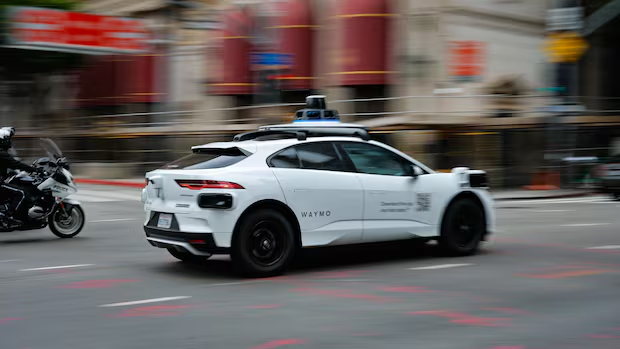

Listen to this article
Estimated 5 minutes
The audio version of this article is generated by AI-based technology. Mispronunciations can occur. We are working with our partners to continually review and improve the results.
Waymo driverless cars were involved in 68 per cent fewer crashes than human drivers over a three-year period across four U.S. cities, according to new data from the U.S. Insurance Institute for Highway Safety.
There were 89 police-reportable Waymo-involved crashes in San Francisco, Phoenix, Los Angeles and Austin between 2021 and 2024, the study released Thursday says.
There were 901,525 police-reported human-caused and involved crashes in that same period, in the same places, excluding on interstates and highways.
“It’s sort of the dream we’ve had as researchers for the last 10 to 20 years to see this technology actually be practised in the real world in a way that’s significant,” said Steven Waslander, director of the University of Toronto Robotics Institute, who was not involved in the study.
Of the 89 Waymo-involved crashes, 72 per cent took place while the involved Waymo was completely driverless. About half had passenger occupants at the time.
The numbers translate to about 80 million kilometres of driverless Waymo operation, compared with 355 billion kilometres by human drivers in the same places over that three-year period, the study said.

Google’s Waymo robotaxis now cause far fewer, and less serious, accidents than human drivers in four major U.S. cities, according to a new report that also calls for better monitoring of self-driving vehicle fleets.
The research was ultimately quantified in terms of crashes per million vehicle miles travelled. In total, human drivers had a crash rate of 4.06 crashes per million vehicle miles travelled, and Waymo vehicles sat at 1.28 crashes per million vehicle miles travelled, leaving Waymo 68 per cent lower in its rate.
The independent study of Alphabet’s driverless vehicles used data collected from police and Waymo, as well as from federal databases.
According to the U.S. Department of Transportation, crashes involving autonomous vehicles must be reported if automated driving systems were used “within 30 seconds of the crash and the crash resulted in certain property damage or injury.”
Waymo is operational in 11 U.S. states and has plans to expand to the United Kingdom and Japan. It has also been lobbying to get programs up and running in Canada.

‘Promising’ for the driverless industry
The types of crashes are important to consider when looking at the data, Eric Teoh, director of statistical services at the Insurance Institute for Highway Safety, told CBC News in an interview.
Teoh sees the study results offering a positive outlook on the future of driverless vehicles, particularly with Waymo’s vehicles being involved less often than human-driven vehicles in crashes causing injuries or fatalities.
“In addition to being less frequent, they are also the less egregious types of crash. They’re not rear-ending people. They’re not getting into head-on crashes as much,” he said.
“These results are promising for Waymo, for the driverless industry in general.”
Be that as it may, Waymo only reports its data voluntarily, and Teoh said governments in the U.S. should make datasets more readily available and easier to understand.
For Canadians, however, they may not be riding without a driver any time soon. Waymo has had little success breaking into Canadian markets with its lobbying, although it has registered for the Automated Vehicle Pilot Program in Ontario.
In an email, Braman Thillainathan, a spokesperson for Toronto Mayor Olivia Chow, said “the mayor’s priority is protecting jobs in Toronto,” and added that Waymo must demonstrate that its vehicles will “not put people out of work or undermine workers’ livelihoods.”
B.C. laws prohibit the class of autonomous vehicles that Waymo falls under
Experts point out climate is another hurdle when thinking about expansion into Canada.

‘We have our winters’
“We have a fairly significantly different climate [in Canada] from what’s happening down in the U.S., where they started originally,” Waslander said. “We have our winters, we have difficult driving in those scenes.”
Although the driverless collision rates may seem low in comparison to those of human drivers, instances of technical difficulties have gone viral on social media.
Moments like a Waymo driving into a flooded roadway or stopping in the path of a tram end up in compilations with millions of views, drawing skepticism about data suggesting they’re on the cutting edge.
“Waymo’s produced evidence in this regard before … there’s always been a certain amount of healthy skepticism of whether this could be trusted, whether they had their thumb on the scale in some way,” Andrew Miller, author of The End of Driving, a textbook about the future of automated driving in cities, said in an interview.
The vehicles are still learning, too, Miller said.
“For instance, they would know what a stop sign looks like, but they’re confused when it’s a stop sign that is being held by construction worker.”
Miller said these vehicles won’t be taking over just yet.
“By 2030, it could be that most people in the downtown core have got an app on their phone they can use to summon a driverless ride-hail vehicle. I don’t think it’ll be bigger than that.”





![15-Hour Flights: Singapore Airlines’ 9 New Longest Nonstop Airbus A380 Routes [Map]](https://dailynewsnblog.com/wp-content/uploads/2026/07/shutterstock_2764064389_cropped.jpg)