dailynewsnblog
Prime Minister Mark Carney has directed his government to serve oil barons rather than confront the inevitable climate crisis his policies will impose on future generations. Alberta Premier Danielle Smith made that choice long ago.
Now British Columbia Premier David Eby has joined them. He sold his political soul to the fossil-fuel industry, trading climate responsibility and Indigenous rights for federal money and short-term economic advantage.
Carney and Smith are working to unleash a massive expansion of bitumen production, regardless of the climate damage, wildfire smoke, health consequences, and enormous costs imposed on the public. Eby has agreed to help clear the way for expanded diluted-bitumen pipeline capacity.
The arrangement is crude in every sense: it expands the production and transport of dirty crude oil while revealing a crude disregard for human health, Indigenous rights, climate stability, and future generations.
Governments protect fossil-fuel interests, taxpayers absorb the costs, and ordinary Canadians are left to breathe the smoke, endure the heat, and pay for the destruction. Our American neighbours will share the enormous environmental and health costs.
Indigenous peoples of Alberta face the heaviest and most immediate burdens. Their lands, waters, communities, health, and treaty rights are once again being treated as expendable in the pursuit of corporate profit.
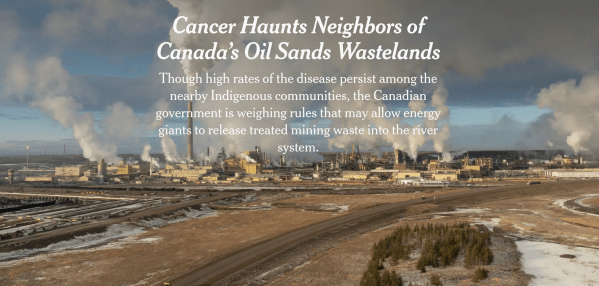
In March, Emily Baumgaertner Nunn reported from Alberta for The New York Times. Her account tells a sad and deeply familiar story—another example of the mistreatment Indigenous peoples have endured since European settlers began imposing themselves on western Canada more than two centuries ago.
The political actors and corporate interests may change, but the pattern remains: Indigenous communities are expected to surrender their land, accept the risks, and live with the consequences so that others can profit.
Emily Baumgaertner Nunn paints a grim picture. She describes Indigenous elders working with university scientists to examine foods their communities have relied upon for generations. Some are no longer safe to eat. The investigators believe contaminants from one of the largest industrial operations on Earth are responsible. Energy companies mining bitumen are…
using water from the Athabasca River to extract [bitumen] from deposits that stretch out beneath some 140,000 square kilometers of boreal forest. Massive pools of toxic waste with known carcinogens — their collective volumes estimated at more than half a million Olympic-size swimming pools — sit near the river, and an analysis suggests they are leaking around 11 million liters per day into the groundwater. As oil-company operations have increased, so have bouts of unexplained illness among residents of Fort Chipewyan.
Governments now intend to allow oil companies to release wastewater directly into regional waterways, although experts say there are no safe levels of exposure to some of the contaminants involved.
The NYT described the scale of the oil sands developments:
- In 1975, their footprint in the Fort McMurray region was smaller than one square mile.
- By 2000, the tailings grew more than 30 times larger.
- They now cover an area greater than 115 square miles, more than twice the size of Vancouver.
As vast tailings ponds leak toxic waste into surrounding waterways, downstream Indigenous communities face mounting health risks. Air pollution from bitumen extraction and processing spreads the damage much farther, compromising human health and disrupting traditional hunting, fishing, gathering, and cultural practices across large areas of northern Alberta.
The industry collects the profits. Indigenous communities inherit the contamination, illness, and destruction of ways of life sustained for countless generations.