dailynewsnblog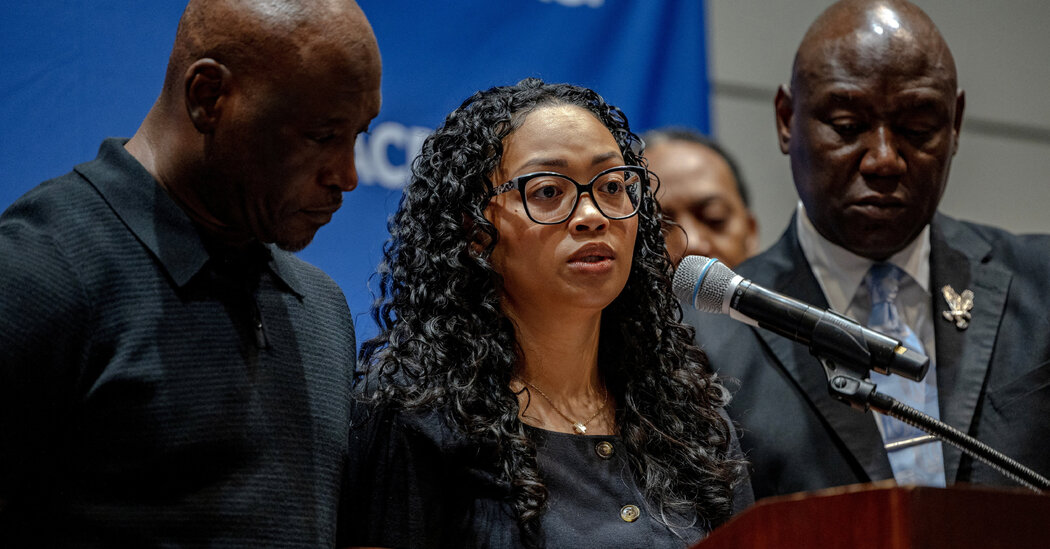
LaTonya Davis has been following the death of Nolan Wells “constantly on TikTok,” she said, and has been thinking of her 21-year-old nephew, Jayden Holmes, whom she has called her “neph-son” since she took legal guardianship of him when he was 11, after his parents’ deaths.
The death of Mr. Wells, a Black 18-year-old community college athlete from Ocean Springs, Miss., who took a boat to a Mississippi barrier island with white friends on July 4 and did not return, has drawn huge attention on social media and beyond. It has also stoked outrage and deep anxiety among parents like Ms. Davis, who say they have long nursed fears about how their Black children are faring in predominately white environments.
“It was like I was watching one of the things that I’ve always been worried about,” said Ms. Davis, 58, who moved Mr. Holmes from Orlando, Fla., to Miami Beach to raise him.
Local authorities in Mississippi say they believe the death was an accidental drowning. The Jackson County Sheriff’s Department released a statement on July 6 — the day Mr. Wells’s body was found — stating that “no foul play was suspected.” The police have said they believe Mr. Wells at one point left his friends to join another group, and possibly boarded another boat. So far nothing concrete has emerged to contradict that.
Even so, internet sleuths and Black activists have parsed details of the investigation that they say suggest malfeasance. And many Black parents say they see a double standard in the way the case has been handled. The authorities, they say, would not have dismissed the possibility of foul play so quickly had a white youth died at a predominantly Black party.
In that case, “those young Black men” would have been “interrogated to the full extent of the law,” Benjamin L. Crump, a civil rights lawyer representing Mr. Wells’s family, asserted at a news conference this week.
Despite any official suggestion of wrongdoing, the intense scrutiny online has often cast suspicion on the group of Mr. Wells’s friends who went with him to the island. The commentary has at times veered into conspiracy theory and misinformation that has set off its own burst of outrage on behalf of Mr. Wells’s friends.
But the attention has also provided a megaphone for Black social media users to describe their own experiences and fears. They have recalled painful moments as the only Black children in predominately white prep schools, neighborhoods and social settings.
Ashley Stoney, a Black freelance journalist, wrote in New York magazine of group chats lighting up with anxiety over Mr. Wells’s death.
“We talked about how isolating it can feel to be the only Black person and how dangerous it can be if no one truly values your humanity,” she wrote. “What kinds of experiences do our kids have when we aren’t around? Who will protect us when no one is looking?”
The worry is rooted in the long, violent history of racial segregation in America and what integration and assimilation look like in modern society. Some social media users have implied that Black parents shouldn’t allow their children to be the only one in “white spaces.”
That is not always possible “for things that you want to expose them to, depending on where you are,” said Tangala Hollis-Palmer, a mother and lawyer in Grenada, Miss., who is Black.
When she learned about Mr. Wells’s death, her thoughts turned to her children, who navigate similar all-white environments in the Deep South. She doesn’t tell her son, who was the only Black child on his baseball team, to be suspicious of white people, but she does say he must “be aware” of potential mistreatment “because you’re the only one there,” she said.
The worries are not just over physical harm but also social alienation, unintentional or not. Ms. Hollis-Palmer said she paused when her daughter wanted to compete on a dance team that required her to straighten her hair, afraid that it would send the message that she wasn’t good enough. But she acquiesced.
“Your hair is just as beautiful,” she recalled telling her daughter.
The death has also provoked a conversation among Black parents about race, privilege and why they feel their children have a more difficult time receiving justice.
Mr. Wells’s family has been castigated even for questioning the initial reports of their son’s death, Nolan’s mother, Christine Wells-Wonsley, said. Some members of the public have been baffled by the Black response.
“Any parent that would be in this situation, you would do anything to find out what happened to your child.” she said.
Mississippi’s history of racial violence and denied justice is also factoring into the skepticism. Last September, a 21-year-old Black student named Demartravion “Trey” Reed was found dead, hanging from a tree on the campus of a small college in northwest Mississippi. The death was ruled a suicide, and no evidence has emerged to suggest otherwise, but Mr. Crump is representing Mr. Reed’s family and has commissioned an independent autopsy in the Reed case. The report has not yet been released.
Then there’s the case of Damien Cameron, a 29-year-old Black man whose face was bloody and swollen when his body arrived at the Mississippi State Medical Examiner’s Office in August 2021 after an altercation with sheriff’s deputies. His cause of death was ruled undetermined, but three pathologists who examined Mr. Cameron’s autopsy report at the request of The New York Times and Mississippi Today said his death should have been ruled a homicide. The same state medical examiner is also conducting Mr. Wells’s autopsy.
The circumstances of Mr. Wells’s death have resonated beyond the particulars of Mississippi and its history as Black families navigate the white worlds of a more integrated America.
Mr. Holmes, Ms. Davis’s nephew, has found himself in situations where, like Mr. Wells, he was the only Black person.
“It’s not necessarily something that I’m nervous about,” he said. “But it is something that is always top of mind. I always assume that I’m being judged.”
Ms. Davis’s worries have gone beyond judgment to fear.
“Anytime the phone rings, late at night, if he’s out with his friends, my heart just drops,” Ms. Davis said.