dailynewsnblog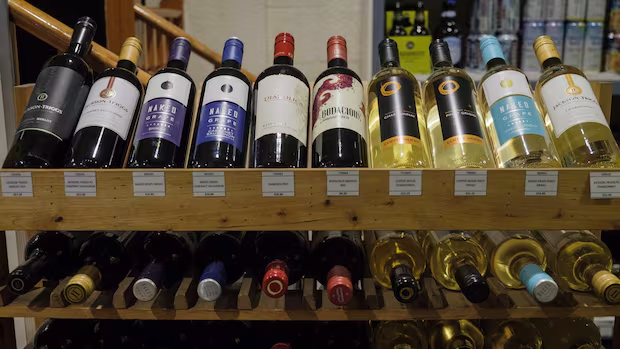
Provinces across Canada will introduce direct-to-consumer alcohol sales — a step forward in breaking down interprovincial trade barriers that prevent the free movement of alcohol across Canada.
Under a new deal, nine premiers say they are updating rules to allow more Canadian brewers, wineries and distillers to sell alcohol directly to Canadian consumers outside of their home provinces.
The push is part of a larger effort to address interprovincial trade barriers across Canada and would lift barriers that make it more difficult or costly for manufacturers to sell alcohol outside their home provinces. Multiple premiers have said such moves matter at a time when U.S. President Donald Trump has repeatedly threatened to impose hefty tariffs on Canadian exports.
On Monday, Trump announced his latest threat, which would slap 50 per cent on a wide range of Canadian goods, including alcohol.
“In the face of President Trump’s latest tariffs, it’s more important than ever that Team Canada work together to build a more united, resilient and self-reliant Canadian economy,” Ontario Premier Doug Ford said in a statement.
British Columbia, Alberta, Saskatchewan, Manitoba, Ontario, New Brunswick, Nova Scotia, Prince Edward Island and Newfoundland and Labrador signed the deal.
Quebec and Yukon have reportedly indicated their support for the agreement and intend to sign it in the future. B.C. said it would allow companies to sell directly to consumers by February 2027.
Nunavut and the Northwest Territories said they would not sign the agreement, citing the “unique realities of our territories.”

Prime Minister Mark Carney responds to whether provinces putting U.S. alcohol back on store shelves could help with contentious trade negotiations – especially as U.S. President Donald Trump is threatening new 50 per cent tariffs on a range of Canadian exports.
Meanwhile, New Brunswick Premier Susan Holt said the initiative is about “getting products to Canadian consumers, who want to buy Canadian now more than ever.”
Nova Scotia Premier Tim Houston said that by signing the agreement, “we are fighting back.”
“The Trump administration has thrown global trade into chaos, and we refuse to let Nova Scotians pay the price for Washington’s politics. That is why I have aggressively been pushing free trade, and this is a good step toward that,” he said.
Holt noted that timing varies from province to province because their laws differ.
Some jurisdictions such as New Brunswick and Manitoba have already reached deals to permit more interprovincial sales of certain types of alcohol.
Tuesday’s news follows U.S. President Donald Trump’s latest tariff threat, which would slap 50 per cent tariffs on Canadian-produced alcohol. The threat prompted local alcohol producers to yet again speak out against the interprovincial trade barriers that have long prevent the free movement of alcohol across Canada.
By opening provincial borders, they say, provinces could offset the losses that small businesses will likely incur as the U.S. market becomes increasingly unstable and unprofitable.

B.C. Premier David Eby is weighing in, after U.S. President Donald Trump announced yesterday he was moving to impose tariffs of 50 per cent on a wide range of Canadian exports.
The president says those products range from wine, to hockey sticks, to cement.
“I know for a fact that there are other local distillers in the Edmonton area who have spent a tremendous amount of time, effort and money in marketing and entering the U.S.,” Gurpreet Ranu, the owner of Anohka Distillery located west of Edmonton, told CBC’s Edmonton AM.
“They’ve actually expanded quite a lot in the U.S., and I think it’s going to be extremely challenging for them.”
Even if Trump’s latest tariff threat doesn’t materialize, the instability and uncertainty is enough to hamstring Canadian alcohol producers.
“There’s no importer in their right mind who would continue to push a Canadian product when there’s this risk of tariffs looming over the product,” said Ranu.

Prime Minister Mark Carney said U.S. President Donald Trump agreed to ‘intensify’ trade talks after ramping up his trade war against Canada. Carney’s comments come as Trump announced a 50 per cent tariff on a wide range of Canadian exports, in retaliation for what he calls ‘unequal treatment’ of U.S. dairy, alcohol and automotive exports.
That’s why Canadian distillers, winemakers and brewers are hopeful that provincial borders will open up even more.
For Dan Kelly, president of the Canadian Federation of Independent Business, Tuesday’s news is “the starting point, not the finish line.”
According to Kelly, provincial and territorial governments should include alcohol under the Canadian Mutual Recognition Agreement, which would allow alcohol products that can be legally sold in one province or territory to be sold in every other jurisdiction.
The Early Edition6:34Trump threatens new 50% tariffs on Canadian goods, including wood products
U.S. president Donald Trump is once again threatening tariffs on Canadian goods. This time, it’s a fifty percent tariff on a long list of products, including alcohol, hockey sticks, and some wood products. Stephen Quinn spoke to forestry industry expert David Elstone about the possible impact.
“That would further reduce barriers for small producers and create a truly open domestic market for Canadian alcohol,” Kelly said.
In the meantime, small business owners are watching to see how the latest tariff threat unfolds — while looking for new opportunities.
“We have to start pivoting to other places as well and start finding other countries, which eventually takes time and effort there,” Bryce Parsons, CEO of Calgary-based True Wild Distilling, told CBC News Network. “Right now, we’re kind of scrambling and assessing … what the future looks like.”