dailynewsnblog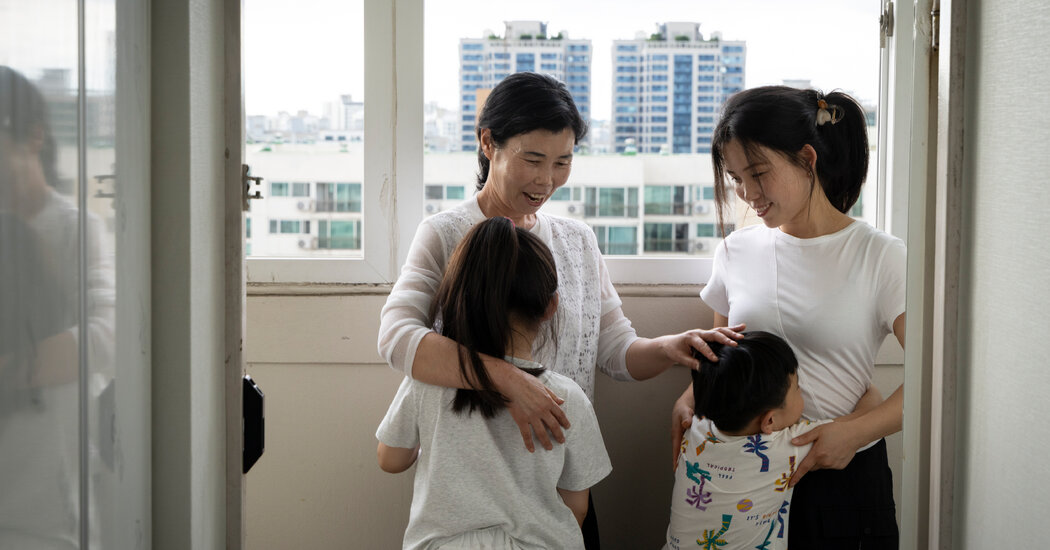
Rain lashed a flimsy wooden boat as it tossed through a churning sea, its engine straining against the swell. Under the cover of a stormy night three years ago, the vessel was fleeing North Korea.
On board were nine people, including two small children and a woman who was six months pregnant. Only a couple of the passengers had seafaring experience. They eluded a patrol ship, speeding across the world’s most heavily guarded maritime border.
Soon after their boat lurched into South Korean waters, a high-speed warship of the South’s navy bore down on it, tearing the water in aggressive circles. Snipers on the vessel trained their laser sights on the chests of the three adult men on the wooden boat.
Through a loudspeaker, a voice boomed: “Are you lost? Engine trouble?”
The North Koreans shouted: “Please help. We are defecting.”
The red dots remained stubbornly fixed on their chests. The South Koreans were taking no chances: The three men were clad in North Korean military uniforms, camouflage for a high-stakes escape. Desperate, the men shouted into the boat’s cramped hold for the other passengers to emerge in order to prove that they were civilians. From below, the two children, a 5-year-old girl and 3-year-old boy, were hauled up first, both pale and wasted from seasickness. Only then did the red dots drop off.
The North Koreans, led by Kim Il-hyeok and his younger brother, Yi-hyeok, were bound together by blood and marriage. The brothers, both in their 30s at the time, were accompanied by their mother and their families: Il-heyok’s partner, who was pregnant, and Yi-hyeok’s wife, their two children, his mother-in-law and brother-in-law.
The family, who defected in 2023, were among the few who managed to escape North Korea after its leader, Kim Jong-un, imposed a crushing lockdown during the coronavirus pandemic. They arrived in their adopted country with rare insights into a nation that had been choked off from the outside world. Some details of their escape have not been previously reported.
“That night,” said Yi-hyeok’s wife, Yu-mi, “we crossed from a sea of darkness to a sea of freedom.”
A Father’s Wish
Over several months of interviews in South Korea, Il-hyeok spoke with the same swagger that he had developed as a self-described “troublemaker” in North Korea. Yu-mi was reserved, pulling her legs tightly to her chest as she spoke. Her mother, who asked not to be named but agreed to be photographed, weighed every word, fearing how her comments might affect relatives left behind in the North. But they all spoke with conviction about why they had to leave North Korea. (The rest of the extended family declined to be interviewed.)
The brothers came from Pyoksong, a county in North Korea’s southwest.
During the famine of the late 1990s, their father, a railway security official, returned with grim accounts from the hardest-hit provinces: The emaciated bodies of children found outside train stations were frozen solid, thumping like frozen fish when they were tossed onto trucks headed to burial grounds. He was the first in the family to lose faith in a ruling class that was unable to feed its people.
One night after his sons reached adulthood, he took them to a hill and pointed toward a cluster of lights across the South Korean border.
“That’s where we should go,” he said. “To live and stand tall.”
Yu-mi lived in the nearby coastal town of Kangryong. From there, she could see planes glinting in the sun as they rose from Incheon International Airport, just across the water — a shimmering vision of possibility, yet unreachable for North Koreans barred from travel and cut off from the internet.
“Our country felt like a prison without bars,” she said.
Beginning in kindergarten, children sang the anthem “We Have Nothing to Envy,” even as they were mobilized to haul river water or scour hills for herbs and pine nuts. After long workdays, adults attended compulsory “life review sessions,” writing self-criticism and pledges of loyalty. When Kim Jong-un visited an island near Yu-mi’s town in 2013, soldiers and villagers swarmed into the sea in jubilation. She knew the scene was staged; ordinary residents, she said, had been banned from leaving home.
In the face of the propaganda, a contraband culture spread. South Korean films and dramas circulated on USB drives smuggled from China. In Kangryong, the devices also arrived inside plastic bottles released by South Korean activists across the water, along with rice and mini-Bibles. Officials warned the bottles contained poison, but South Korean entertainment was winning.
Il-hyeok idolized K-pop groups like Girls’ Generation and styled his hair in a mohawk like BigBang’s Taeyang. He was arrested for “capitalist delinquency” and released only after paying a bribe, his hair razored. He and his friends once secretly watched “Valkyrie,” the Tom Cruise film about the plot to kill Hitler. When the conspirators failed and were executed, his friends wept.
The brothers’ notion of deserting North Korea felt just as perilous. Their father forbade them from marrying, reasoning that the larger the family, the greater the risk of being caught while defecting. He then used connections to transfer Yi-hyeok, his youngest, to Kangryong, where he learned navigation, mapped guard posts, and cultivated ties with officials. Yi-hyeok became a helmet diver, who harvests seafood from the ocean floor, breathing fresh air piped through a surface hose. He eventually met Yu-mi.
Il-hyeok worked in North Korea’s shadow economy, bribing his way into opportunity and out of trouble. He butchered animals for restaurants, ran a small gold mine and bought rice stolen from state granaries, reselling it at a profit. He also grew disillusioned with the system he was gaming.
Then, in 2014, their father died unexpectedly. The South Korean dream seemed to die with him.
Where Il-hyeok, the older brother, was restless, Yi-hyeok was steady. He married Yu-mi in 2017, and the couple soon had their two children. He joined a military-run fisheries company, operating three vessels. Despite a United Nations ban, Chinese buyers worked openly in Kangryong, and on a good day Yi-hyeok could earn more than a typical worker’s annual salary.
Il-hyeok began dating a kindergarten teacher. Defection was no longer a priority.
“When I mentioned it, my brother told me to watch my mouth,” Il-hyeok recalled.
The pandemic overturned everything.
Lockdown
North Korea imposed one of the world’s harshest lockdowns. In Kangryong, access to the sea was closed off with barbed wire and armed guards. Yi-hyeok’s boats rusted and his debts mounted. Officials claimed that South Korea was dumping infected bodies and waste into border waters. Yet boats supplying seafood to the top tiers of society continued to fish.
“The elites still ate whatever they wanted,” Yu-mi said.
Il-hyeok once filmed a gaunt toothless man in rags begging for food. The man said soldiers had shot a villager who tried to gather crabs.
“They are ruthless,” he said in a tired whisper. “Even if you won’t give alms, you shouldn’t break the beggar’s bowl.”
Public executions grew more frequent, targeting those accused of committing violent crimes like murder, which surged during the lockdown, or of distributing “nonsocialist” content such as South Korean dramas. Thousands, including the brothers, were forced to watch as rifle fire cracked across the execution grounds. The crowds dispersed in silence.
“The goal was to instill fear,” Il-hyeok said. “To erase any fantasy about the outside world.”
The authorities were closing in on him, too.
He wanted to marry his girlfriend, the daughter of a farmer. In a system that claimed to be classless, marrying a woman who worked on a collective farm — even as a teacher — would mean a loss of status for Il-hyeok. Both families opposed the match. The couple moved in together anyway. Then, in 2022, Kim Jong‑un banned unmarried cohabitation. Offenders faced labor camps.
“I had to choose between her and North Korea,” Il-hyeok said. “I chose South Korea — and a true class revolution.”
The Escape
The brothers no longer argued about whether to leave — only how.
By early 2023, North Korea had begun easing its pandemic restrictions. Yi-hyeok’s boats were among the first permitted back to sea. But the window to escape was already closing. The authorities were preparing to install surveillance cameras along the coast to deter defections.
The brothers spoke in code over the phone. “Good weather” meant a storm was coming, forcing patrol boats back to port. “We’ve got a good catch — come down here” meant Il-hyeok should bring their mother and his girlfriend to Kangryong.
The weather and the catch were ideal the night of May 6, 2023.
Yu-mi’s mother, a 52-year-old widow, signed up last, just five hours before departure.
“I could die trying to escape,” she said. “But if my family reached the South and I stayed behind, I’d be as good as dead anyway — the relative of traitors.”
Yi-hyeok’s brother-in-law, his fishing partner, slipped away by boat and waited offshore. The rest of the family crossed a coastal hill strewn with land mines to reach a secluded beach. To carry Yi-hyeok’s two young children more easily, the brothers sealed them inside burlap sacks and hoisted them onto their shoulders. Before they closed the sacks, Yu-mi caught her children looking up at her.
“I thought it might be the last time I’d ever see them,” she said. “I cried, and my husband teared up, too.”
Yi-hyeok’s brother-in-law spotted the prearranged signal — a flashlight blinking three times from the beach — and steered the boat in to pick up the rest of the extended family. Around 10 p.m., the 30-foot-long vessel pulled away, its engine throttled down to little more than a brisk walking pace as it tried to slip quietly toward Yeonpyeong Island in South Korea, just nine miles away.
Below deck, Yu-mi suddenly felt the engine roar to full throttle, filling the hold with black exhaust and leaving the women and children seasick. Her youngest child’s eyes rolled back. She carried him up for fresh air — and found the men on deck in a panic.
“That’s when I saw a searchlight from a North Korean patrol boat sweeping across the waves behind us,” she said. “My heart dropped.”
The brothers had already agreed on what to do if they couldn’t outrun a security vessel: strap life jackets and flashlights onto the women and children and send them into the sea, trusting the current to carry them south. The men would steer the boat away as a decoy, making a last stand with 20-inch knives and homemade red-pepper bombs. To lighten the boat, Il-hyeok threw anything heavy overboard — axes, wrenches, fishing net, his brother’s air compressor for helmet diving.
He ran below deck, fastened a life jacket onto his partner and rushed back outside. She believed he was about to throw her into the sea to save the others. His mother thought her son had chosen to save his girlfriend before his mother.
“It gave me endless trouble with them, until I could convince them they’d misunderstood me,” he said.
Gradually, the searchlight behind them faded. The brothers later speculated that the fishing net they had thrown overboard had tangled in the pursuing boat’s propeller.
Their two-hour gamble ended shortly after midnight, after the South Korean vessel stopped them and all nine family members were brought aboard.
An officer greeted them: “Welcome to paradise.”
New Beginning
Before they disembarked, the officer raised his fist and shouted, “Fighting!” The English word — common in South Korea as encouragement — was unfamiliar to the North Koreans.
“But he was smiling and shaking our hands,” Yu-mi said, “so we assumed he wished us well.”
In the South, Yu-mi studied to gain an accounting clerk certificate and found work at a school. Her brother enrolled in college, while Yi-hyeok returned to helmet-diving for seafood.
“My brother joked the diving gear here was so advanced he could fall asleep underwater if he wanted to,” Il-hyeok recalled.
Il-hyeok’s girlfriend gave birth to their first child in the South. The couple married in 2024 and soon welcomed another daughter. Il-hyeok is finding his footing in the South’s capitalist economy, trying part-time jobs at restaurants and operating forklifts and excavators.
The plunge into the South’s noisy democracy was overwhelming. Televisions offered endless channels — so different from the North, where only government broadcasts existed. Back home, Il-hyeok’s used motorbike was a prized status symbol; now he found himself on highways crowded with modern cars. City squares rang with protests.
Yu-mi’s mother marveled at faucets that produced both hot and cold water. On her first day working at a nursing home, she faltered when colleagues asked for “napkins” — another English word she had never heard. The brothers’ mother was scandalized by a TV drama in which a wife slapped her husband. And when Il-hyeok first ventured beyond Seoul, the South’s capital, he dutifully called a police detective to ask for permission. The detective only laughed.
And then there were elections.
In the North, people lined up in formal dress to receive a ballot with only one name. They placed their vote in the “yes” box with both hands and bowed deeply to portraits of Kim Jong-un’s father and grandfather, who ruled before him. No one dared approach the “no” box. When Il-hyeok and his wife voted in June as South Korean citizens, they found voters arriving in shorts and slippers, earphones in place. The ballot was a bewildering list of names.
Yet, South Korea was no paradise.
After 19 months in the South, Yi-hyeok died in a diving accident in late 2024. The brothers’ mother and Il-hyeok’s wife were diagnosed with cancer.
Il-hyeok vented frustration at Seoul’s soaring housing prices. He is saving every penny to move his family out of their cramped, government-subsidized rental apartment. Still, he insisted the defection was “100 percent” the right choice. Before his death, Yi-hyeok appeared on television, explaining that he fled to spare his children the indoctrination of North Korean schools. His daughter is now a second grader at a South Korean school, and his son is in kindergarten. The children adapted fastest to their new lives, quickly embracing South Korean staples like fried chicken and pizza.
“My husband gave me and our children the freedom he promised before he died,” Yu-mi said.
The brothers also honored their father’s final wish: When their boat fled North Korea, they carried his ashes with them.