dailynewsnblog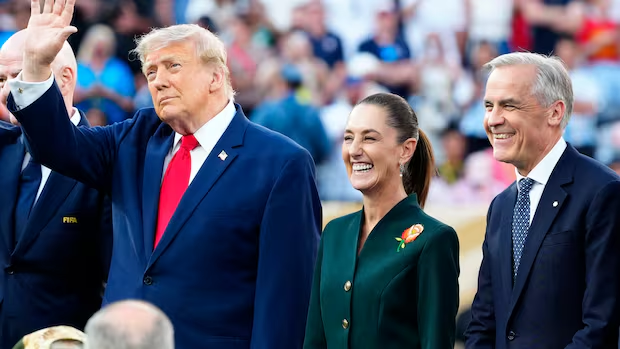
U.S. President Donald Trump personally told Prime Minister Mark Carney to stop poisoning American air and take action to put out wildfires burning across the country.
Trump said he raised the issue of wildfire management with Carney when the two leaders appeared together to watch the World Cup Final between Argentina and Spain in East Rutherford, N.J., on Sunday.
“I told him, I mean, ‘You got to stop these fires from coming in and, you know, poisoning our air. Our air has been poisoned,'” Trump said at Joint Base Andrews after the game.
The U.S. president said he has a “good relationship” with Carney before reiterating his threat to impose financial penalties on his northern neighbour for the wildfires’ impact on U.S. air quality.
“If we can help them, we’ll help them. But maybe they should pay some damages or something, or we should do some tariffs. But it was terrible,” Trump said. “I mean you had businesses closing in particular Michigan.”

Prime Minister Mark Carney says he ‘made very clear’ the scale of investments and resources Canada is putting on the front lines to fight wildfires across the country when he spoke to U.S. President Donald Trump over the weekend. On Sunday, Trump said he might ‘do some tariffs’ on Canada if wildfire smoke drifting into U.S. states didn’t abate.
Carney said Monday he had “made very clear” to Trump that Canada was doing its utmost to control the wildfires.
During recent conversations with the U.S. president, Carney told CBC News that he had conveyed the size of the problem, including “the scale of the forest that Canada is blessed with — eight times the size of Texas — [and] the fact that we have effectively drought conditions that have extended from the equivalent of Texas all the way to Minnesota, to put it in American terms.”
Carney also said he had highlighted Canada’s investments in firefighting: “$12 billion in recent years, but fundamentally more than 5,000 brave women and men — firefighters — on those front lines.”
The prime minister also said he underscored Canada’s contributions during American disasters.
Managing the situation was “a complex issue,” Carney acknowledged. “It’s one we’re managing and we’ll continue to do that.”
Last week, cities in Michigan shut down beaches, splash pads, the Red Oaks water park and even indoor pools because of the toxic smoke that blanketed Michigan and other northern U.S. states.
The Detroit Free Press reported that dozens of workers at Ford’s Michigan assembly plant were taken to hospital after inhaling wildfire smoke inside non-air-conditioned plants.
Trump’s threats over wildfires
Trump first threatened to make Canada pay for the cost of U.S. air quality in a Friday social media post when he joined some Republican House representatives’ broad criticism of Canada’s forest management practices calling them “wilful negligence.”
“We are holding Canada responsible for the fact that they are not properly maintaining their Forests, and brush therein, and the United States is being unnecessarily invaded by filthy, polluted and unhealthy air,” the president wrote in a social media post on Friday.
“This is Willful Negligence, and becoming a yearly occurrence, costing the United States Billions of Dollars, which cost of this pollution must of necessity be added to the TARIFFS Canada is currently paying.”
This morning, I met with federal workers in Ottawa who are supporting the wildfire response efforts in Northwestern Ontario and across the country. This is one of the most intense wildfire seasons in Canadian history due to extreme heat waves and record-breaking dry conditions.… pic.twitter.com/ubS7Gupgam
—MarkJCarney
Canadians “prefer to focus on helping one another,” Minister of Energy and Natural Resources Tim Hodgson said during a media conference in Prince George, B.C., on Monday, referring to past assistance Canada has provided to fighting wildfires in the United States.
“We want to focus on being good neighbours and good allies.”
The federal government is doing “what we can do” to combat wildfires, he said, outlining measures to train new firefighters, procure more water bombers, support the provinces in delivering emergency services and develop new firefighting technologies.
“Extreme weather is a global challenge and we have to recognize that we’re doing our part by trying to be a clean and conventional energy superpower,” he said. “The world will be better off if we all work together as opposed to pointing fingers at one another.”
During a wildfire briefing in Toronto on Monday, Ontario Premier Doug Ford described Trump’s comments as “disappointing to say the least.”

“With all the assets the U.S. has, he’s sitting there complaining,” Ford said. “Why don’t you send up some water bombers? Why don’t you start helping us, like we would help you in a heartbeat?
“You should support your neighbours. That’s my message to the president.”
On Friday, Ford reminded the U.S. president, and other Republican legislators, it was time to repay the efforts Canada undertook to restore electricity in the U.S. after Hurricane Helene in 2024 and the California wildfires last year.
“If there’s some politicians out there chirping away, well maybe what you should do rather than complain is send support, send help, because we have done the exact same thing for our American friends. That’s what you’re supposed to do,” Ford said.
The premier said he thinks Americans are good neighbours but need to start acting that way.
U.S. senator proposes sanctions
Last week, Ohio Republican Sen. Bernie Moreno promised to introduce new legislation to sanction Canada for what his office called the “wildfire pollution emergency.”
The text of that bill, the Canada Fire Act, posted on Moreno’s website, gives Trump the power to declare if smoke originating from Canada over the last 12 months found its way into the U.S.

U.S. President Donald Trump raised the possibility of imposing punitive tariffs over Canadian wildfire smoke crossing the border. Ontario Premier Doug Ford called Trump’s words a ‘bunch of rubbish,’ and pointed to wildfires burning in the U.S.
If so declared, the bill, which has yet to be introduced to the Senate, sets out stiff financial penalties for any Canadian official, from the prime minister to lower-level officials, involved in wildfire management.
Those penalties include halting loans to entities owned or controlled by the Canadian government, stopping any imports to the U.S. of anything produced by a Canadian government-owned entity and banning any officials from entering the U.S. if they have a hand in the wildfire response.
As an interim measure, the legislation asks U.S. Secretary of State Marco Rubio to consider kicking out Canada’s ambassador, chief of mission and more than a dozen other officials right down to the embassy spokesperson.