dailynewsnblog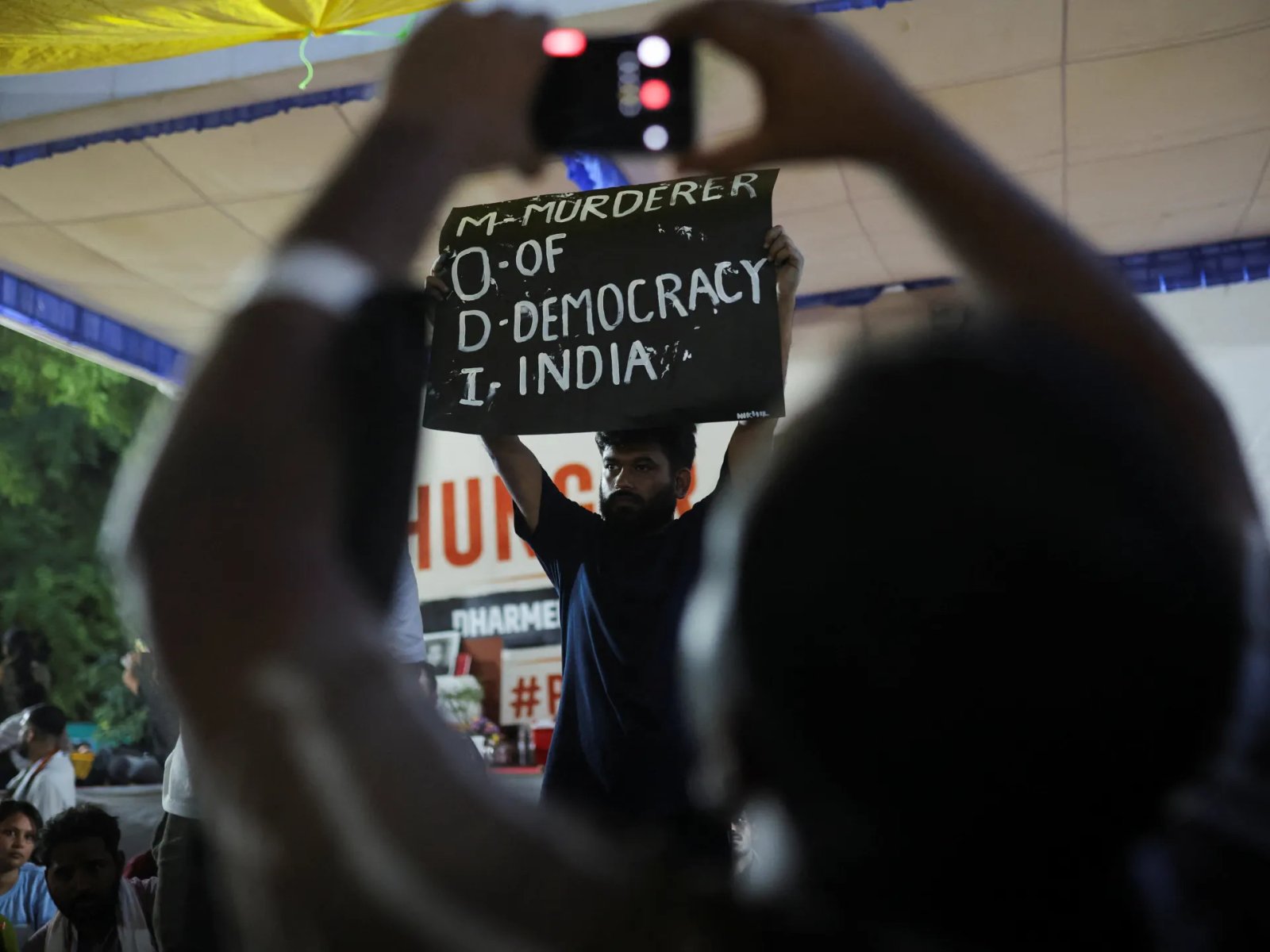
Two months after the Cockroach Janta Party (CJP) went viral in India, its followers have entered dangerous territory. Police forcefully removed educator-activist Sonam Wangchuk from the CJP’s sit-in at Delhi’s Jantar Mantar observatory, taking him to hospital against his will on the 21st day of his indefinite hunger strike.
Protesters rallied at the site while CJP founder Abhijeet Dipke began his own hunger strike. The demonstrators plan to march towards the Indian Parliament on Monday to demand the resignation of Education Minister Dharmendra Pradhan over university entrance exam leaks that caused nationwide outrage and wider failures of accountability in India’s competitive examination system. There have even been calls for the resignation of Prime Minister Narendra Modi.
The CJP emerged in mid-May after remarks by Chief Justice Surya Kant in which he called unemployed youth “cockroaches”, sparking outrage across the nation. Since then, the “party” has garnered an immense online following among India’s youth and staged massive protests.
Before Saturday’s escalation, the state’s response was neither open accommodation nor an all-out crackdown but calibrated containment: permit protests within narrow limits, police their reach and wait for the coalition to fragment. It now appears that the CJP has unnerved those in power.
It seems it is no longer possible to treat the CJP as another viral storm in India’s crowded and volatile politics, as a satirical youth outfit born on social media, briefly visible on the street and destined to fade as quickly as it appeared. The cockroach has travelled far because it has named a widespread sentiment in society.
To be called a cockroach is to be told that one is dirty, dispensable and best kept out of sight. The cockroach is an ugly, comic, subaltern creature. It is despised, hard to kill and lives in the cracks of polite society. It survives poison, darkness and disgust. It appears when a house is not as clean as its owners claim.
For many young Indians, especially those facing unemployment, exam-paper leaks and rising costs, the insult captured something they already felt. The CJP turned humiliation into visibility. If this is how power sees us, they said, then let us speak in that name. An insult became a badge worn proudly. This is not revolutionary politics. It is tragicomic, even farcical, because the cockroach stands for an India in which vast dreams of upward mobility have come to naught.
“Cockroach politics” emerged at a time when Modi’s Bharatiya Janata Party (BJP) is running a formidable electoral machine with vast resources, ideological discipline and a capacity to convert welfare, Hindu nationalism and opposition fragmentation into votes.
Yet the BJP’s own mandate remains, paradoxically, that of a very large minority. In the 2024 general election, the party won the support of a little more than a third of voters nationally. Put differently, two-thirds of those who voted did not endorse the BJP’s re-election bid, led by Modi.
The regime’s power rests not on an empirical majority but on aggregation: regional and caste alliances, opposition defections and splits, and the steady shrinkage of India’s third space between two national parties.
The CJP appeared at a time when electoral politics looks settled from above but untrustworthy from below. The young are angry about a lack of jobs and botched exams. They are also entering politics at a time when the usual democratic channels of expressing public anger – parties, elections, media and independent institutions – look increasingly vulnerable to distortion.
Then there is the economy.
In the aftermath of the COVID-19 pandemic, which sent the Indian economy into recession, more than 800 million Indians depend on food handouts from the government. For the poor majority, food support tackles hunger, keeps households afloat and makes the state visible in everyday life.
A welfare floor, however, does not reflect a social compact. It reflects a failure to address structural precarities exposed during the pandemic.
At the other end, wealth has concentrated sharply. The richest 1 percent now claims a share of income and wealth not seen in India in the past century. This is no accident. It defines the political economy of the present: welfare below, monopoly above and a tightly squeezed middle, plagued by jobless growth and a sense of blocked aspirations.
India has expanded schooling and higher education, but it has not generated enough dignified, stable work for those it has encouraged to aspire. Educated youth are especially exposed to this contradiction. They have been raised to believe in credentialed mobility, but the economy offers mere crumbs of comfort.
This is why paper leaks, recruitment delays and exam cancellations produce such intense anger. An exam is not merely an exam. For middle-class families, it is a wager on social mobility. Parents save, borrow, sell land and pay exorbitant coaching fees for the possibility that a child might secure respectable salaried work.
When an exam is leaked, the betrayal is intimate. The state has not only failed to administer a test but also mocked the sacrifice of millions of families.
This is why the cockroach symbol carries much weight. It speaks to those caught between aspiration and contempt: the graduate without work, the small entrepreneur pressed between taxes and weak demand, the gig worker always online but never secure and the student who knows that a leaked exam paper can waste years of preparation. The cockroach is the citizen who survives without being honoured for surviving.
The Modi era has mastered electoral conversion without social reconciliation. It has not answered the question that haunts millions of young Indians: What future remains for those outside inherited privilege, monopoly capital or a global exit?
The CJP cannot answer that question either. It is too fragile, too open, too vulnerable to the forces it mocks. Its incoherence is its truth. It symbolises not so much the arrival of a new party as the exhaustion of older political languages. A joke that travels this far need not become a movement to reveal a malaise. It need not defeat the BJP or articulate a pure ideology to be politically meaningful.
That is the deeper meaning of cockroach politics. The democratic spirit survives but in diminished forms. It speaks through satire because ordinary speech feels blocked. It appears as a meme because organised politics seems risky. It laughs because humour in dark times is the last public form of courage.
The cockroach is, to disappoint keyboard warriors, no revolutionary hero. It is a humble creature that appears when the house is not as clean as its owners claim.
The views expressed in this article are the author’s own and do not necessarily reflect Al Jazeera’s editorial policy.