dailynewsnblog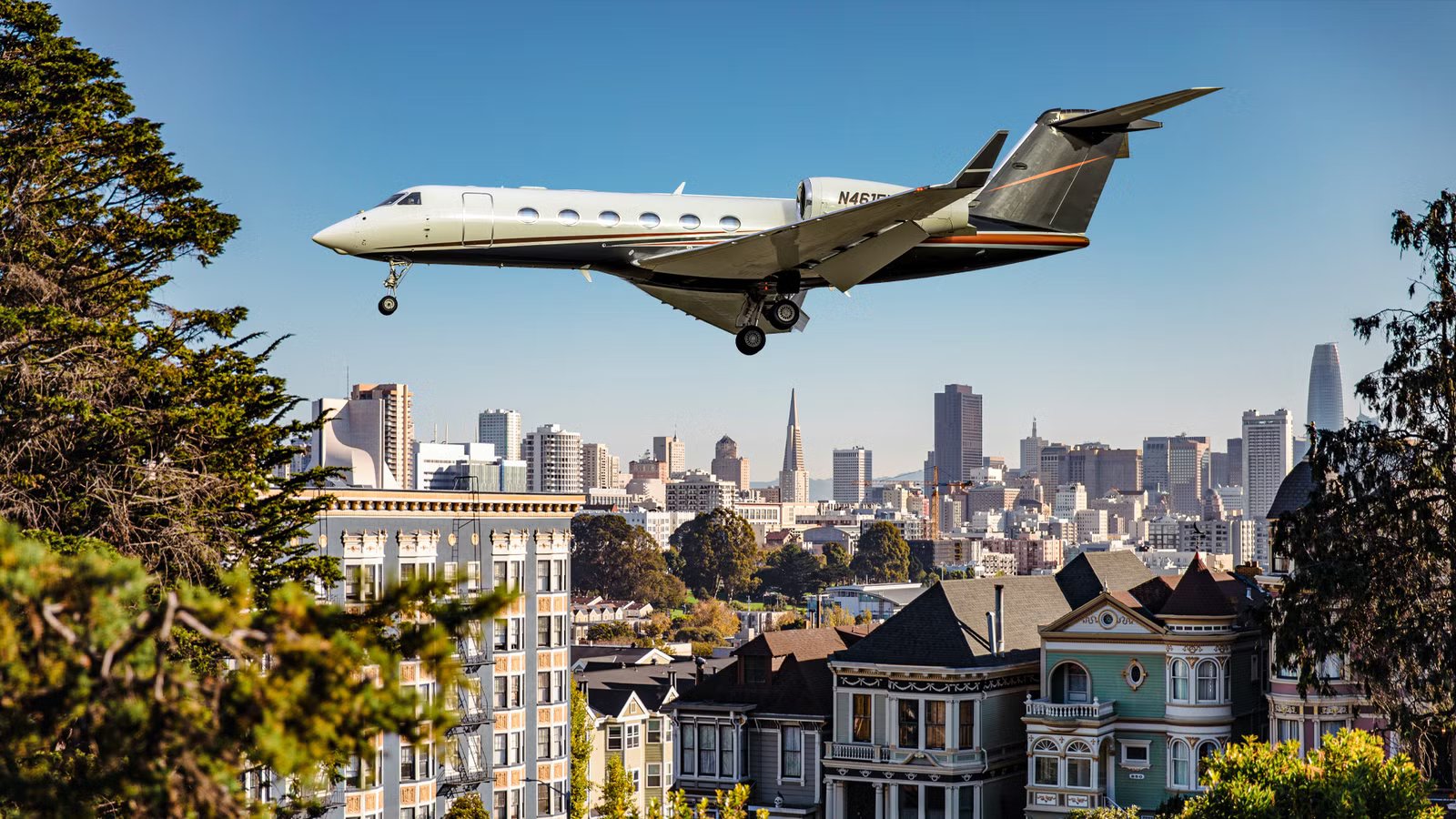
Chartering a private jet from San Francisco to Paris is one of the most demanding routes in private aviation. The 5,570-nautical-mile (10,315 km) crossing eliminates most available charter aircraft and limits nonstop options to a few ultra-long-range heavy jets with the fuel capacity to fly for 11 to 12 hours without stopping.
The cost of that crossing in 2026 depends on the aircraft, the fuel market, the time of year, and a series of additional charges that most published hourly rates do not include. Here is what a private transatlantic charter from San Francisco to Paris actually costs when every line item is accounted for, which aircraft can make the trip, and at what group size the per-passenger economics start to compete with a commercial business class ticket.
Why San Francisco To Paris Requires The Biggest Jets In Private Aviation

San Francisco to Paris covers approximately 5,570 nautical miles (10,315 km), a distance that immediately rules out the majority of the private jet market. Light jets, midsize jets, and even most super-midsize aircraft do not have the fuel capacity to cross the Atlantic at all, let alone on a route that begins on the West Coast of the United States. This is not a New York to London charter, where a range of 3,500 nautical miles (6,500 km) opens up a wide selection of available aircraft. San Francisco to Paris requires an ultra-long-range heavy jet, and even within that category, the options are limited.
The two aircraft that can make the crossing nonstop with comfortable fuel reserves are the Gulfstream G650ER, at approximately 7,500 nautical miles (13,890 km) of range and the Bombardier Global 7500, at 7,700 nautical miles (14,260 km). Both carry enough fuel to fly the route with margins that account for headwinds, routing deviations, and regulatory reserve requirements. The standard G650, without the extended-range package, sits closer to the edge at 7,000 nautical miles (12,964 km) and may require a fuel stop depending on wind conditions and air traffic control routing on the day. The Dassault Falcon 8X, at 6,450 nautical miles (11,945 km), cannot make it nonstop under any realistic conditions.
For aircraft that fall short of the nonstop threshold, the standard solution is a technical stop in Iceland or Greenland, typically at Keflavík or Kangerlussuaq. The stop adds two to three hours to the total journey, including descent, refueling, and climb back to cruise altitude, turning what would be an 11 to 12 hour nonstop flight into a 13 to 15 hour door-to-door experience. For clients chartering a private jet specifically to avoid the time penalties of commercial travel, a fuel stop partially undermines the purpose.
What The Base Charter Rate Covers And What It Doesn’t

Private jet charter pricing starts with an hourly rate that covers the aircraft, crew, and basic operating costs for the time the aircraft is in the air. For the aircraft capable of flying San Francisco to Paris nonstop, those hourly rates in 2026 sit between $12,000 and $15,000 per flight hour for a Gulfstream G650ER, approximately $14,000 per hour for a Bombardier Global 7500, and $23,000 or more per hour for a VIP airliner configuration such as a Boeing Business Jet.
Applied to the 11 to 12 hours of flight time the San Francisco to Paris crossing requires, the base cost for flying time alone ranges from approximately $132,000 to $180,000 on a G650ER, $154,000 to $168,000 on a Global 7500, and $253,000 or more on a BBJ. These figures represent what the operator charges for the hours flown and nothing else. They do not include fuel surcharges, international fees, catering, crew overnight costs, or the repositioning cost of returning the aircraft to its home base after the charter is complete.
The distinction between the published hourly rate and the final invoice matters because the gap between the two is significant on international charters. On a domestic flight from San Francisco to New York, the add-on costs are modest relative to the base rate. On a transatlantic crossing that involves overflight permits across multiple countries, customs handling at both ends, crew rest requirements that mandate hotel stays in Paris, and an empty return leg that doubles the operator’s positioning cost, the additional charges can add 30-50% to the base flying-time figure. The hourly rate is the starting point of the pricing, not the total.
The Costs That Turn A $150,000 Flight Into A $250,000 One

The largest single variable cost above the base rate in 2026 is fuel. Charter operators pass this cost through as a variable surcharge, typically adding 10-15% above the base hourly rate. On a $150,000 base charter, that surcharge alone adds $15,000 to $22,500 before any other line item is considered.
International fees come next. Overflight permits for crossing Canadian, Icelandic, UK, and French airspace must be arranged in advance and carry individual fees. Landing and handling charges at Le Bourget or Charles de Gaulle vary by airport and time of day but typically range from $3,000 to $8,000 combined. Customs handling at both ends adds further costs. Catering for a 12-hour transatlantic flight on an ultra-long-range jet is not a beverage cart and a sandwich. Full-catering packages with multi-course meals, premium beverages, and specific dietary requirements run $2,000 to $5,000 depending on the level of service requested. Crew overnight costs in Paris, including hotel accommodation and per diem for two pilots and a cabin attendant, add another $1,500 to $3,000.
The single largest hidden cost is repositioning. Unless the operator has a return charter booked from Paris, the aircraft flies back empty, and the client typically absorbs part or all of that cost. On an 11 to 12 hour return leg, repositioning can add $50,000 to $100,000 or more to the total invoice. When all additional costs are included, a fully loaded one-way charter from San Francisco to Paris realistically totals $180,000 to $250,000 on a G650ER or Global 7500, and $280,000 to $400,000 or more on a VIP airliner.
Empty Legs, Booking Windows, And How To Reduce The Price

The most significant discount available on a route like San Francisco to Paris is an empty leg, which occurs when an operator needs to reposition an aircraft and is willing to sell the flight at a reduced rate rather than fly it empty. Discounts on empty legs typically run 50-75% below the standard charter price, which on this route could bring a G650ER crossing from $200,000 down to $50,000 to $100,000. The catch is availability. Empty legs are unpredictable, often posted with short notice, and cannot be relied upon for travel that needs to happen on a specific date. They exist when someone else’s charter creates a repositioning need that happens to match your route and timing.
Catch what other flight trackers miss
Emergency squawks, holds, NOTAMs — live signals, no signup.
Open tracker
Catch what other flight trackers miss
Emergency squawks, holds, NOTAMs — live signals, no signup.
Open tracker
International charters also carry booking windows that domestic flights do not. Overflight permits, customs arrangements, and ground handling logistics across multiple countries typically require five to seven days of advance planning at minimum. Last-minute bookings are possible but incur premium pricing and risk permitting delays that can push departure times. Peak travel periods compress availability further. Summer, major holidays, and the 2026 FIFA World Cup, which is being hosted across the United States, drive both demand and pricing upward. Booking two to four weeks in advance during peak periods is standard practice, and operators charge accordingly.
Beyond empty legs and timing, the other practical lever is aircraft selection. Chartering a Dassault Falcon 8X with a fuel stop in Keflavík costs less per hour than a G650ER flying nonstop, and the total price including the stop can be $30,000 to $50,000 below the nonstop option, depending on the operator. The trade-off is two to three additional hours of travel time, which, for some clients, is an acceptable compromise and, for others, defeats the purpose of flying private in the first place.
The Per-Passenger Math That Makes Private Aviation Competitive

A Gulfstream G650ER seats between 14 and 19 passengers depending on cabin configuration. At a fully loaded charter cost of $200,000 one-way, a group of 14 passengers pays approximately $14,300 per person for a nonstop private flight from San Francisco to Paris. That figure is less than many roundtrip business class fares on the same route, which on airlines like United and Air France typically run $8,000 to $12,000 each way in 2026. At 14 passengers, the per-person private charter cost sits in the same range as a one-way commercial business class ticket, with the addition of private terminal access, no security lines, no connections, and a departure time set by the group rather than the airline.
The math changes rapidly as the group gets smaller. At eight passengers, the per-person cost rises to $25,000. At four passengers, it reaches $50,000 per person one-way, a figure that exceeds most commercial first class fares on the route and is difficult to justify on economics alone. For a couple or a solo traveler, a private transatlantic charter is a pure luxury expense with no rational cost in comparison to commercial alternatives in any cabin class.