dailynewsnblog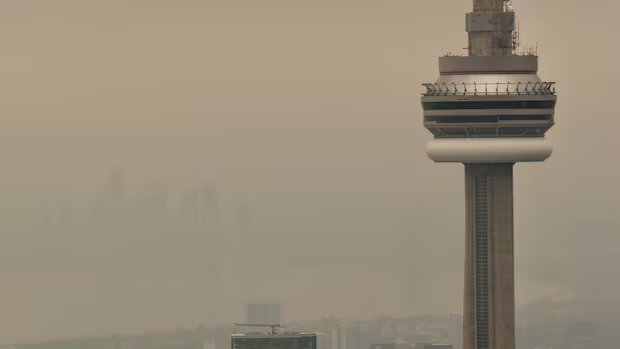

Listen to this article
Estimated 5 minutes
The audio version of this article is generated by AI-based technology. Mispronunciations can occur. We are working with our partners to continually review and improve the results.
It’s another smoky summer in southern Ontario, and people breathing poor air in and around Toronto are once again asking what governments can do about wildfire smoke.
Ontario Premier Doug Ford has defended the province’s wildfire budget and has asked Ottawa for extra help. Some Republican lawmakers in the U.S. have also demanded Canada do more to stop smoke from drifting across the border.
But experts say the politics can obscure a harder reality: fire is a natural part of Canada’s forests, and a warming climate is making those fires more intense, harder to fight and more likely to send smoke into major cities.
“A lot of this is not entirely unexpected. [But] it’s happening far sooner than a lot of people expected,” said Patrick James, an associate professor at the University of Toronto’s forestry department.
“What we’re seeing is very modest increases in temperature can result in multiplicative effects in terms of the number of fires and the intensity of those fires.”
Behind the smoky skies that have turned parts of southern Ontario orange is a climate system behaving in increasingly unpredictable ways. Hotter temperatures and drought conditions dry out forests faster, while weather patterns can carry smoke hundreds or thousands of kilometres into cities.
Smoke from wildfires can reach cities such as Toronto through natural wind patterns. This time, an unusually strong El Niño weather pattern likely helped push smoke toward southern cities. The heat dome that brought record-breaking temperatures earlier in July may also have trapped smoke and made it linger longer.
“Because of global climate change and the warming of the planet, we’re drying out vegetation much more than we did in the past, and that makes it more susceptible to fire,” said Jonathan Overpeck, a climate scientist and dean at the University of Michigan.

A CN crew captured dramatic video of wildfire flames nearly engulfing their train in northern Ontario, where at least 150 wildfires have destroyed homes, forced evacuations and unleashed smoke thick enough to make Toronto’s air quality among the worst in the world.
Canada is warming much faster than the global average. The country is warming at twice the global rate, while the Canadian Arctic is warming at nearly four times the global rate, raising concerns around thawing permafrost in northern regions.
That could expose carbon-rich soils, which may release carbon dioxide and methane into the atmosphere — greenhouse gases that would speed planetary warming.
“It’s already started, and it could get worse and worse. And there’s a huge amount of carbon locked up in the permafrost and also in the shallow seas in the Arctic Ocean,” Overpeck said.
There is still scientific uncertainty around exactly how much warming is required before Arctic permafrost begins thawing more widely, but research indicates the process has already begun.
What can governments do?
Experts agree that more firefighting resources are important.
“Right now we have fires burning in Nova Scotia, we have fires burning in coastal British Columbia, and we have fires burning in the far north,” said Ze’ev Gedalof, an associate professor and climate scientist at the University of Guelph.
“So we can’t move resources around. We used to just move planes and helicopters and people around as the wildfire season shifted across the country.”

As Ontario asks Ottawa for help with evacuations, Premier Doug Ford is rebutting criticisms his government hasn’t properly budgeted for this year’s wildfire season. CBC’s Lane Harrison breaks down the numbers.
That has led to calls for a more permanent national firefighting force to deal with longer and more widespread fire seasons in Canada.
But while firefighting resources are important for protecting local communities — some of which have been completely destroyed in Ontario fires this year — experts say it is not possible to extinguish every fire sending smoke toward major cities.
In a detailed online post, acclaimed U.S. climate scientist Zeke Hausfather wrote that fires in Canada’s boreal often burn as intense crown fires, where flames reach the treetops, in remote areas far from human management. Many are too remote and intense to douse.
“[I]t’s a landscape that waits, and then burns catastrophically under extreme weather,” Hausfather wrote.
That has not stopped a group of Republican lawmakers from Michigan from demanding that Canada do more to tackle the smoke — a step some of them took last year. A Republican U.S. senator from Ohio has said he plans to introduce a bill to sanction Canadian officials deemed responsible for failing to address the smoke.
None of those lawmakers mentioned climate change or the burning of fossil fuels. A landmark 2023 study directly linked increasing wildfires in western U.S. and southwestern Canadian forests to a group of the world’s 88 largest fossil fuel companies, including several American oil majors.
“When people talk about a perfect storm for something bad, that’s what we’re dealing with,” Overpeck said.
“And the best way to solve it is to just stop burning fossil fuels.”