dailynewsnblog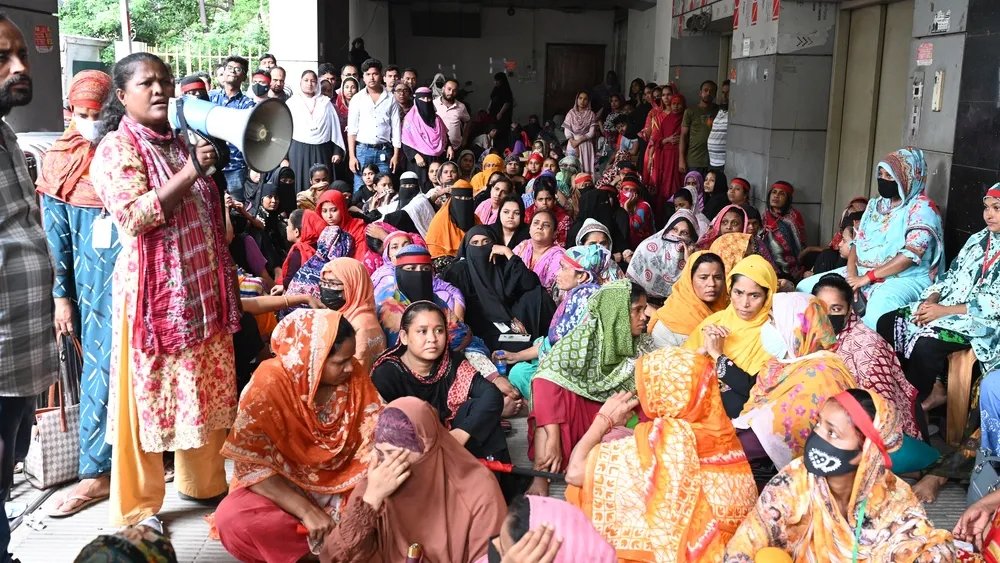
On the Line is a weekly roundup of sourcing and labor quick hits in the apparel and footwear industry, from worker protests to boardroom maneuvering, tracking the developments shaping conditions on the factory floor and beyond.
Bangladesh under pressure
Factory closures and layoffs across Bangladesh are escalating into an acute human rights crisis, a French human rights organization warned in a report Wednesday.
Between August 2024 and this past June, JusticeMakers Bangladesh in France reported that 457 factories ceased operations, leaving roughly 240,000 workers unemployed. Of these, it said 205 closures were attributed to insufficient production orders, 190 to financial difficulties, 11 to labor unrest and 51 to miscellaneous factors such as political instability, banking complications, gas and electricity shortages, raw material scarcity and factory relocation.
“Individual factory closures illustrate the human impact behind the figures,” the report continued. It cited cases where thousands of laid-off workers were forced to protest for wages, termination benefits, provident fund contributions and other legal entitlements, adding that delayed and unpaid wages are among the most persistent causes of labor unrest in Bangladesh’s garment industry and reflect shortfalls in labor administration and dispute resolution systems.
“For workers living from one salary payment to another, even a short delay can create a household emergency,” JBIF wrote. “Rent becomes overdue, food purchases are reduced, medical treatment is postponed and families become dependent on loans and informal credit. Earned wages are not discretionary benefits. They are legal and contractual entitlements.”
Even workers who are still employed face double economic pressure as basic wages increasingly fail to meet rising living costs and reduced overtime, driven by falling orders, has hampered their ability to supplement income.
The only way through the morass, it said, is coordinated action by the government of Bangladesh, employers, industry associations, trade unions, international buyers, development partners and civil society. The report added that the country’s garment sector cannot achieve long-term stability if workers’ rights and industrial competitiveness are treated as competing priorities.
“The future success of Bangladesh’s garment industry must be measured not only by export earnings, production volumes or international market share, but also by whether the millions of workers behind those achievements can live and work in dignity, safety, freedom and economic security,” JBIF said.
Caught polluting in Cambodia
Two Chinese-owned garment factories in Phnom Penh—XSLJ (Cambodia) Garment Co. and Yun Jian Garment Co.—face fines and other penalties after inspections by the environment ministry found they burned fabric scraps in boilers and emitted air pollutants above legal limits.
Though Yongjian Cai, chairman of Yun Jian Garment Co., told the Cambodian Journalists Alliance Association that he rejected the findings and said inspectors found no pollution affecting nearby residents or the environment, the ministry said the factory burned roughly 10 kilograms of fabric scraps a day in a boiler that lacked an air pollution control system and had not prepared an environmental protection agreement or obtained the required waste discharge permit.
XSLJ, which did not respond to a request for comment, burned about 3,000 kilograms of fabric scraps daily, officials said, adding that a second boiler burned 10 to 15 cubic meters of firewood a day while also using diesel fuel. Despite the installation of a smoke filtration system, preliminary testing found that emissions from its boiler smokestacks exceeded Cambodia’s legal limits. The company had prepared an environmental protection agreement but had not obtained the required waste discharge permit.
Using fabric waste as low-cost boiler fuel remains a persistent problem in Cambodia, despite being illegal. Companies burning solid waste, including garment and fabric scraps, can be fined $250. Pollution that endangers “human bodies or lives” also violates Cambodia’s environmental law, which can impose more than $12,000 in fines and five years in prison on the worst offenders.
Some of the world’s biggest brands have been implicated in the practice. In 2022, Greenpeace’s investigative journalism arm, Unearthed, found the charred remnants of footwear and clothing from Clarks, Diesel, Michael Kors, Next, Nike, Ralph Lauren and Reebok at five brick kiln clusters.
The use of pre-consumer garments to keep kiln fires burning contributes to the “dynamic relationship between modern slavery, environmental degradation and climate change,” the report noted.
Covid cancellation consequences
Fashion brands that refused to pay suppliers for orders that were contracted, produced and sometimes even shipped performed slightly worse on the stock market than companies that met their commitments, according to a report by U.K. and Italian academics, suggesting that investors paid close attention to whether they were fulfilling their responsibilities.
“There was a decrease in shareholder wealth for fashion brands that refused to pay their suppliers between Day 2 and Day 5 after the non-pay event,” wrote Michael Rogers, assistant professor of operations management at the University of Sussex, and his co-authors. “In the first 10 days after the event day, brands agreeing to pay their suppliers had a 30 percent higher [Cumulative Abnormal Return] than those who refused to pay garment factories.”
To reach their findings, researchers used Worker Rights Consortium data on which brands were paying suppliers and paired it with share price data to assess how investors reacted to brands that increased worker vulnerability.
“We posit that—possibly for the first time—shareholders accounted for human rights risks to workers in the extreme conditions of the pandemic, suggesting that trends toward protecting human rights in and across supply chains could have shareholder wealth implications,” the report said.
Even as human rights scandals continue to swirl, the pandemic stands out as a test of corporate commitment that many companies failed.
“The fashion industry’s profitability fell by 93 percent in 2020, yet this financial stress was cascaded onto Tier 1 and lower-tier suppliers,” the report said. “During Covid-19, many fashion brands undertook exploitative practices. To illustrate, fashion brands cancelled $40 billion worth of product orders, including suspending payments for goods and materials that had already been produced.”
The Business and Human Rights Resource Centre estimates that cancelled orders cost 50 million workers nearly $5.8 billion in lost pay over just three months.
Still, the research results were illuminating, Rogers et. al. said.
“If firms, as it often seems, are unwilling to act to protect vulnerable workers in their supply chains, perhaps evidence that the wealth of their shareholders is being affected by that irresponsibility might trigger a more positive response,” they added.
DIFE safety shutdown
Bangladesh’s Department of Inspection for Factories and Establishments has temporarily halted production at three readymade garment factories in Chittagong—HB Fashions, HKTG Garments and Chumki Apparels—after structural assessments found major safety issues in their shared building, according to The Business Standard.
The companies occupy a six-story building in North Kattali. HB Fashions spans all floors, while HKTG Garments and Chumki Apparels operate on the ground, first and second floors. Chumki Apparels has been closed for roughly seven years because of financial difficulties. The other two factories employ 1,300 workers.
At a meeting earlier this month, the RMG Sustainability Council warned that structural weaknesses could put lives and property at risk if the building remained open. It recommended vacating hazardous sections, removing excess loads, installing temporary supports, suspending operations until permanent repairs are complete and carrying out another technical assessment before reopening.
Chittagong deputy commissioner Mohammad Zahidul Islam Miah said protecting workers’ lives outweighed business concerns and that Bangladesh could not risk another industrial tragedy like the Rana Plaza collapse, which killed 1,300 workers and injured thousands more in 2013. He said operations would restart only after the building was certified safe.
DIFE deputy inspector general Mohammad Mahbubul Hasan also backed the decision, saying the suspension was necessary to safeguard workers. HKTG Garments managing director Enamul Aziz Chowdhury, however, disagreed, saying the immediate shutdown left 300 to 350 employees in limbo and that roughly 70 percent to 80 percent of the renovation work had already been completed and production had been shifted away from unsafe areas.