dailynewsnblog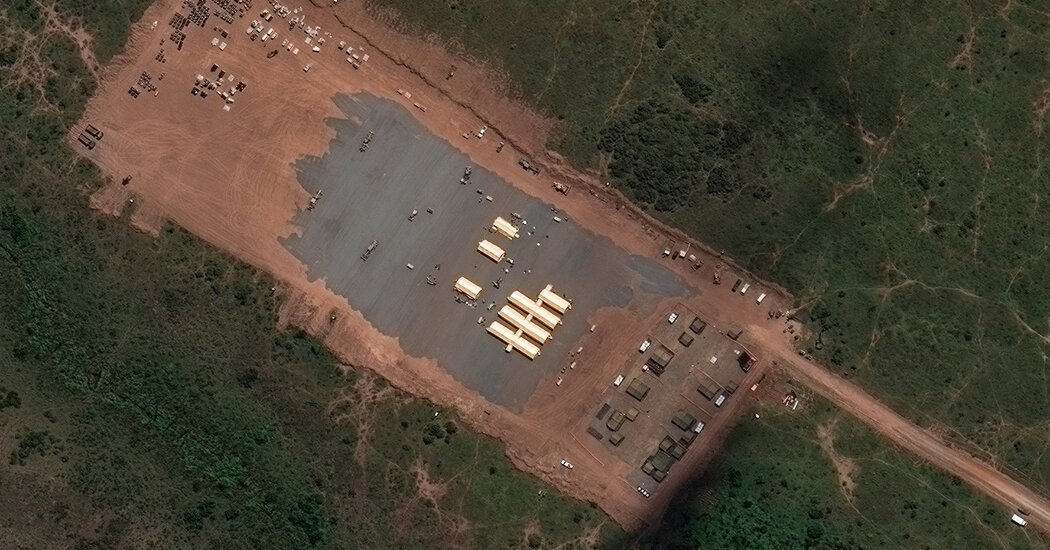
Seven American aid workers are being quarantined at a recently built U.S. facility on an air base in Kenya, their employer said on Friday. They are the first Americans to be monitored at the site, and arrived at the facility even as the Trump administration announced a new Ebola-related travel ban this week.
The aid workers had been on the front lines of the fight against Ebola in the Democratic Republic of Congo and have shown no symptoms of the virus, according to their employer, Samaritan’s Purse, a disaster relief organization. It was unclear whether they were voluntarily in quarantine.
But hundreds of Americans remain stranded in Congo after the Trump administration issued the new travel ban on July 13, which applies to anyone seeking to enter the United States after traveling in the country, according to a federal official with knowledge of the situation.
About a dozen Americans were rerouted to Fort Drum, a military base in New York, after they tried to return to the United States via Canada this week, the official said. It is unclear how long they might be held there or where they might be sent next.
The new policy marks an extraordinary departure from the response of previous administrations to Ebola outbreaks, when Americans exposed to the virus were brought home to be monitored and treated at state-of-the-art facilities.
Two American citizens who tested positive for Ebola in the current outbreak were both transported to medical facilities in Germany.
The Department of State and the Department of Health and Human Services did not immediately respond to requests for comment.
The World Health Organization declared an outbreak of the Bundibugyo virus, a type of Ebola, in Congo in mid-May, but the disease is believed to have spread for several months before then. The official toll topped 2,000 confirmed cases and 820 deaths as of Wednesday, according to the W.H.O. If the outbreak continues to grow apace, it is on track to become the largest ever recorded.
Franklin Graham, the president of Samaritan’s Purse, said in a statement that the aid workers, who were not identified, would be quarantined in Kenya for 21 days, the incubation period of the virus.
“They are being housed in large military tents in a fenced-in, graveled area, sleeping on military cots, and their food is being provided by the U.S. military,” he said in the statement.
The seven aid workers are the first Americans to be monitored at a U.S. facility built at Laikipia Air Base in central Kenya. The site was hurriedly constructed under an agreement between Kenya and the United States earlier this year.
Hundreds of people in the nearby town of Nanyuki demonstrated against the construction of the facility in June. Three people were killed when Kenyan security forces responded with a crackdown.
Kenya’s high court issued an order in June saying that the government must suspend construction at the facility and not admit people exposed to the virus if they were brought under the auspices of an agreement between Kenya and the United States.
The Katiba Institute, a civil society organization that sued the Kenyan government over the facility, said in a statement on Friday that if foreign nationals had been brought to Kenya under the bilateral deal for monitoring, it would be an “absolute outrage” and a “flagrant and dangerous defiance of the court order.”
In May, the Trump administration invoked a public health law, known as Title 42, to bar entry into the United States of all immigrants who had been in Congo, Uganda or South Sudan in the previous 21 days. It then extended the ban to permanent residents “who originate from or have recently traveled through” those three countries.
American citizens had been exempted from those orders, even after Secretary of State Marco Rubio said in May that the administration would “not allow any cases of Ebola to enter the United States.”
But earlier this week, the Trump administration extended the ban to American citizens, including government scientists and aid workers deployed to help with the outbreak, saying they would not be allowed back into the United States until after they had quarantined in a third country for 21 days.
Some public health experts said there was little scientific rationale for the bans.
“The Trump administration’s decision to further complicate U.S. travelers’ return from a country facing an Ebola outbreak blatantly ignores the world-class infectious diseases care available right here at home,” Dr. Ronald G. Nahass, president of the Infectious Diseases Society of America, said in a statement.
“This policy will likely deter Americans from traveling to the Democratic Republic of Congo to help stop the largest outbreak of this deadly disease in history,” he said.
It is unclear whether the administration will help citizens with the costs of quarantining or rerouting travel. It does not reimburse the costs incurred by travelers, including permanent residents, who are turned back at the border because of the bans.