dailynewsnblog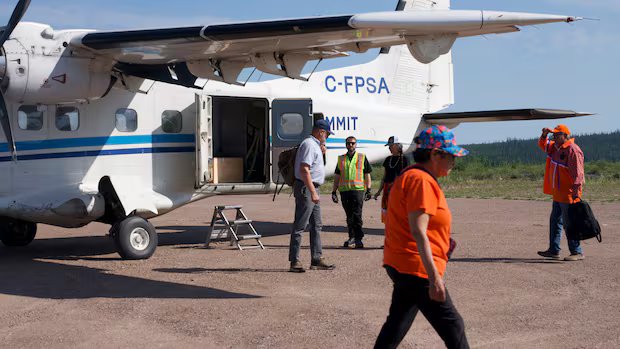

Listen to this article
Estimated 4 minutes
The audio version of this article is generated by AI-based technology. Mispronunciations can occur. We are working with our partners to continually review and improve the results.
The remains of two girls who died at residential school in Fort Resolution, N.W.T., in the 40s have been brought home to their community in Łútselk’e, and laid to rest next to family members.
Deninu Kųę́ First Nation Chief Louis Balsillie escorted Denise Boucher and Alice Abel’s small wooden caskets by plane on Thursday morning. The remains were then driven to a graveyard next to the Snowdrift River. There, a burial ceremony was held for each of them.
“I feel really relieved,” said Adeline Jonasson, Boucher’s half sister.
She said the day was good, but emotional.
“It needed to happen. I wanted her to come home, to be with Dad and her family and her relatives here at the cemetery.”

During the ceremony, Jonasson said Boucher died at residential school after her apron caught fire and that according to Boucher’s death certificate – she died from burn injuries.
A shiny new plaque on the cross marking Boucher’s grave indicates she was born in June 1935 and that she died in August 1943 at the age of eight. Jonasson said the old plaque that marked her grave in Fort Resolution showed Boucher died at 7 years old, a discrepancy she chalks up to poor record-keeping.
“I wish I would have known you, I always wanted a big sister,” Jonasson said, before the casket was covered with dirt.

Like Jonasson, Therese Abel also yearns for a relationship with a family member she never got to meet. She said Alice, who died when she was 13 years old, would have been her aunt.
“I just want to meet her, how she’s like, who she looks like. It’d be different nowadays if she was alive, she would have kids probably. It’s kind of sad.”
Therese only found out about Alice a few years ago, when the team working to find, identify and repatriate children buried in Fort Resolution contacted her and her late brother and asked for a DNA sample.
They later told Therese the remains belonged to her dad’s sister – her aunt.

Therese said she wanted Alice to be buried next to family members, in a place where she can visit the grave. If Alice’s remains stayed in Fort Resolution, it’d be harder to visit and as far as Therese knows, there aren’t any family members there.
During the burial ceremony for both girls, a strong breeze blew through the cemetery – offering temporary reprieve from the sun’s heat. Brother Edouard Prince, part of the Oblate Missionaries of Mary Immaculate, led the ceremonies. He said the wind was a sign of God – which Therese took comfort in.
“While I was praying, I could just feel this breeze,” she said. It represented, to her, that both girls were in a good place. “They’re happy where they are now, rest in peace.”

Deninu Kųę́ First Nation has been working to map the graves of children who died at residential school. Diane Giroux, one of the First Nation’s councillors, said the process involves research, records, and DNA testing.
“There are a lot of children [in Fort Resolution] that aren’t from our community. So it was a matter of finding out where they were from, who they were, and then identifying them and, you know, advising the family.”
Some families, she said, prefer that remains are not disturbed.
Giroux said the First Nation had repatriated remains three times so far.
“Any time you’re doing a burial, it’s saying goodbye … it was sad, in that sense. But at the same time I would say it sort of gave you a sense of peace, as well, knowing they’re home.”