dailynewsnblog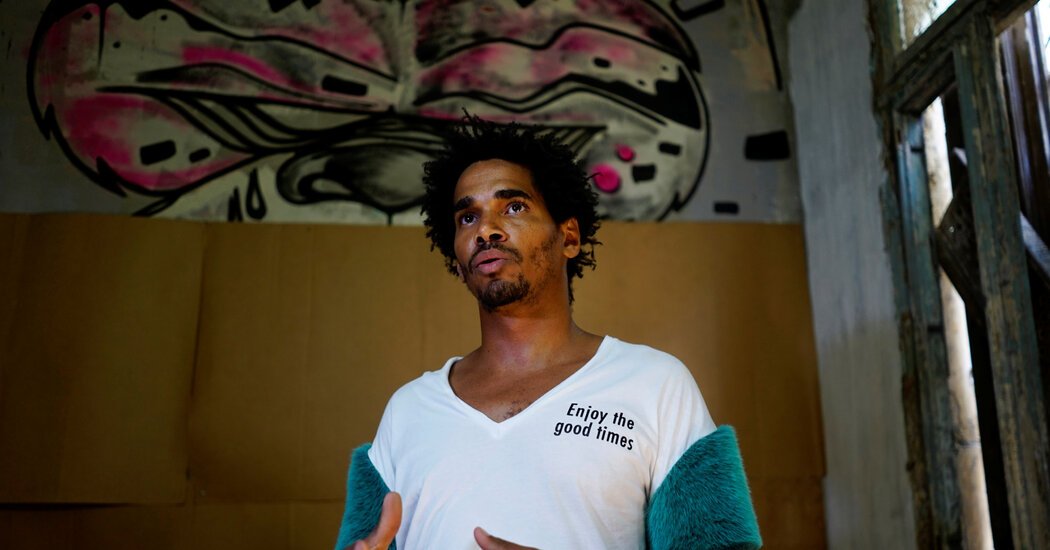
The whereabouts of Cuba’s highest profile political prisoner, the musician and artist Luis Manuel Otero Alcántara, are unknown, more than a week after he completed a five-year prison sentence for disorderly conduct. Human rights activists say he is the victim of a forced disappearance.
Mr. Otero, 38, co-founded the San Isidro Movement, a group of Havana artists, journalists and academics who fought for liberties in Cuba, all based in the San Isidro neighborhood. He was swept up in widespread protests held July 11, 2021, along with more than 1,000 others.
Mr. Otero helped compose a Latin Grammy-winning song, “Patria y Vida,” which means “Homeland and Life,” a rallying cry for the protest movement in Cuba.
He was convicted of disorderly conduct and contempt, for using the Cuban flag in his performances. His sentence was scheduled to end on July 9, according to a Cuban Supreme Court ruling earlier this year.
On July 7, Mr. Otero was forcibly removed from the Guanajay maximum-security prison in a “large-scale military operation” and taken to an undisclosed location, according to a habeas corpus motion, to challenge the legality of a person’s detention, filed on his behalf by Cubalex, a human rights organization of exiled lawyers.
Cuban State Security offered Mr. Otero freedom in exchange for exile, a deal he accepted, according to Laritza Diversent, the group’s executive director.
“Luis Manuel’s sentence ended,’’ she said. “They should have released him. Keeping him deprived of his liberty and withholding his location is an illegal deprivation of liberty.”
Failing to release him, she said, meets the criteria for an “enforced disappearance,” because state entities are holding him against his will.
The United Nations Committee Against Enforced Disappearances activated an “urgent action,” meaning the United Nations wrote to the Cuban government asking that Mr. Otero be located.
“You cannot keep a person imprisoned or with restrictions on their movement after they have served a sentence handed down by a court,” Ms. Diversent said.
Cuba’s foreign ministry in Havana and its embassy in Washington did not respond to several requests for comment.
The habeas corpus motion was filed on Monday. Legal representatives went Thursday to a courthouse in Cuba to pick up the government’s response after a required 72-hour turnaround time, but were turned away, she said.
The Cuban government appears to be stalling in responding to the motion until Mr. Otero received a visa to enter the United States because the government doesn’t want him free in Cuba, Ms. Diversent said.
In order to accept the offer of forced exile, Mr. Otero needs a visa from the United States, and his request to enter the United States on humanitarian grounds was submitted weeks ago, his supporters said.
Coco Fusco, a New York-based writer and artist who helped prepare Mr. Otero’s application, said that it was submitted to the U.S. Embassy in Havana weeks ago.
“It’s clear the government wants to expel Luis, but the U.S. hasn’t granted him a humanitarian visa yet,” she said. “You should ask the State Department why they’re taking so long.”
The U.S. State Department did not respond to repeated requests for comment about the visa. The U.S. embassy, in a social media post two days after the end of Mr. Otero’s sentence, urged his release.
It was unclear if the delay in Mr. Otero’s release was directly related to the visa not being ready. But his supporters insisted that even if the visa had not been issued, Mr. Otero should still be free.
“One thing has nothing to do with the other,” said Anamelys Ramos, an exiled activist who is serving as his spokeswoman.
Ms. Ramos, in a social media video, said she had spoken to Mr. Otero by phone and he inquired about the status of his humanitarian visa. When she asked where he was, he told her he could not say.
“I have spoken to him twice, but always through a call from State Security, from an unknown number on speaker phone, and with them listening, of course,” Ms. Ramos said in an interview. “He sounded like a person trying to remain calm.”
The Trump administration cut off oil deliveries to Cuba in January and is insisting on the release of prisoners and political and economic transformations. The Cuban government announced a major economic overhaul, but has not ceded on most of the administration’s demands.
“I’ve been hearing a lot of rumors within the prison: that the state won’t free me, that the island is running out of food and fuel, that President Trump is going to bomb Cuba,” Mr. Otero wrote in an essay published in April. “Even though the Trump administration has demanded the release of Cuba’s political prisoners, I don’t know if I will be allowed to go free, or what will happen to me or my country.”
David C. Adams contributed reporting from Miami.