dailynewsnblog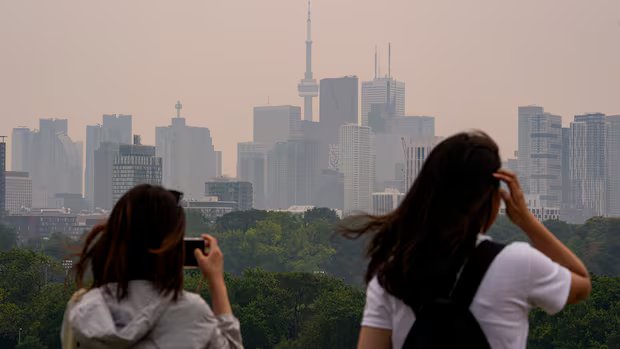

Listen to this article
Estimated 4 minutes
The audio version of this article is generated by AI-based technology. Mispronunciations can occur. We are working with our partners to continually review and improve the results.
Despite improvements overnight with the smoke, an orange-level air quality warning by Environment Canada remains in place Friday across most of the Greater Toronto Area.
Drifting smoke from forest fires in northwestern Ontario are still resulting in “very poor air quality” and reduced visibility Friday morning, said the national weather agency’s warning update at 6 a.m.
While “temporary” relief is expected in the afternoon, Environment Canada said heavy smoke will return Friday night and into the weekend.
Meteorologist Rob Kuhn said he “wouldn’t put any bets” on major improvements in the air quality today. He expects the smoke and an air quality health index around 10 to remain for most of Friday and into Saturday.
“This is not as good as we’d hoped yesterday,” he said, adding cleaner air “tried to come in from the northeast briefly” overnight before the smoke returned.
Eastern regions of the GTA, like Oshawa, are catching a break from the smoke for the time being, but he said there will likely be a drop in air quality as “smoke-laden air” drifts eastward tonight. Environment Canada lowered Oshawa’s air quality warning to yellow at 8:40 a.m. given the change in smoke levels.
Kuhn said showers with the chance of a thunderstorm on Saturday could “help sweep out some of the smoke” temporarily.
But there’s bigger hopes that a strong cold front forecast will sweep through the region Saturday night into Sunday to “get rid of a lot of the smoke,” he said.
But Kuhn warns that we might not be entirely done with the smoke this summer as wildfires continue to burn in the province.
Ontario officials say there are 136 active wildfires in the northwest region as of Wednesday, with 63 out of control. Another 44 fires are burning in the northeast, nine of which are out of control.
The wildfire affecting Namaygoosisagagun First Nation, Armstrong and Whitesand First Nation was more than 350,000 hectares large as of Thursday, according to Ontario’s Aviation, Forest Fire and Emergency Services.
Pollutant levels dropped Friday morning
Concentrations of fine particulate matter, or PM 2.5, in the atmosphere decreased drastically compared to Thursday, according to the province. PM 2.5 are airborne particles that are less than 2.5 micrometres in diameter, smaller than a strand of human hair, and can travel deep into your lungs.
As of 9 a.m. Friday, Toronto has about 8 to 28 micrograms/cubic metre (μg/m³) of PM 2.5 in the air. That’s an improvement compared to the nearly 300 μg/m³ measured Thursday morning.
Concentrations of the pollutant also dropped in Oakville at 84 μg/m³. In Mississauga it dropped to 62 μg/m³ and Oshawa to 6 μg/m³.

Andrew Chang explains how Ontario wildfire smoke is able to change the colour of the air in cities more than a thousand kilometres away, and the health risks of inhaling it.
Images provided by The Canadian Press, Reuters, Adobe Stock and Getty Images
The province’s air quality health index as of 9 a.m. Friday varies across the GTA with Oakville at 10, or high risk, downtown Toronto at 4, or moderate risk, and Oshawa at 2, or low risk.
Toronto ranked fifth on Friday morning in a list of the world’s most polluted cities, according to a global ranking by IQAir, a Swiss air quality technology company.
Outdoor pools still closed due to warning: city
Outdoor pools remain closed and lifeguards at 10 supervised Toronto beaches have been cleared due to the ongoing air quality warning, said the City of Toronto in a news release Friday.
CampTO programs and city-run child care centres are open, but operating indoors, it said. CampTO field trips have been cancelled for the day.
The city said outdoor workers will continue to be moved inside “where possible” to reduce exposure to smoke.
Toronto has six “cleaner air spaces” open at city hall, Metro Hall, North York Civic Centre, Scarborough Civic Centre, York Civic Centre and East York Civic Centre.
Environment Canada warned residents may experience symptoms including headaches, eye and throat irritation, wheezing or chest pains.
“During heavy smoke conditions, everyone’s health is at risk regardless of their age or health status,” it said, adding people should reschedule or cancel any outdoor activities.
Seniors, pregnant people, young children, people who work outdoors and those with existing health conditions are more likely to be impacted by the wildfire smoke. They’re advised to avoid going outdoors and to seek medical attention if experiencing symptoms.