dailynewsnblog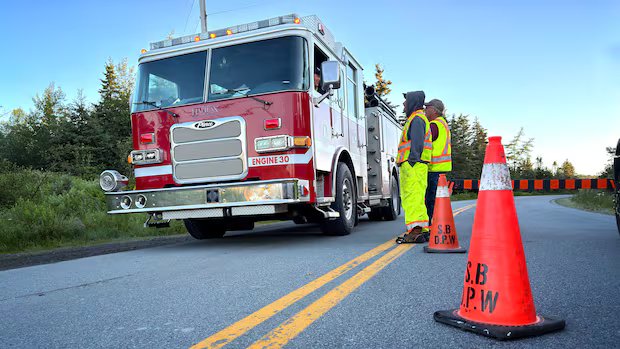

Listen to this article
Estimated 4 minutes
The audio version of this article is generated by AI-based technology. Mispronunciations can occur. We are working with our partners to continually review and improve the results.
Firefighters continue to respond to a wildfire near Mooseland Road, on Nova Scotia’s Eastern Shore, about 100 kilometres east of Halifax.
The fire is estimated to be 300 hectares, Jim Rudderham, director of fleet and wildfire management for the Department of Natural Resources (DNR), told CBC’s Information Morning Nova Scotia on Friday.
Crews resumed tackling the blaze at first light, the day after a mandatory evacuation order was issued for a 22-kilometre stretch of Mooseland Road, from civic address 4315 down to Highway 7.
“The good news of this fire — and I say this carefully because I know people are evacuated from their homes — but this is mostly a woods fire,” said Rudderham. “We don’t like stuff to burn, but it’s not going towards a town at this point.”

The evacuation order was issued after the fire crossed Mooseland Road on Thursday, forcing Nova Scotia Power to cut electricity to active lines in the area.
“Nova Scotia Power will have to assess that once they get in there safely, but that’s the reason,” Rudderham said. “It is an active fire, and we are very hopeful and confident about where it’s going, but we have to be sure as well.”

Crews from various local volunteer fire departments are assisting, with support from Halifax Regional Fire and Emergency and the DNR. Helicopters were preparing to take off around 8:15 a.m. AT to support ground efforts.
Two fixed-wing water bombers from Nova Scotia will be in use today, along with two water bombers from Newfoundland and Labrador.
“Every tool in the toolbox will help us,” said Rudderham. “This morning, the weather is a little calmer, and we can get some heavy aircraft on the fire, and our crews as well, to start tightening those boundaries. It’ll certainly help.”
The fire began late Wednesday night, but grew amid dry, hot conditions on Thursday.
While there was 4.6 millimetres of rain in the area overnight, Rudderham said the forest remains dangerously dry.
“I suspect that the fire last night probably laid down pretty good and didn’t do much movement at all, but as the morning progresses and the day heats up, it will start to move again.”
No power, poor cell service
Jacob Prest, who lives in the area covered under the evacuation order, said the fire appeared to escalate quickly Thursday evening.
“It kind of erupted, the smoke did, around supper time … and the fire, as you know, just ran away from everybody yesterday,” he told CBC News on Friday.
He said Mooseland Road is a tight-knit, family community, with about a 70/30 split between full-time and seasonal residents.
According to a Thursday estimate from the Halifax Regional Municipality, the evacuation order affects between 100 to 150 people.
“It was pretty hectic,” said Prest. “Mostly with people, of course, who don’t live here that have senior parents, responding quickly and coming out to get their parents.”
Prest said firefighters came to his door to inform him of the evacuation order, but after talking with officials, he’s decided to stay for now, as the fire appears to be tracking in the opposite direction of his home.
He said he was told one of the main reasons for the evacuation was the fact that power was cut off in the area.
“They didn’t seem to have a huge problem at that point with us staying, but again, we’re watching things closely,” Prest said. “We have our go bags packed and and ready if the wind changes.”
As of 9 a.m. Friday, Nova Scotia Power’s outage map listed 167 customers in the area without electricity.
Cellphone service near Mooseland Road is also “non-existent,” Prest said.
Rain forecasted for Sunday
Crews are keeping a close eye on the forecast, which calls for rain on Sunday.
“We live on the weather. We watch it. We listen to it … so we’re very hopeful that that rain does materialize on Sunday.”
With wildfire season in full swing, Rudderham urged all rural Nova Scotians to be prepared to evacuate at a moment’s notice.
“You have to be prepared. You never know what might come,” he said.
MORE TOP STORIES