dailynewsnblog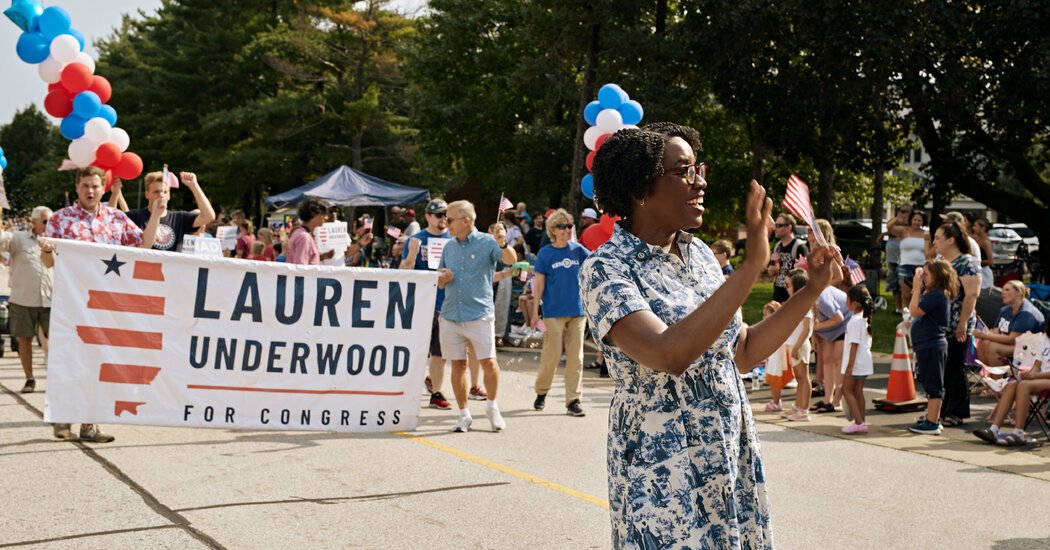
As majority-Black districts are blown up one by one, the future of Black representation in Congress could look something like Yorkville, Ill., where Representative Lauren Underwood joined the town parade on the Fourth of July. The congresswoman and her parents were among the few Black people in a sea of white faces along the mile-long route.
Or it could look like the majority-white House district in and around Denver, where Melat Kiros, an Ethiopian-born 29-year-old, made far more of her socialist ideology than her race to defeat the white incumbent, Diana DeGette, in last month’s Democratic primary.
Black representation in government will depend less and less on Black voters in the wake of the Supreme Court decision that rendered many intentionally drawn majority-Black districts unconstitutional. Instead, Black politicians will have to win more votes from people who do not look like them, whether by appealing broadly to a multiracial, multiethnic electorate, or ideologically to just enough like-minded voters to give them a majority.
“The idea that Black candidates are only electable in Black districts is patently false,” said Ms. Underwood, who is running for a fifth term after flipping a seat in 2018 that stretches from Chicago’s suburbs to Illinois’s corn and soybean fields.
After the Supreme Court weakened the Voting Rights Act in April, Republican states in the South moved quickly to dilute Black voting blocs, arguing that dispersing concentrations of reliably Democratic voters wasn’t racially motivated but a purely partisan quest for more Republican House seats. Alabama, Louisiana and Tennessee eliminated majority-Black districts first, but similar efforts loom ahead of 2028 in several other states.
In blue states such as Illinois and New York, Democratic leaders are likely to scatter highly concentrated Black voters into more suburban districts, trading Black urban seats won now by huge margins to more competitive districts that weaken Black voting power as they maximize Democratic seats.
Fears about dwindling representation hinge on the idea that Black candidates need Black voters to win office. But the data contradicts that: Already, about half of the more than 60 elected Black members of Congress represent multiracial, multiethnic constituencies in which Black voters are not a majority.
“The reason we don’t need racial gerrymandering in the United States of America is because you’re seeing Black candidates get elected in a lot of different places,” said Representative Byron Donalds, a Republican now running to be the first Black governor of Florida. “And that’s not a party question, that’s just a values question.”
Charles Bullock III, a political science professor at the University of Georgia, recalled a “Black tax” that used to cost Black candidates a certain percentage of votes on race alone. No more — in the twin Georgia Senate races of 2020, the Rev. Raphael Warnock, a Black Democrat, won his seat by a wider margin than his fellow Democrat Jon Ossoff, who is white.
In interviews, Black candidates and elected officials said they appealed to voters through a host of cultural and values-based issues — from faith and family, to health care and cost of living. They also said they connected on ideological lines, running as outsiders compelled to upset the status quo.
“Every district is unique, and we want to make sure that we are in tune with the needs of the district,” said Representative Marilyn Strickland, a Democrat from Tacoma, Wash. “My district is urban, rural, suburban. It has one of the largest military installations in the entire country.”
Ms. Strickland champions issues that help her relate her racial identity to the broader concerns of her constituents. Her Black father met her Korean mother as a U.S. Army soldier stationed in Korea, and pushing veterans services has allowed Ms. Strickland to combine her background with a politically popular position.
“The most successful Black candidates are people who are somehow able to walk that line to demonstrate, somehow, that they’re universalistic,” said Elijah Anderson, a sociologist at Yale University who studies how Black people navigate white spaces.
In 2024, Janelle Bynum pitched herself as a business-minded state politician and flipped a Republican-held seat that includes the suburbs of Portland, Ore., and the city of Bend, where less than one percent of her constituents are Black. She recalled door knocking for a State House seat in 2018 when the police received a call about a “suspicious person” in a neighborhood.
“You have to stay focused on the main thing, and the main thing is winning,” Ms. Bynum advised aspiring Black candidates.
Chris Jones, the Democratic nominee for a House district that includes Little Rock, Ark., and the neighboring suburbs, presents himself as a minister and the husband of a former combat flight surgeon. His campaign message centers on the affordability crisis.
When Mr. Jones was the Democratic nominee for governor in 2022, he introduced himself as a model minority, a physicist with a doctorate in urban studies from M.I.T., while his campaign videos extolled the importance of representation.
Now, explicit overtures about his race are limited.
“The time was different,” Mr. Jones said.
Another pathway for Black candidates is as an outsider, particularly on the left. Progressives such as Representative Summer Lee, a Democrat who represents Pittsburgh and surrounding Allegheny and Westmoreland Counties, have risen to power on kitchen-table policies, without an emphasis on race. Ms. Lee’s district is 73 percent white.
“Our race wasn’t so much about, you know, Black folks or Black issues,” Ms. Lee said. “It was about poor and working-class people.”
Ms. Kiros, the democratic socialist who just defeated a 15-term incumbent, said racial diversity was less important than representation “that can actually deliver the kind of equitable policies that would deliver liberation for Black people.”
Ideology can transcend differences the same way American-pie cultural ties evoke a broader sense of collective identity in less liberal districts.
“You’re finding candidates who understand how to tap into the phenomenon of outsider-versus-insider politics,” said Leah Wright Rigueur, a political historian at Johns Hopkins University.
In Detroit, Donavan McKinney is running as both an anti-establishment candidate and a racially conscious one in a district where Black people hold a small majority but are represented now by a progressive Indian American, Shri Thanedar.
“He’s not like us,” Mr. McKinney says of the incumbent in campaign ads, even as he courts left-wing voters through his association with the progressive insurgency group Justice Democrats.
Some Black politicians say that running as a Black candidate in a multiracial district does come with a higher hurdle to clear — “electability.” In 2018, Jahana Hayes was not the Democratic establishment’s preferred primary candidate when she ran in a Connecticut House district that was less than 10 percent Black. Ms. Hayes said she had worked “twice as hard” and leaned on her background as a schoolteacher who was once a teenage mother and had experienced homelessness.
“I went into communities that had never really voted for a Democrat, let alone a Black woman, and talked about the future I imagine for my children,” she said. “And just about everywhere, from the suburbs to the cities to the most affluent or the lowest income places, most people have a similar idea of what it is that they want.”
She trounced both her primary and general election opponents, both white.
“If I had listened to them,” she said, “I wouldn’t be here four cycles later.”