dailynewsnblog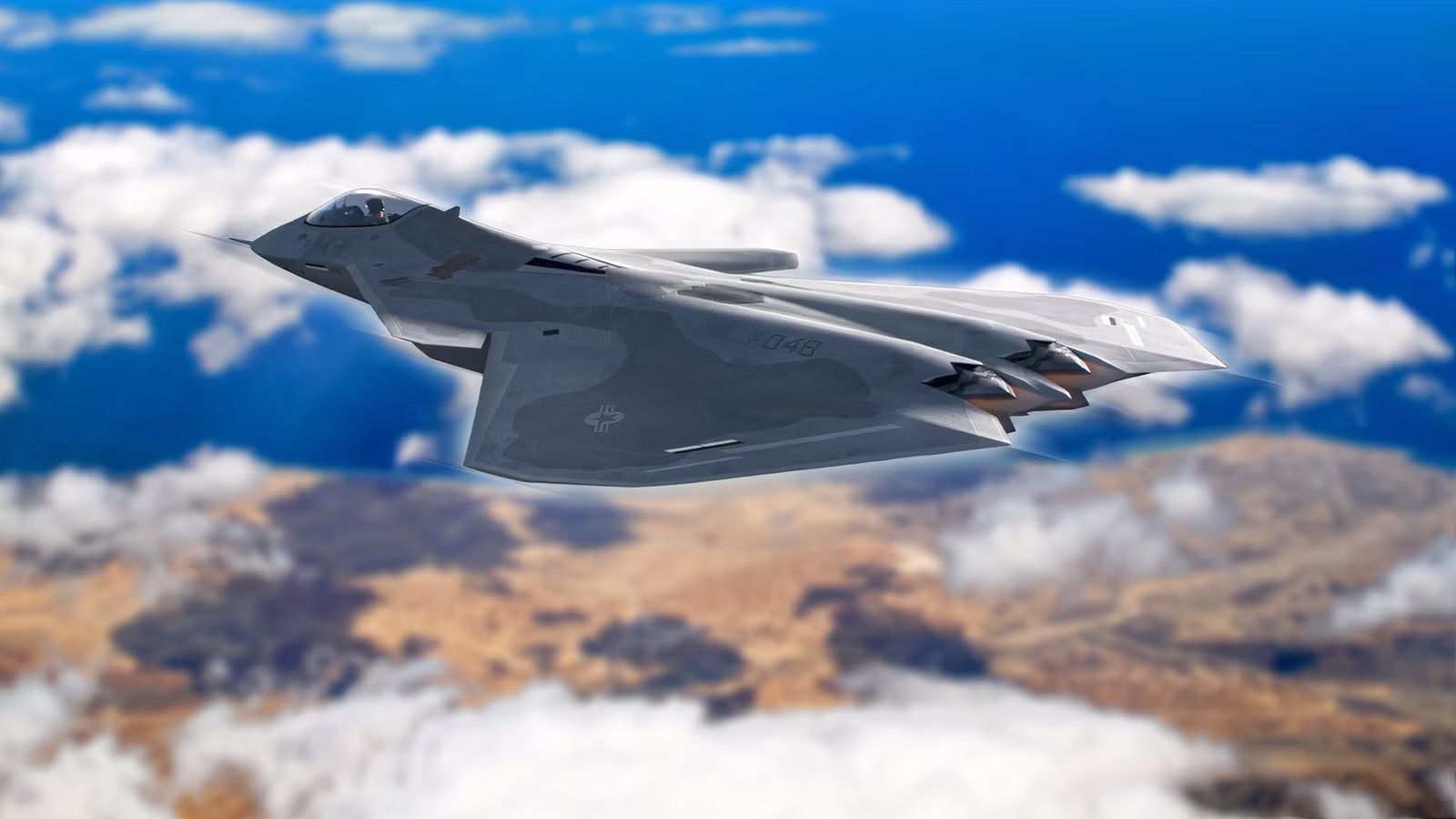
The future does not wait, and the march of technological progress is relentless. This is particularly evident in military technology, where much is to be gained, and much can be lost. While fifth-generation fighters like the Lockheed Martin F-35 Lightning II have captured headlines and have been the focus of countless think-tank reports, they are already being eclipsed by sixth-generation aircraft currently under development.
At the forefront of the American effort to develop this newest generation of combat aircraft is the United States Air Force’s (USAF) F-47. This aircraft will not simply consist of one pilot commanding one aircraft, but rather a system-of-systems that connects the pilot to a vast network of sensors, collaborative aircraft, and other platforms. Although the F-47 is expected to be significantly more expensive than the F-35, many analysts view the cost as necessary to maintain a commanding lead in air dominance, an advantage that could have an outsized effect on great-power competition, particularly in the Indo-Pacific region.
What is the F-47?

Under the USAF’s Next Generation Air Dominance (NGAD) program, the F-47, currently under development by Boeing, is expected to succeed the Lockheed Martin F-22 as the Air Force’s premier air-superiority fighter. The aircraft is intended to combine advanced stealth, long-range penetration, and air-control capabilities, enabling it to clear the skies ahead of follow-on forces while also conducting strikes against high-value targets, including command-and-control nodes, air-defense systems, and other critical military infrastructure.
Significantly, it has been claimed that the F-47 will have a 1,000-nautical-mile (1,852 km) range and will likely be capable of exceeding Mach 2. Additionally, it has been speculated that the aircraft’s propulsion will be enabled by an adaptive engine, a power source capable of providing improved thrust, efficiency, and cooling. General Electric Aerospace and Pratt & Whitney are known to have been working on their own versions of such an engine under USAF programs. An adaptive engine is capable of automatically adjusting its configuration to deliver the most efficient performance based on mission requirements.
By automatically shifting its airflow configuration to match the needs of the mission, such an engine can deliver higher thrust during combat, improved fuel efficiency during cruise, and increased cooling capacity for the advanced avionics and sensors present in a fifth-generation combat aircraft. These capabilities can extend an aircraft’s range, enhance performance and survivability, support more powerful onboard systems, and reduce operating costs compared with conventional fixed-cycle engines. Once installed, these advantages will allow an aircraft to remain in combat for longer periods of time at greater distances while improving its overall efficiency and effectiveness.
The F-47 is likely to feature an advanced AESA radar, providing extended range, high-resolution targeting, and integrated electronic warfare capabilities. It is also expected to be equipped with infrared search-and-track (IRST) sensors that detect and track aircraft without emitting radar signals. In addition, the aircraft will most likely incorporate a distributed infrared sensor system, similar in concept to that of the Lockheed Martin F-35 Lightning II, providing near-360-degree situational awareness of aircraft, missiles, and other threats.
With all the information these sensors generate, the aircraft will almost certainly employ advanced sensor-fusion processors that combine incoming data from onboard sensors into a single tactical picture. This reduces pilot workload and enhances mission efficiency. Additionally, defense experts have noted that the F-47 will likely make extensive use of an AI assistant to manage the vast quantities of sensor data, provide updates and potential courses of action for the pilot, and may have limited control over certain functions such as electronic warfare and countermeasures.
A Look At The Projected Price Tag

If all goes as the blue-uniformed generals and defense contractors are planning, the F-47 will propel US air superiority into the future at a time when— given the heightened tensions in the South China Sea—controlling the air domain is absolutely crucial. The program cost and unit cost are therefore viewed as necessary, particularly when America’s chief competitor, China, has already begun testing what is claimed to be a sixth-generation air dominance aircraft, the Chengdu J-36.
With the clock ticking in the next-generation air supremacy race, the FY2027 defense budget request includes roughly $5 billion (£3.7 billion) to accelerate development for the NGAD project. As reported by Air & Space Forces Magazine, the funding (seen below) is forecast to increase, before dipping in 2031, when the aircraft is slated to begin operational fielding.
F-47 Budget
YEAR | 2026 | 2027 | 2028 | 2029 | 2030 | 2031 |
|---|---|---|---|---|---|---|
(In billions) | $3.45 | $5.04 | $5.25 | $4.12 | $3.29 | $2.95 |
The per-unit price is widely reported to be around $300,000,000 (£224 million), and the baseline for this fleet is expected to be 185 aircraft. Given that the anticipated fleet size is 185+ aircraft, even a production rate of 20–30 aircraft per year would mean manufacturing could continue well into the 2030s and possibly the 2040s. However, if the budget remains strong and the challenge posed by China maintains its persistent scrutiny by policymakers, the fleet of F-47s could swell to between 250–300 aircraft.
To put this price into perspective, a single F-35, depending on the variant, costs anywhere from $80 million to $100 million (£60–75 million) per unit, while an F-15EX costs about $90 million (£67 million) each. Finally, the F-22, the aircraft the F-47 is set to replace, had a unit cost of about $150 million (£112 million) by the time the aircraft was nearing the end of its production run.
A Look At How The F-47 Will Operate Alongside Drones

One of the most intriguing aspects of the F-47 is that the aircraft will fly alongside drones or Collaborative Combat Aircraft (CCA), as part of the system-of-systems approach that will define sixth-generation fighter aircraft. The CCAs are not the low-end drones that may come to mind; they are highly sophisticated aircraft capable of conducting kinetic strikes, electronic warfare, surveillance, reconnaissance, and distributing vital information to other aircraft or platforms involved in a particular mission.
So vital is the CCA to the NGAD program that the USAF will likely spend approximately $8.5 billion (£6.33 billion) on developing these aircraft through the end of the decade. The plan is to procure up to 1,000 CCAs and assign two or more of them to an F-47 in order to further their missions.
To this point, the CCA will likely fly ahead of a formation, penetrate contested airspace, locate and destroy enemy air defense sites, degrade enemy electronic systems, locate further high-value targets and pass that information on for further strikes, and generally absorb risk that would fall on the crewed aircraft.
The F-47 & The Future Of Air Dominance

The F-47 will take US airpower decades into the future, particularly at a time when great-power competition is heating up. The U.S. military needs an aircraft capable of flying into contested airspace, which will be replete with layered missile defenses and enemy interceptor aircraft. Additionally, the aircraft will compete directly with the J-36, which has been seen during reported aerial evaluations. The F-47 cannot enter service quickly enough, as the Chinese aircraft will continue to mature as testing advances.
With an eye towards the Indo-Pacific, and with the aircraft’s advanced stealth features, adaptive engines and CCAs, the F-47 will be able to reach deep into hostile airspace, given that it is expected to have a 1,000-nautical-mile range. This will be important as U.S. carrier battle groups will be forced to remain outside the ballistic missile “bubble” that China has carefully constructed. In such a situation, the F-47 will help clear the way for follow-on strikes to be carried out by carrier-based fifth-generation aircraft.
For military planners, the F-47 is viewed as a critical capability, and there appears to be little that will significantly slow the program, given future contested operating environments and the need to stay ahead of peer efforts to develop similar platforms. The price tag is therefore considered acceptable, as any delay in the development and fielding of advanced sixth-generation platforms could lead to vulnerabilities an adversary might exploit, to the detriment of U.S. forward-deployed personnel, partner states, or homeland security more broadly.