dailynewsnblog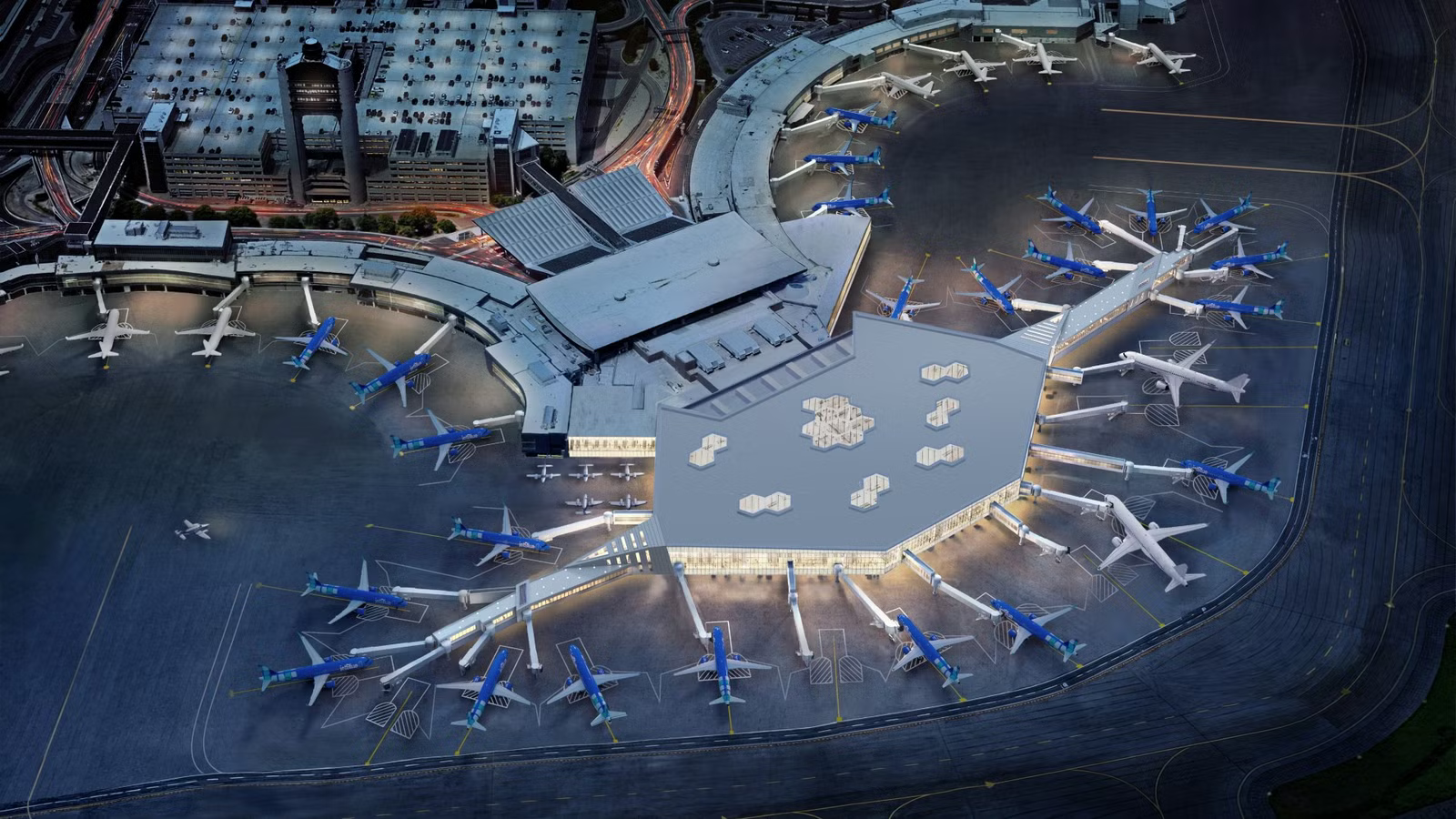
JetBlue Airways’ plans to transform its primary home at  Boston Logan International Airport (BOS) have taken a significant step forward after Massport’s board approved a proposal for a sweeping redevelopment of Terminal C. Valued at more than $1 billion, the project will replace much of the aging terminal with a modern, light-filled facility designed to improve passenger flow, aircraft operations, and the overall airport experience. Construction is expected to begin in about a year, with the redevelopment taking approximately four years to complete.
The project, highlighted by The Boston Globe, represents one of the largest infrastructure investments ever undertaken at Logan Airport and underlines JetBlue’s long-term commitment to Boston despite the carrier’s recent financial challenges. Boston has become JetBlue’s largest operation by passenger volume, with the airline carrying around 11.7 million passengers annually through Logan, accounting for approximately 27% of the airport’s total traffic. Logan itself handled more than 43.2 million passengers and approximately 407,000 aircraft movements in 2025.
A Modern Terminal Built Around Today’s Passenger Demand

Massport CEO Rich Davey noted that Terminal C was originally designed around traffic levels and aircraft sizes from the 1960s, leaving areas such as hold rooms, concessions and restrooms increasingly unable to cope with today’s demand. The urgency has only grown as Logan continues to experience record traffic. According to Massport, June alone saw approximately four million passengers pass through the airport, the busiest month in Logan’s history. Since 2010, annual passenger numbers have increased from around 27.4 million to more than 43 million, representing growth of almost 60%, while the average aircraft size serving the airport has also increased significantly.
The project itself is primarily focused on improving the passenger experience rather than increasing capacity: Davey stressed that “This is not about adding more gates. This is really about bringing us a modern terminal that can handle our current passenger flow.” A Massport representative highlighted the project’s initial roots, which stemmed from the airline itself.
“Our Board took a vote today to allow the Massport team to negotiate a term sheet with JetBlue and their development partner Vantage to renovate Terminal C. JetBlue approached us with this idea. The details are not finalized, and won’t be for a few months, and this will require future Board votes.”
JetBlue Is Investing In Its Largest Hub

Terminal C serves primarily as JetBlue’s home at Boston Logan, while also accommodating airlines including Aer Lingus, Cape Air, Etihad Airways, and TAP Air Portugal. Boston has become central to JetBlue’s network, with the carrier serving more than 70 nonstop destinations from the airport, including a growing portfolio of transatlantic services to London, Paris, Amsterdam, Dublin, and Edinburgh. The airport has become a cornerstone of JetBlue’s premium and long-haul strategy, making the Terminal C investment one of the airline’s most significant infrastructure commitments in recent years.
The redevelopment will be delivered through a partnership between JetBlue and Vantage Airport Group, the infrastructure company that played a leading role in the $5.1 billion transformation of New York LaGuardia Airport. Under the proposed structure, JetBlue and Vantage will finance construction before leasing the completed facility from Massport over an estimated 30 to 35 years, allowing construction costs to be recovered through the long-term agreement rather than direct public funding.
Davey dismissed concerns surrounding JetBlue’s recent financial performance, emphasizing the strength of the Boston market.
“The Boston market within the JetBlue network is really strong, and I think very financially viable, which is why you’ve seen JetBlue continue to make investments here while they have retracted, frankly, from some other markets because we are really important to their business.”
Efficiency Gains Extend Beyond The Passenger Experience

Although the redevelopment will not increase the number of gates, the redesign aims to make substantially better use of the available space. Plans include larger gate hold rooms, expanded passenger seating, additional concessions and restaurants, wider circulation areas, improved post-security passenger re-composure space, and a dramatic new central hall featuring soaring ceilings and hexagonal skylights.
The redesign also delivers operational benefits on the airfield. The existing “hammerhead” gate structures will be demolished and replaced with a single hexagonal extension that improves aircraft parking positions and taxi flows. The current layout forces aircraft to taxi through relatively constrained ‘alleyways’ before reaching the runway, contributing to unnecessary ground delays and engine idling. By repositioning aircraft stands and improving the terminal’s geometry, Massport believes it can streamline aircraft movements while reducing fuel burn during taxi operations.
Davey said the revised layout could cut greenhouse gas emissions from aircraft idling by 5% to 8%, providing environmental benefits alongside improved operational efficiency. The Terminal C redevelopment will also complement Logan’s wider modernization program, including the recently completed $800 million expansion of Terminal E, a new $450 million parking facility serving the international terminal, JetBlue’s forthcoming Boston lounge and a future American Express Centurion Lounge. Collectively, these projects represent well over $2 billion in airport infrastructure investment aimed at supporting continued passenger growth while modernizing one of the United States’ busiest airports.