dailynewsnblog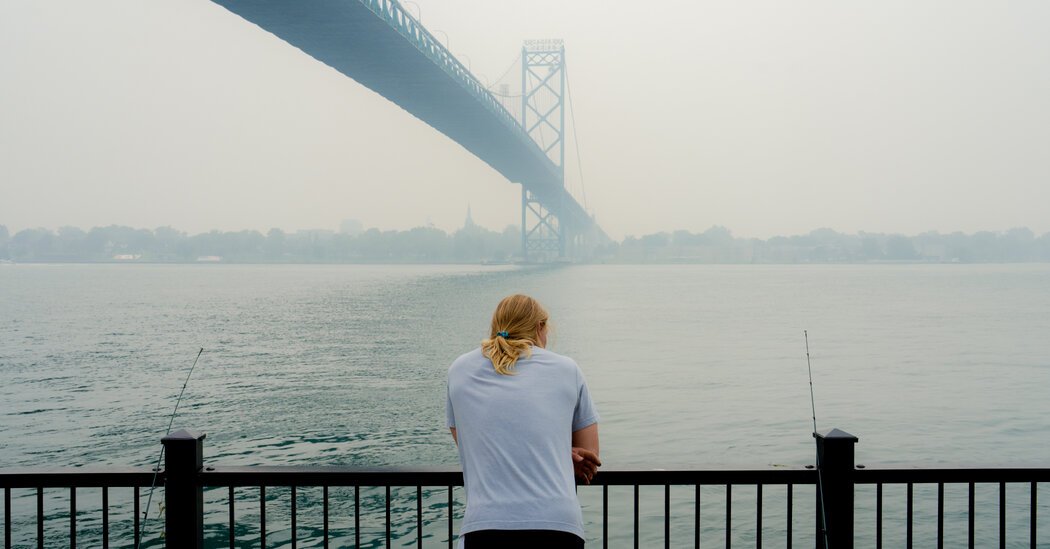
Air quality readings are expected to surge to unhealthy levels in New York City on Thursday as temperatures climb to the low 90s and smoke from the Canadian wildfires continues to darken the sky.
Levels between 151 and 200 mean that some people may experience negative health effects. The toxic air particles from wildfire smoke can cause coughing and wheezing, headache, stinging eyes, a scratchy throat, sinus irritation, chest pain, rapid heartbeat and fatigue.
These might be more serious for high-risk people including those with asthma and other chronic conditions. Children and pregnant women may also be at greater risk of negative health effects, according to the Centers for Disease Control and Prevention.
In Flushing, Queens, as a dull beige haze settled over the city on Wednesday evening, the National Women’s Soccer League match between Gotham FC and the Washington Spirit included four hydration breaks — a first for this season.
After the game, where Gotham won 1-0, Trinity Rodman, the Washington Spirit and United States national team star, said she wasn’t a fan of the continual interruptions, according to The Athletic, which is owned by The New York Times Company.
“Air quality was rough,” Ms. Rodman said. “Not to make excuses at all, but I think on both sides we were all like, ‘another break, another break, another break.’”
Elsewhere in the city, some residents wore masks to protect their lungs from the smoke.
Darwin Marte, 20, and Jordan Stevens, 19, both students at Brooklyn College, decided to put on masks at the urging of Mr. Marte’s father as they watched the skyline from the Brooklyn waterfront.
“It gives off the unsettling feeling of a liminal space,” Mr. Stevens said.
Mr. Marte recalled the Canadian wildfire smoke that drifted to New York City in 2023 and said that the latest conditions were another example of how climate change was affecting the environment.
Research suggests that extreme forest-fire years are becoming more common because of climate change.
“It’s not a good feeling,” Mr. Marte added.
Others weren’t as concerned.
“It’s just smoke, deal with it,” said Raj Advani, 44, a software engineer, while walking his dog. “This is how it is in Delhi every day.”
By 10 p.m. on Wednesday night, as thick plumes of smoke moved farther south of the Canadian border, New York City reached an air quality index of 192 — surpassing even that of New Delhi, a city known for having some of the worst air pollution in the world.
On Thursday, as New Yorkers woke up to a thick haze, Mayor Zohran Mamdani urged residents to limit their time outdoors.
“At unhealthy levels, everyone — not just people with asthma and heart conditions, not just older adults, everyone — may feel health effects,” the mayor said at an unrelated news conference. “So today, every New Yorker should take precautions.”
“This is very serious,” he added.
Cooling centers remain open, and the city is distributing free masks at locations including public libraries, firehouses, transportation hubs and police precincts.
Earlier Mr. Mamdani advised New Yorkers to “stay somewhere cool with air conditioning, limit your time outdoors, drink plenty of water and check on your neighbors — especially older New Yorkers and anyone with a health condition.”
The heat can make air pollution especially dangerous because it traps air in place, preventing toxic particles from dissipating.
Forecasters said that by the weekend another weather system was expected to push away the hottest air, easing the heat and smoke in the Northeast.
Until then, if you need to go outside, experts suggest wearing a high-quality, tightfitting mask, like an N95. And if you’re able to stay inside, it’s best to keep windows closed, run an air purifier and turn on the air conditioning.
Nate Schweber and Sally Goldenberg contributed reporting.