dailynewsnblog
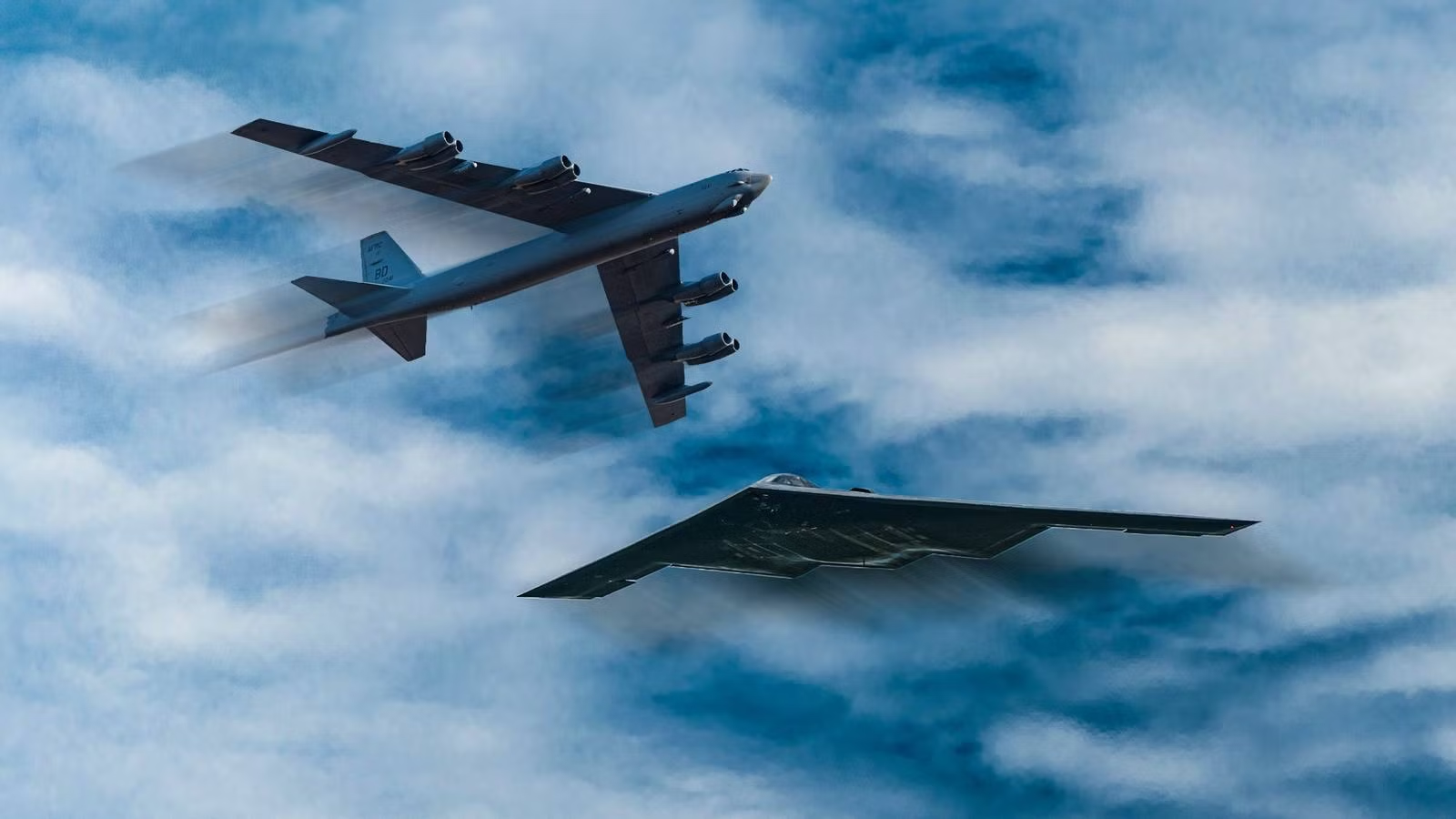
The Northrop Grumman B-21 Raider program is already underway, and the aircraft is the future of the US military’s long-range strike capability. The Raider is set to replace legacy aircraft, such as the B-2 Spirit and the Rockwell International B-1B Lancer. While the B-21 is set for operational service as soon as 2027, it will take time for the United States Air Force (USAF) to receive enough of the aircraft to finally and permanently retire both older bombers.
Therefore, the current plan is to continue operating both legacy bombers and, in doing so, fund modernization programs that will ensure they are capable of fulfilling their essential missions. Of the two older aircraft, the B-2 will receive the majority of the funding, reflecting the USAF’s priorities for long-range strike missions.
What Is The Current Status Of The B-21 Program?

Presently, due to the critical nature of the Raider program, Northrop Grumman and the USAF are accelerating the aircraft’s production capacity. To this point, the program partners have agreed to increase the pace of manufacturing by 25 percent, in a bid to ensure that the aircraft enters service by 2027, with a projected fleet size of 100. Detailing this development, Northrop’s CEO, Kathy Warden, has publicly stated that “Northrop Grumman has invested more than $5 billion in digital engineering and manufacturing infrastructure, and we are ready to produce B-21 faster.”
Highlighting the crucial nature and speed of the project and its strategic role, Secretary of the Air Force Troy Meink states the, “…B-21 is foundational to our long-range strike capability and to credible deterrence.” He further elaborates that accelerating “…production capacity now ensures we deliver operational capability to combatant commanders faster — strengthening our ability to outpace, deter, and, if necessary, defeat emerging threats. This is disciplined execution at the speed the security environment demands.”
According to Northrop, the dedicated professionals focused on the B-21 project consist of 8,000 industry and USAF personnel. Together, this team works on the airframe and its systems and subsystems, fabricates components, and tests the aircraft to ensure it meets all of its mission requirements. The broader ecosystem supporting its manufacture comprises more than 400 suppliers across 40 states.
The rapid proliferation and expansion of the requisite supply chain needed to support the Raider’s manufacture and sustainment indicates that the program has gained a very high degree of confidence among policymakers, military planners, and industry professionals. It is therefore highly likely that the aircraft will remain in production and subsequent modernization, for decades to come. Given this is the case, how will the USAF handle the increased need for dedicated deep-strike aircraft?
While Raider Manufacturing Is Speeding Up, Legacy Bombers Continue To Fill The Gap

In order to maintain its ability to carry out long-distance deep-penetration strike missions on a global scale, the USAF plans to invest $1.7 billion (£1.3 billion) to continue modernizing the B-1B Lancer and the B-2 Spirit over the next five years. This is in contravention of earlier plans to retire those aircraft in the early 2030s, before the B-21 enters service in large numbers.
In accordance with this plan to keep these bombers in service, the USAF will invest $1.35 billion (£1.02 billion) in its fleet of 19 B-2s, and the remainder, $342 million (£258 million), will be allocated to modernizing the B-1B fleet, which consists of 44 aircraft. This disparity in investment means the Spirit fleet will receive roughly 10 times more funding per airframe than the Lancer fleet, and it reveals that the Pentagon has prioritized stealth over speed and overall payload.
Furthermore, the B-2 is the only aircraft of the two that is capable of carrying nuclear weapons and the 30,000 lb (13,608 kg) GBU-57A/B Massive Ordnance Penetrator or “Bunker Buster”. The B-1, with its internal payload of 75,000 lb (34,019 kg), is equipped to carry a greater amount of conventional weapons.
Speaking to this, Colonel Mark Gunzinger (USAF Ret.), a former deputy undersecretary of defense and expert in strategic strike operations, has stated that the B-2s are likely to remain in active service for an extended period of time. This strategy would maintain the USAF’s stealth strike capability until the B-21s are in service in greater numbers.
Further, Col. Gunzinger expanded on the need to maintain the B-2 fleet by stating, the “B-2 is the only fully operational stealth bomber that we have, and frankly, long-range penetrating strike capability is one of the most significant shortfalls in our military. So why divest the B-2 early…?” While both the B-1 and B-2 fleets have had their service lives extended to maintain credible strategic global strike capabilities, newly minted B-21s already have their first basing assignment.
The Centrally Located Future Home Of The B-21

With the expected first arrival of the Raider in 2027, its first home base will be in the wide-open expanses of South Dakota. Specifically, Ellsworth Air Force Base —home of the 28th Bomb Wing— will house the first operational B-21s. The base is home to approximately 3,300 Air Force personnel and civilian employees and is one of only two bases that operates the Lancer.
The decision to base the B-21 Raider at Ellsworth reflects several advantages, including the installation’s existing bomber infrastructure, extensive training ranges, and its strategic location within the continental United States. As a result, the base has been described as a cornerstone of America’s strategic deterrence and long-range strike capability.
Situated near the geographic center of the contiguous United States, Ellsworth provides an ideal launch point for global bomber operations. With aerial refueling, a B-21 can reach virtually any region of the world within hours, giving the President a credible and flexible strategic response option while also providing combatant commanders with the ability to deliver precision ordnance against high-value targets anywhere on the globe. Given the immense importance of the airbase, requisite preparations have already been initiated to sustain the Raider.
Ellsworth AFB Has Made Great Progress In Preparation For Receiving The Raider

In an effort to prepare Ellsworth for operational use of the B-21, $2 billion has been spent on expansion projects that began in 2021 and accelerated in 2022. Of the previous sum, $161 million (£121,200,000) was allocated for a Low Observable Restoration Facility; this building will enable technicians to inspect, repair, and maintain the bomber’s radar-absorbent materials in a climate-controlled setting. A further $81 million (£61 million) for a Wash Rack and General Maintenance Hangar.
Additionally, Runway 31 required considerable work, which is required roughly every 50 years. As such, $129.5 million (£97.5 million) was spent on the runway reconstruction project. This effort entailed the removal and replacement of the top 12 inches of the runway’s center keel section, along the entire length of the 13,497 ft (4,114 m) runway, and the modernization of the airfield’s lighting and electrical systems. According to the Army Corps of Engineers, the project used “…106,000 tons of concrete cement, 105 miles of joint sealing and 83 miles of electrical conduit to deliver a durable pavement system and long-life lighting infrastructure.”
The Legacy Bombers Will Continue To Hold The Line

The move to continue operating the B-1 and B-2 bombers while waiting for the Raider to arrive in numbers means that the USAF will have the tools not only to maintain nuclear deterrence but also to engage in long-range strike missions with stealth capability. Such missions are essential for degrading enemy air defenses in preparation for further strikes by less-stealthy aircraft, as was seen in Iran during Operation Epic Fury. Additionally, having the Lancer and Spirit will also ensure that hard-to-hit, high-priority targets, such as key leadership figures and mobile missile launchers, can be taken out with precision, reducing collateral damage.
While the legacy bombers will continue to do their essential strategic and conventional missions, the fact that the necessary work has been completed at Ellsworth AFB in preparation for the arrival of the B-21 to this point, Secretary of the Air Force Troy Meink stated taking ownership of the new support facilities for the Raider “…is a step toward fielding advanced capabilities at scale…” he further stated that the “…infrastructure completed…is truly innovative, allowing us to preserve the technological edge and deliver the long-range deterrence our Nation depends on.”
When the B-21 is operational, the president and military planners will have an aircraft with what some analysts believe is a radar cross-section roughly comparable to that of the Lockheed Martin F-22 Raptor, despite the Raider’s much larger size. This is attributed to its advanced shaping, next-generation radar-absorbing materials, and modern manufacturing techniques. The aircraft’s advanced stealth capabilities will allow U.S. military planners to hold adversaries at risk, complicate their military calculations, and strengthen the United States’ strategic deterrence posture.