dailynewsnblog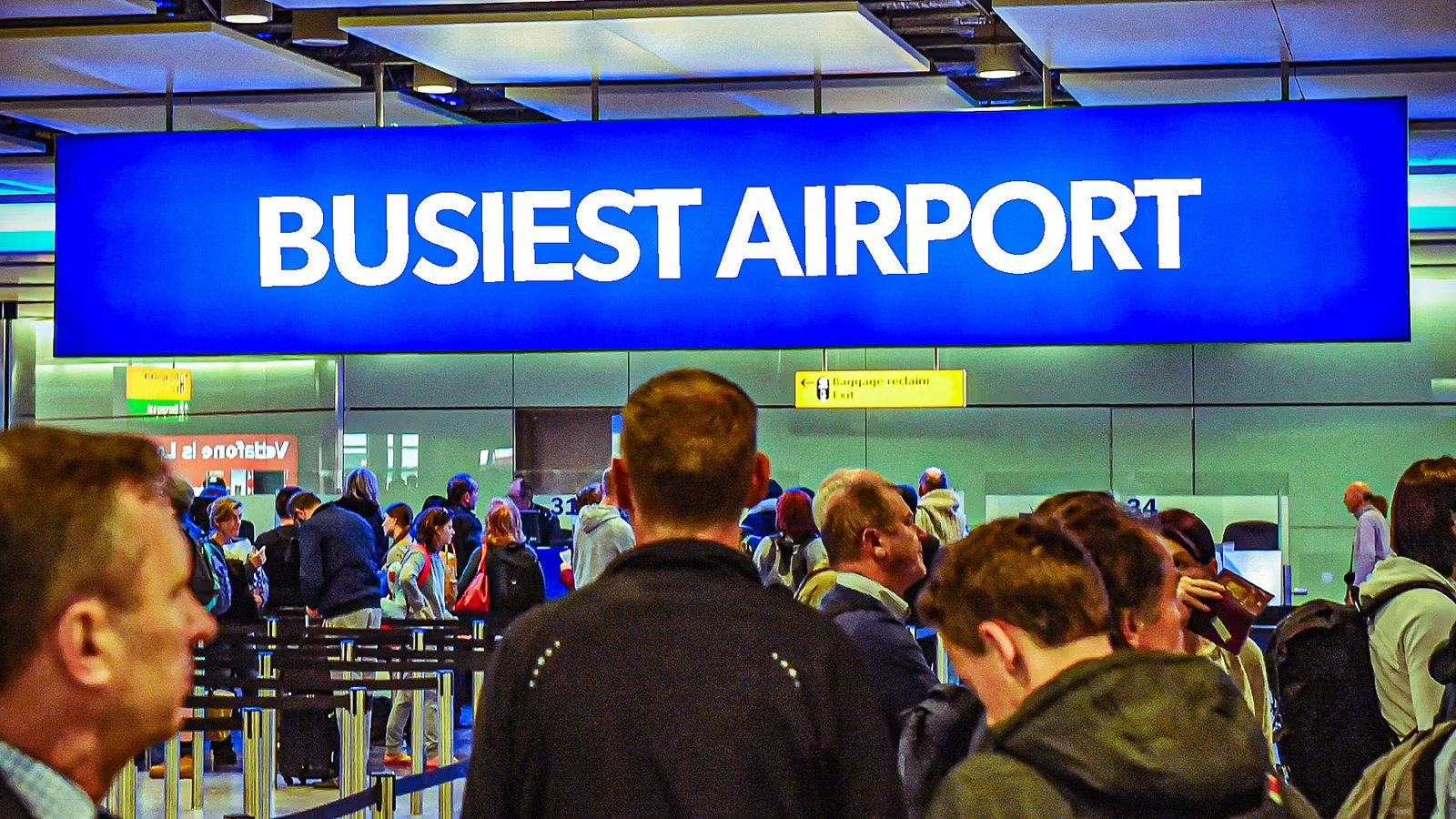
The question of which airport is the busiest in the world is more than just a piece of trivia for aviation enthusiasts. As travel demand continues to recover post-pandemic, the size and business of an airport help passengers anticipate wait times, helps airlines optimize their networks, and allows governments to prioritize massive infrastructure investments. For a facility to claim the top spot, it must manage a staggering symphony of takeoff and landing slots, coordinating tens of millions of passengers across hundreds of gates every single year.
While names like  London Heathrow or
  Dubai International often dominate the conversation, the busiest airport title frequently depends on how you measure it. The true winner differs when measured by total seat capacity, international arrivals, or aircraft movements. Using the latest data from airports around the world, this article will clarify which global hubs are currently leading the pack, exploring the shift between domestic-heavy giants in the United States and the explosive growth of international transit hubs in the Middle East and Asia.
A New Leader?

The short answer depends on whether you are looking at the full 2025 calendar year or the most current January 2026 data. For the entirety of 2025,  Hartsfield-Jackson Atlanta International Airport retained its title as the world’s busiest airport with 63.1 million seats. However, the start of 2026 has brought a historic shift. In January, Dubai International Airport has officially unseated Atlanta to claim the #1 spot globally, recording 5.5 million passengers to Atlanta’s 4.9 million.
This turnover highlights the difference between long-term dominance and current travel trends. While Atlanta is historically the busiest due to its massive US domestic network, Dubai is the undisputed leader in international traffic. In 2025, Dubai handled 62.4 million international passengers, over 13 million more than its closest international rival, London Heathrow. Dubai’s relentless growth, which has been up 16% since 2019, has finally allowed it to bridge the gap and surpass Atlanta’s total capacity in early 2026.
Beyond the top two,  Tokyo Haneda Airport consistently holds the third position with 55.4 million passengers in 2025. While the main three airports remain the same, the data shows a significant reorganization further down the list.
  Istanbul Airport has surged into 5th place globally, boasting a capacity 22% higher than its pre-pandemic levels, proving that the center of gravity in global aviation is shifting rapidly toward the Middle East and Asia.
Models, Location, And Infrastructure

Determining which airport is the busiest is not as simple as counting heads at the gate. Depending on which data set you prioritize, the winner can easily change. For example, an airport with hundreds of small regional jets might have more movements than a hub filled with massive Airbus A380s, even if the latter carries more people. As a result, looking at key metrics like total seat capacity, passenger throughput, and total aircraft movements helps narrow down the possible options.
The primary driver of these rankings is the hub-and-spoke model vs. the point-to-point model. Mega-hubs like Atlanta and  Dallas/Fort Worth act as central hubs for airlines like
  Delta and
  American, funneling millions of domestic passengers through a single point to connect elsewhere. Conversely, origin and destination airports like
  Los Angeles or London Heathrow serve as final destinations for more travelers, which often leads to higher congestion despite potentially lower total seat counts.
Beyond airline strategy, geography and infrastructure are especially of note. Crossroad airports like Istanbul and Dubai are taking advantage of the 8-hour flight radius to almost any major city in the world, capturing the growing middle-class travel markets in India and Southeast Asia. Additionally, an airport’s ability to expand its physical footprint, such as Istanbul’s massive six-runway plan, allows it to climb the rankings, while older, land-locked hubs like London Heathrow remain stuck, unable to add the capacity needed to grow further.
What Do The Experts Say?

Aviation analysts and airport CEOs view the busiest ranking not just as a trophy, but as a strategic roadmap for infrastructure and investment. Paul Griffiths, CEO of Dubai Airports, has been vocal about his goal to see Dubai International claim the absolute #1 spot. Following a record-breaking December 2025, when the hub serviced 8.8 million passengers, Griffiths has accelerated the airport’s growth timeline. He now projects that DXB will reach the elusive 100 million passenger mark by the end of 2026, a milestone originally not expected until 2027.
Industry experts at OAG and IATA point out that the growth in Istanbul and Dubai reflects a permanent shift in the global aviation balance of power. While Atlanta remains the king of the US domestic market, experts argue that its growth is tapering, up only 3% between 2023 and 2024. In contrast, the aggressive network expansion of carriers like  Turkish Airlines and
  Emiratesis funneling a new wave of international transit traffic through the Middle East, with IATA forecasting that 5.2 billion people will take to the skies globally in 2026.
Source | Projection | Implication for Rankings |
IATA | 5.2 Billion global passengers | Record-high load factors of 83.8% expected |
Dubai Airports | 100M annual passengers | DXB likely to beat ATL as total #1 by year-end |
OAG Analysts | +22% capacity growth for IST | Istanbul solidified as Europe’s primary gateway |
Aviation Week | Supply chain/aircraft shortage | Favors hubs with large, existing widebody fleets |
The implications of these insights show a clear revelation. The busiest airports are those that have invested in unconstrained capacity and can continually expand. Experts frequently contrast the success of Istanbul Airport, which recently recorded the highest connectivity growth in Europe, a massive 59% increase since 2019, with the physical constraints seen at London Heathrow. As long-haul travel continues to shatter pre-pandemic levels, airlines are prioritizing hubs that can accommodate aircraft like the upcoming Boeing 777X and Airbus A380, further cementing the lead of these super-hubs over traditional Western gateways.
One Mega Airport Or Six Combined?

While Atlanta and Dubai often dominate the busiest conversation, the answer shifts dramatically if we measure by aircraft movements, otherwise known as the total number of takeoffs and landings, rather than seat capacity. Under this metric, Chicago O’Hare and Dallas/Fort Worth frequently challenge for the top spot. These airports handle a higher volume of smaller regional jets making frequent short-hop domestic flights, and so they can technically be busier on the runways than a hub like Dubai, which focuses on fewer, but much larger, widebody aircraft.
Another alternative answer emerges when looking at city-wide airport systems. If you define busiest by the total number of people flying into a single metropolitan area, London typically reigns supreme. Between Heathrow, Gatwick, Stansted, Luton, City, and Southend, London’s collective airspace handles over 170 million passengers annually. This approach argues that the true measure of a busy destination is the combined strength of its aviation infrastructure rather than the performance of one single mega-facility.
Ultimately, these alternative metrics prove that the busiest label is often a matter of perspective. A pilot might consider Chicago O’Hare busier because of the intense frequency of radio chatter and taxiway traffic, while a logistics manager would point to Hong Kong as the busiest hub for global cargo. By contrasting these different data points, it becomes clear that while Dubai is the rising star of 2026 capacity, the traditional American hubs still maintain a strong grip on the sheer frequency of flight operations.
Capacity Limits Could Spell Disaster

Even for the world’s most dominant hubs, maintaining a busiest ranking in 2026 is fraught with operational and geopolitical risks. The primary drawback of extreme scale is infrastructure saturation. Both Atlanta and Dubai are currently operating at near-maximum capacity, meaning that a single disruptive event, such as a major thunderstorm in the American South or a record-breaking winter storm in Europe, can cause a cascading failure that grounds thousands of flights. For these giants, being the busiest often means being the most vulnerable to systemic delays.
Supply chain constraints also present a significant cap on growth. According to IATA, aircraft delivery backlogs from Boeing and Airbus are now so severe that a normalization of supply is not expected until the early 2030s. This creates a paradox: while travel demand is at an all-time high, the world’s busiest airports cannot always add the flights needed because airlines lack the physical planes. Additionally, Atlanta specifically faces a unique financial hurdle: the airport has already forfeited over $37.5 million in federal grants, part of a larger $1 billion six-year capital program, due to a local policy dispute with the FAA over federal grant requirements. This has already delayed several taxiway and terminal renovation projects.
There is a growing backlash against overtourism, and environmental regulations are becoming increasingly strict. While the Dutch government’s previous attempts to cap flights at Amsterdam Schiphol were met with legal challenges, the airport still faces intense pressure to reduce noise and emissions. In early 2026, Schiphol struggled with exceptional winter conditions that forced the cancellation of hundreds of flights, highlighting that environmental and weather-related instability can shift rankings overnight.
New Era, New Challenges

The definitive takeaway for 2026 is that the crown for the world’s busiest airport is currently in the midst of a historic transition. While Atlanta remains the statistical leader for the full 2025 calendar year with 63.1 million passengers, the monthly data from January 2026 confirms that Dubai has officially seized the top spot globally. This shift signals the end of an era in which American domestic dominance was untouchable, replaced by a new reality in which international transit and Middle Eastern super-hubs set the pace of global aviation.
This data reveals that busy no longer just means crowded terminals. Now it means highly optimized, tech-driven ecosystems. Airports like Dubai and Istanbul are evolving into cognitive airports that utilize AI-driven slot allocation and biometric boarding to manage record-high load factors.
Looking ahead toward 2030, the landscape is set to transform even more radically. The aviation industry is already preparing for the transition of major operations to  Al Maktoum International Airport, envisioned as the world’s largest airport, while hubs across the United States and Europe face the green ceiling of environmental regulations and funding disputes. Whether you measure by seat capacity, aircraft movements, or passenger satisfaction, the next generation of busiest airports will be defined by their ability to balance massive volume with sustainable, net-zero operations.
Catch what other trackers miss
Emergency squawks, holds, NOTAMs — live signals, no signup.
Open tracker
Catch what other trackers miss
Emergency squawks, holds, NOTAMs — live signals, no signup.
Open tracker