dailynewsnblog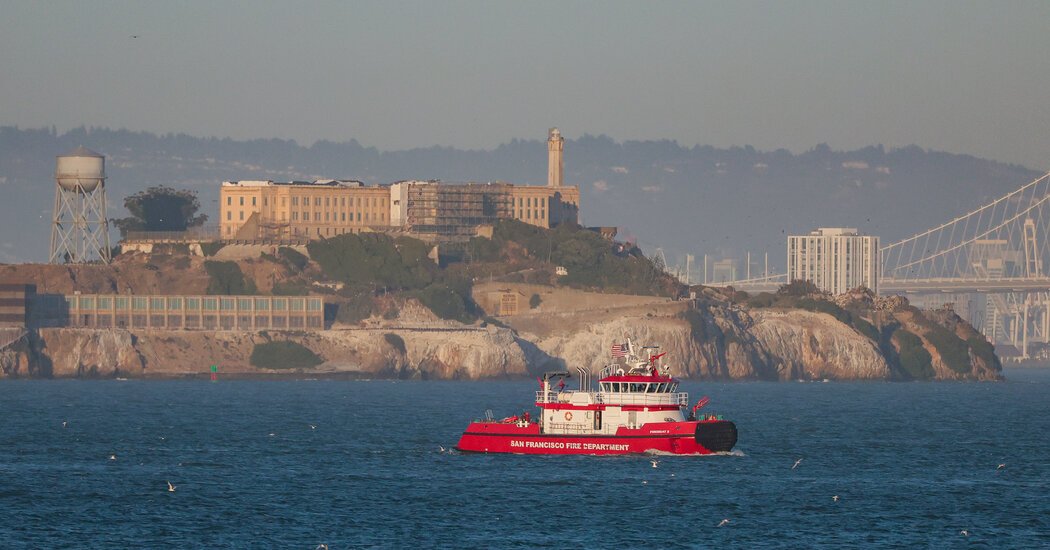
A recreational boat that sank in the San Francisco Bay on Tuesday, killing at least one person, was slammed by a wave before it rolled on its side and began to sink, officials said on Wednesday.
Of the 20 people onboard, 16 were rescued on Tuesday, and another three remain unaccounted for. One person, Clifford Joseph Boisa, 79, of Sutter County, Calif., outside Sacramento, was brought to shore in distress and died of his injuries.
The group were all close friends and family, according to the authorities, and had gathered to spread the ashes of a loved one in the bay’s waters.
The new details from officials about the minutes before the disaster offer the first clues as to why the three-deck, 49-foot cabin cruiser sank to the bottom of the bay.
Captain Jarod Toczko of the U.S. Coast Guard said at a news conference Wednesday that the boat, called the Volare, lost stability after being hit by a wave, and several people tumbled overboard as it rolled onto its right side. Others on the boat most likely became disoriented as the boat listed, he said.
After tilting, the boat began to take on water, he said. By the time rescue workers arrived, at around 3:30 p.m., the two lower levels of the boat were already submerged.
“All indications are that things happened very quickly when the vessel took on a wave over the side,” Captain Toczko said.
Several boats that were nearby raced over to help rescue people as the Volare began to sink. James Smith, 52, who was captaining a fishing boat, recalled seeing passengers clinging to the hull of the Volare as it sunk deeper. Others were holding onto the board of a windsurfer who came to help.
Some were atop the vessel, huddling on a portion still sticking out of the water. Many were in the water.
“In my career, I’ve never seen anything like this,” said Mr. Smith, who has operated charter boats for 40 years. “I’ve never even heard of anything like this.”
Scuba divers and helicopters on Wednesday afternoon were still searching for the three passengers who remained missing, Captain Toczko said, but they would stop at sunset that night. He noted that rescue crews had searched for nearly 24 hours and covered 950 square nautical miles.
“Suspending an active search is one of the most difficult things we do,” he said.
Rescue crews had not yet been able to find the sunken boat, which went under near Alcatraz Island, famous for its shuttered prison, in a part of the bay that is 130 feet deep with strong currents. Captain Toczko said that the missing passengers could have become trapped inside the boat’s two lower, enclosed compartments when it rolled.
The group on the boat had left from San Francisco and visited Angel Island, a scenic state park, before the accident. They likely set sail on Tuesday morning, when winds were light across the San Francisco Bay.
But, as they often do in the summer, the gusts picked up in the afternoon, creating choppier waters. The narrow passage between Alcatraz and the northern shore of San Francisco can act as a bottleneck that quickens the current and generates big waves.
At the time the boat capsized, “it was definitely a little breezier than what it normally would be, but not by a ton,” said Brian Garcia, a meteorologist with the National Weather Service. While there is no instrumentation on the bay that measures wave height, Mr. Garcia said that waves may have reached about four feet high.
The authorities did not identify the boat captain, but said he had been brought to a hospital and has since been released.
John Edward Boisa of Stockton, Calif., owns the Volare with his wife, according to registration documents.
Mr. Boisa, a younger brother of Clifford Boisa, the man who died, had posted on social media about earlier trips on the boat. He did not respond to voice mail messages left on his phone on Wednesday.
Christine Kaplan, who runs a boating fuel center that hosted rescue workers’ emergency operations on Tuesday, said that the entire group of survivors — who largely appeared to be older than 50, she recalled — was drenched when they were brought ashore. Some had bruises and scrapes on their heads. Others were missing their shoes.
“It was very scary,” said Ms. Kaplan, 72. “Everyone was cold and wet, didn’t look like anybody didn’t get into the water.”
Aaron Anfinson, 49, had been captaining a recreational fishing boat when he was alerted to the sinking Volare. He was one of the first to arrive, and saw several people in the water clinging to floating boards, he said.
Mr. Anfinson said that some of them had life jackets, but some did not, and there was no life raft in sight. He said he tossed extra life jackets to those who needed them.
He spotted one woman in the water with a head wound, he said. So he and his brother pulled her aboard and applied first aid, while a smaller boat continued to collect people from the water.
At the Wednesday news conference, Captain Toczko thanked good Samaritans for initially notifying officials about the disaster and for helping pull people from the waves. “You saved lives,” he said.
Amy Graff contributed reporting and Kirsten Noyes contributed research.