dailynewsnblog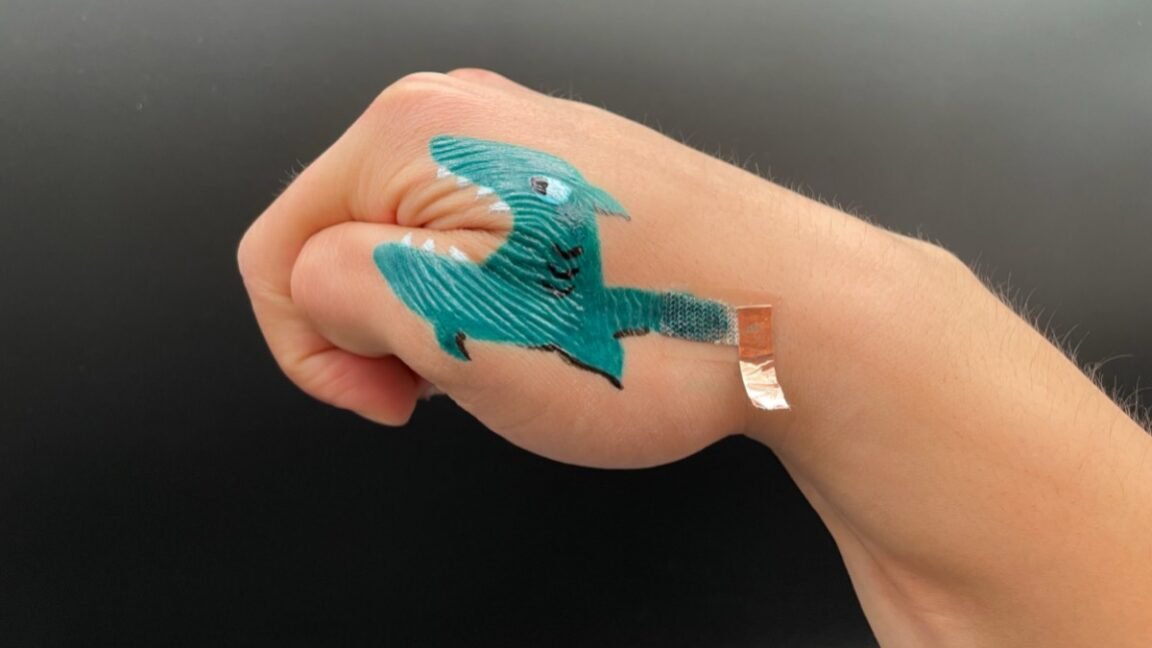
Scientists at Pennsylvania State University have developed a novel conductive ink that can be painted directly onto the skin in colorful custom designs, turning into a functional electrode for biomonitoring after drying. They described their work in a new paper published in the Proceedings of the National Academy of Sciences (PNAS).
As previously reported, epidermal electronics attached to the skin via temporary tattoos (e-tattoos) have been around for more than a decade. So-called e-tattoos connect to skin without adhesives, are practically unnoticeable, and are typically attached via temporary tattoo, allowing electrical measurements (and other measurements, such as temperature and strain) using ultra-thin polymers with embedded circuit elements.
However, these e-tattoos have their limitations, most notably that they don’t function well on curved and/or hairy surfaces, as well as requiring personalized electrode placement design to cover larger areas, since biosignals are spatially distributed. So scientists have been getting creative. For instance, in 2024, researchers developed special polymer-based conductive inks that can be printed onto a person’s scalp to measure brain waves, even if they have hair. This could one day enable mobile EEG monitoring outside a clinical setting, among other potential applications.
Penn State mechanical engineer Larry Cheng, a co-author of the new PNAS paper, has been working on electrode designs for biomonitoring applications for more than 10 years, including EEGs, ECGs (for heart activity), and EMGs (for muscle contractions). Using rigid materials, like metals, makes for a stable biomonitor, but it is easily dislodged when the wearer moves too much, such as during exercise. Hydrogels have emerged in recent years as alternative materials, since they can absorb water, swell, and stretch with the body’s skin during movement. But hydrogels degrade rather quickly and lose those benefits with prolonged use.
As easy as face paint
Sweat or hair can also reduce the accuracy of recording biosignals. That’s because commercial electrodes are prefabricated and then applied to the skin, creating an air gap that weakens sensor readings. Cheng et al. decided to develop their conductive ink to address that issue. They mixed together several different kinds of polymers and acidic additives in a water-based ethanol/polyvinyl alcohol solution. PEDOT:PSS—aka poly (3,4-ethylenedioxythiophene): poly (styrene sulfonate)—provided electrical conductivity, along with DBSA (4-dodecylbenzenesulfonic acid), which also served as a plasticizer to give the ink flexibility.