dailynewsnblog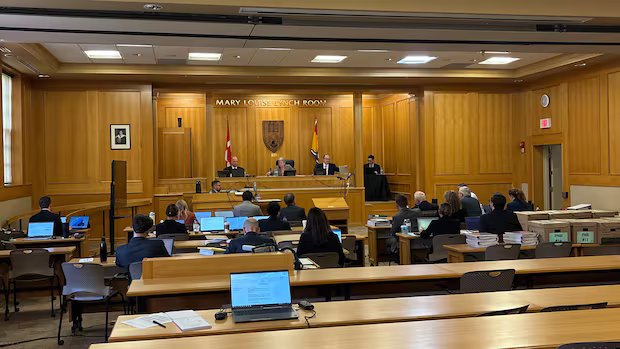

Listen to this article
Estimated 4 minutes
The audio version of this article is generated by AI-based technology. Mispronunciations can occur. We are working with our partners to continually review and improve the results.
The New Brunswick government is pushing back on accusations that it discriminates against out-of-province contractors, arguing that an Ontario company is trying to inflate a routine contract dispute into a major internal-trade issue.
A lawyer for the province told a panel hearing the company’s complaint that comparisons between government actions and Donald Trump’s protectionist tariffs were “just colour” without any concrete evidence backing it up.
“This case is simple,” lawyer Mark Heighton told the hearing.
“It’s a contractual dispute between the province of New Brunswick and Julmac, and the fallout from the contract dispute.”
He made the comments during his opening arguments on the second day of the hearing convened under the Canadian Free Trade Agreement.
The 2017 accord committed provinces to reducing protectionist barriers between them.

Julmac Contracting Ltd. alleges the province discriminated against it by forcing it to use costlier materials than local companies, being less flexible on penalties for missed deadlines and taking longer to review and approve plans.
On Monday, Julmac’s lawyer, David Outerbridge, said that the province’s actions and Trump’s tariffs were “variations on the same wrong-headed idea” about protectionism.

New Brunswick lawyers dispute accusation that it applied unfair standards to out-of-province company.
Julmac’s complaint revolves around its contracts for the Anderson Bridge replacement in Miramichi and the refurbishments of the Mactaquac Dam bridge, parts of the Centennial Bridge in Miramichi and the Nashwaak Bridge in the Marysville area of Fredericton.
Heighton said Julmac’s evidence did not reveal “a single instance” of discrimination, and the company was using it as a diversion from its $29.4-million breach-of-contract lawsuit against New Brunswick.
The five-day hearing is the first ever held under the current version of the Canadian Free Trade Agreement.
A panel of three trade lawyers from Ontario and British Columbia is hearing the case over five days this week. Three other provincial governments, Ontario, Nova Scotia and Saskatchewan, are intervening in the hearing.
On Tuesday, another lawyer for the province, Conor O’Neil, cross-examined Julmac president Derek Martin about his claims.

Most of the discussion was detailed and technical, but at one point O’Neil pointed out that after Julmac was removed from the Centennial Bridge project, it was taken over by Dexter Construction — a Nova Scotia company, not one based in New Brunswick.
Martin disagreed with his logic, saying that decision used a different process.
O’Neil also cross-examined an Ontario engineer who created the designs for Julmac’s work on the Centennial Bridge.
In a pre-hearing witness statement, Tamas Kalenda backed up Julmac’s claim that the province was holding the designs to “a higher standard” than those produced by New Brunswick-based companies.
The company argues frequent notes and requests for changes created delays that raised Julmac’s costs, putting it at a competitive disadvantage compared to local contractors.
“It’s not about whether the comments are valid or not,” Kalenda said Tuesday. “It’s about whether others [within New Brunswick] get those comments.”
O’Neil pointed out that five regional, national and international engineering firms had criticized Kalenda’s designs.
“All five of them found your designs were inadequate,” he said, suggesting this explained the volume of comments and requests for changes from New Brunswick.
Kalenda estimated he gets comments and change requests on about 50 per cent of his design work in New Brunswick, and about 20 per cent when the work is outside the province.
In his opening statement, Heighton accused Julmac of “a complete retreat” from its initial claim of discrimination under the internal-trade agreement.
In its arguments last year against a summary dismissal of its complaint, Julmac said the province discriminated against it “on every project, at every level.”
This week, Heighton noted, the company argued that the Canadian Free Trade Agreement panel only had to find a single example of different treatment to prove discrimination, a far cry from its earlier claim of systematic favouritism.
“It has retreated from that characterization,” Heighton said. “That is not accidental.”
Julmac is not seeking damages in the case.
The company is asking for a finding that New Brunswick violated the trade agreement and a recommendation that it treat out-of-province contractors the same as local companies.
The hearing is scheduled to end on Friday.