dailynewsnblog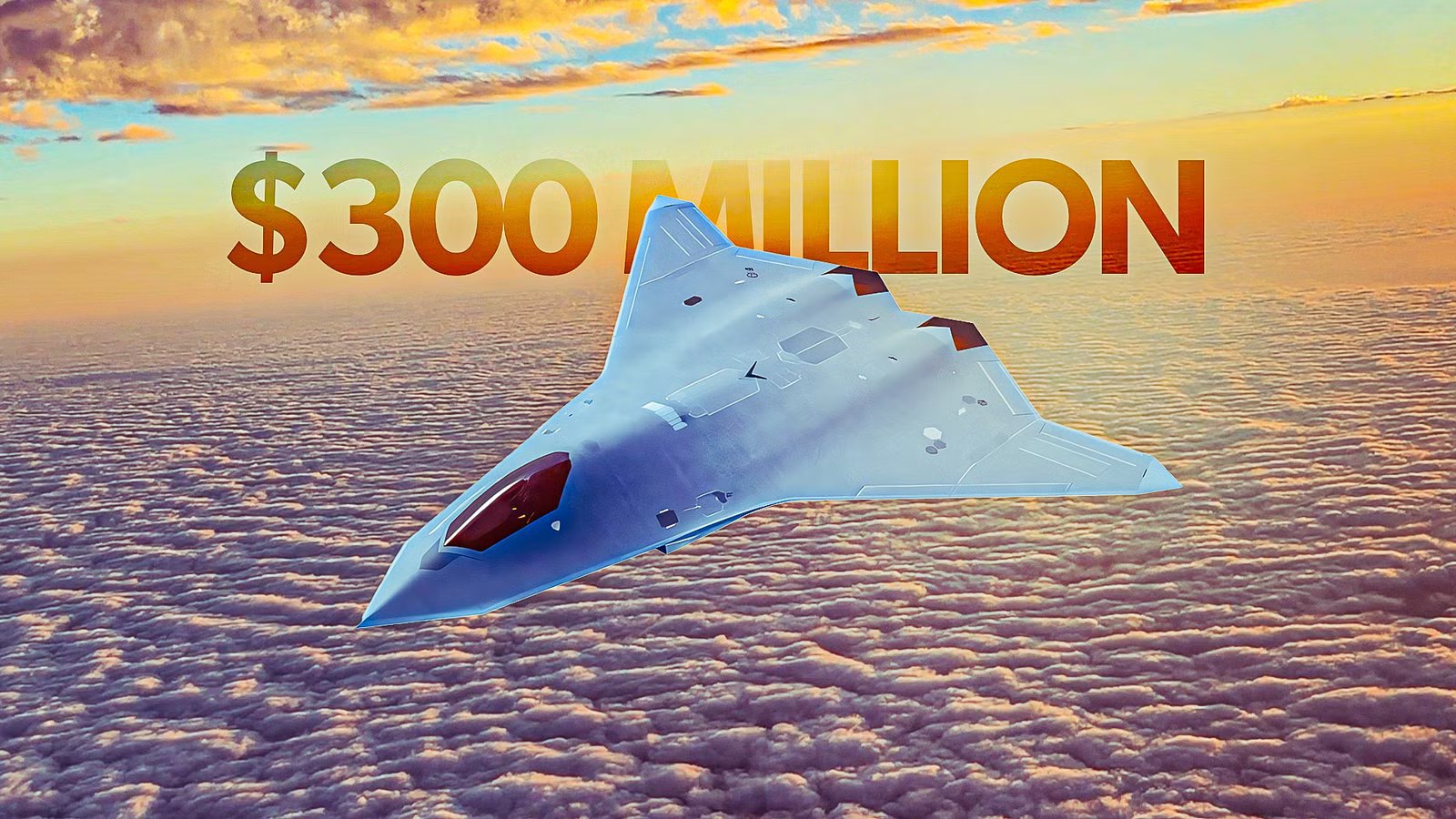
The race to build the first sixth-generation fighter jet is well underway, with the United States and the People’s Republic of China competing to be the first to produce a fully combat-capable example. While the People’s Liberation Army Air Force made headlines in late 2024 by test-flying two different prototypes, the US program has been quietly testing new designs since 2019. When Boeing was awarded the contract for the F-47 Next Generation Air Dominance in early 2025, the program jumped into the spotlight.
The Department of Defense has declared that the F-47 will cost $300 million per airplane, and the total fleet size is anticipated to be between 185 and 200 planes. These numbers have raised the question about future force levels when compared to the progress made by the PLAAF. Although the two prototypes that flew in 2024 are far from ready for the front line, the fifth-generation fighter program has been steadily ramping up in the background.
The fleet of Chengdu J-20 Mighty Dragon stealth fighters is expected to exceed 1,000 strong by 2030. Although these are closer in comparison to the Lockheed Martin F-35 Lightning II, the Joint Strike Fighter is lacking range and performance to compete with it in every scenario. So the question is, will there be enough next-gen fighter jets to sustain credible deterrence in the future, with a maximum of only 200 F-47s on the way?
By The Numbers: The Air Force Of The Future

Doing a casual surface-level comparison of fleet numbers between the US and the Chinese next-gen fighter fleets is very often misleading, as the numbers can be skewed heavily based on a number of conditional facts. First and foremost, the US will actually have dramatically more stealth fighters even after China begins producing sixth-generation stealth planes because the fifth-generation fleet of F-35s will still far outnumber the J-20 and likely the forthcoming aircraft as well.
Despite the fact that the F-35 JSF program has suffered a number of setbacks due to technological hiccups since its introduction, there are still over 1,200 flying today. That number is expected to double, or even reach over 3,000, based on the current backlog of orders. Add on to that anywhere from 100 to 185 of the Northrop Grumman B-21 Raider sixth-generation stealth bombers, 1,000 or more ‘loyal wingman’ advanced drones, and then 200 F-47s.
The US alone accounts for more than 2,400 JSF orders between the US Air Force, Navy, and Marines. Meanwhile, some of the largest operators outside of America are also located in Asia, namely Japan and Australia. The Royal Navy of the United Kingdom also routinely cruises aircraft carriers with F-35B ‘jump jets’ aboard in the Pacific. The combination of all these assets represents the true force of coalition air power in the region.
All of these aircraft function as an interoperable ‘system of systems’ between next-gen platforms and international operators. So while America’s fleet of stealth jets will not solely be dedicated to freedom of navigation and deterrence in Asia, they will be complemented by many supporting platforms. Additionally, the US Navy is still pursuing the development of these sixth-generation F/A-XX fighters, which could potentially be a carrier-capable variant of the F-47. Adding a dozen or two of these onboard one of America’s 11 super carriers also greatly improves the Joint Defense posture overall.
Deterrence Through Technological Superiority

There are various alarmist ‘dog whistles’ infiltrating the conversation surrounding next-gen fighter jet programs around the world. Specifically in reference to the US and PRC, the perception on social media and many public platforms is often a poor representation of reality. The rapid, iterative progress displayed to the public has been a very effective PR campaign for the PLAAF; however, the assessment made by the Pentagon shows a massive technological disparity.
China indeed plans to produce large numbers of the J-20 in order to extend its air power presence over the Asia-Pacific region. It is also true that it is performing a parallel development of what appears to be a land-based and carrier-capable sixth-generation fighter. The aspect that is often exaggerated is the maturity of these programs and how advanced they are relative to similar developments in the US and the Western security bloc.
Although the NGAD has not made as much high-profile progress, the technology anticipated to be built into the plane far outstrips the capabilities of the aerospace sector of the PRC defense industrial base. A good example is the fact that the Chengdu J-36 has three engines instead of just one or two, as is typically found on a fighter jet. It is reflective of the crucial fact that the development of jet engines in China is decades behind that of the US and European aerospace manufacturers.
Hearts On Fire: The NGAP Program

The Boeing F-47 will be powered by Next Generation Adaptive Propulsion, currently in development by both Pratt & Whitney and General Electric. These power systems will make the aircraft dramatically more fuel-efficient as well as extremely high-performance, unlike any plane ever before. They will also produce an enormous amount of electrical power that will run the ‘supercomputer’ level avionics packed inside the F-47 and possibly even directed energy weapons, or lasers. But equally crucially, they will be extremely difficult to detect using thermal sensors.
The J-20 has recently been upgraded with WS-15 engines that do improve the plane’s performance and likely reduce its thermal signature; however, they still fall well short of even the powerplants installed on the much older Lockheed Martin F-22 Raptor. As 19FortyFive detailed, short of a major technological breakthrough, it would be very difficult for the J-36 or the twin-engine Shenyang J-50 next-gen prototype to match what is in development in the US.
Overreliance On Exquisite Weapons Systems

There is one problem with the plan for the AFOTF, which the Pentagon is currently working to remedy. As shown during Operation Epic Fury, US forces are highly vulnerable to costly losses in prohibitively expensive equipment and weapons that are slow to produce during periods of intense conflict. The F-47 would be another example, as the plane’s extremely high cost per airframe and exceptionally complex systems position it neatly at the top of the most exquisite systems in the US inventory alongside the B-21.
The Air Force is continuing to procure Boeing F-15EX Eagle II 4.5-Gen fighter jets to support its fleet of advanced F-35 and F-47 fighters. These aircraft are not much cheaper than the F-35; however, they do pack significantly more punch per plane and are far more rugged with a higher level of readiness on average, thanks to their tried-and-true systems. The venerable Boeing B-52 Stratofortress is also undergoing a massive overhaul to bring it up to the new J-standard; it will allow it to complement any of these next-gen aircraft as a standoff ‘mothership’ or ‘missile truck.’
Making The High-Low Fleet More Survivable

The key that brings the new ‘high-low’ fleet together on the battlefield is interoperability through data-link, which not only makes it possible for legacy airframes with new avionics to fight effectively alongside next-gen jets, but also to do so with international allies. Meanwhile, the true mass of the future fleet will be provided by low-cost drones. The loyal wingman, or CCAs, will cost about one-third that of an F-35 and have the ability to support any of these data-link-equipped aircraft.
All of this is based on lessons learned from not only past operations and forecasts of future military requirements, but also very recent events. The US military burned through a massive supply of extremely expensive missiles to counter Iranian low-cost drones like Shahed during hostilities this year. In order to prevent a massive drain on readiness and equipment that is both extremely expensive and very slow to resupply, the CCAs and 4.5-Gen aircraft will be an important component of the AFOTF high-low fleet.
Increasing Allied Investment In Next-Gen Fighters

Across the pond, Europe is ramping up next-gen development, even as the Future Combat Air System has been downgraded to merely a collaborative combat aircraft development between Spain, Germany, and France. The Global Combat Air Program is advancing under the trilateral leadership of the United Kingdom, Italy, and Japan, with the Edge Wing joint program office being established earlier this year. Germany and Canada are both considering joining GCAP, India, and other European nations at varying levels of investment.
GCAP does not have any flying prototypes, but it is following a very similar model to the American NGAD. The technology proposed under GCAP, or the BAE Tempest, far exceeds that estimated to be possible with either of the Chinese prototypes. The GCAP is expected to be very similar to the F-47 in terms of systems, performance, and capability. Crucially, it will also be made as an interoperable platform to function as a ‘quarterback’ in the joint ‘kill web’ in any battle space around the world where there are coalition forces.
This is an important element to consider for the balance of air power in the Pacific, as Japan is one of the founding members of the GCAP program and will procure a significant number for its Air Self-Defense Force. Meanwhile, while it’s unlikely that Royal Air Force Tempests will spend much time in the Pacific, the loyal wingman drones being developed in Europe under the umbrella of GCAP are expected to be deployed aboard the RN aircraft carriers to support RAF and Royal Air Arm F-35Bs.
Although videos leaked from Chinese social media through the ‘Great Firewall of China’ paint a picture of massive technological progress, their credibility evaporates upon even a modest amount of analysis. So while it is true that the small number of F-47s and Tempests, and their very high price tag, carries risk, the overall strategy behind the planes’ procurement aims to create a multi-layered defense network not reliant on just one exquisite aircraft.