dailynewsnblog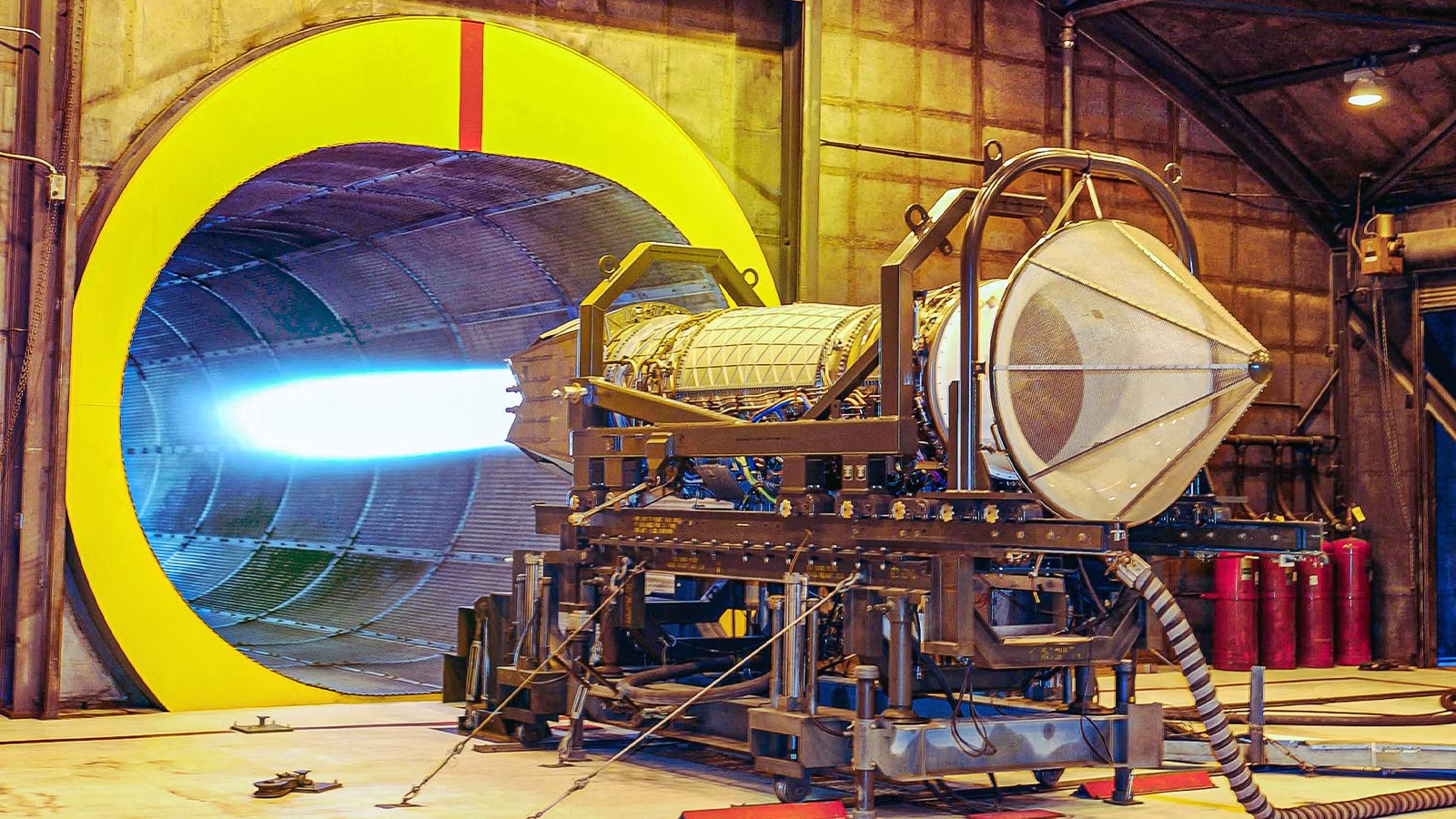
The Lockheed Martin F-22 Raptor was built as a generational leap over the existing F-15 Eagle. The F-15 Eagle was designed as an air superiority fighter, but by the 1980s, the Air Force felt it might not have the “unfair” advantage that they wanted, as the Soviet Union developed the Su-27 and MiG-29. The F-22 was initially designed as a late Cold War effort to overmatch any fighter jets the Soviets could field.
The program started with the Advanced Tactical Fighter (ATF) in 1981 and eventually entered service in 2005. A next-generation fighter jet needed a next-generation engine. The Air Force selected the Pratt & Whitney YF119. While the F119 became what is arguably the most advanced fighter jet engine of its time, the pragmatism of the Air Force was also on display as it elected not to choose the even more capable (but risky) competing YF120. Here is what to know about the engineering marvels and requirements of the F119 powering the Raptor.
The Parallel Engine Competition

The history of the F-22’s engine was unlike that of previous aircraft. It is useful to think of the F-22 competition as two parallel competitions: one for the aircraft itself, by Lockheed and Northrop, and one for the engine, by Pratt & Whitney and General Electric. Each prototype had to compete with both engines, allowing the Air Force to compare the engines independently of the airframe.
These engines were not evolutions of the older engines powering the F-15 and F-16. These were new engines that needed to sustain supersonic cruise without afterburners, have much reduced infrared signatures, be exceptionally reliable, produce greater thrust, be compatible with thrust-vectoring nozzles, and achieve better fuel economy.
Pratt & Whitney and General Electric were selected by the Air Force to produce prototype engines for the program that would lead to the F-22. These prototype engines were designated the YF119 and the YF120, respectively. Both of these companies provided engines for the two demonstrator aircraft: the YF-22 (by Lockheed/Boeing/General Dynamics) and the YF-23 (Northrop/McDonnell Douglas).
The Pratt & Whitney And GE Solutions

Pratt & Whitney’s design philosophy was comparatively conservative from an engineering point of view. It opted to design an extremely advanced fixed-cycle low-bypass turbofan, instead of an entirely new engine cycle. PW sought to reduce maintenance, achieve a very high dry thrust, make supercruise a practical function, maximize reliability, and more. It used single-stage high- and low-pressure turbines, counter-rotating spools, stealth-compatible rectangular thrust-vectoring nozzles, and more.
While these technologies were cutting-edge at the time, they were also individually understood. General Electric’s solution (the YF120) was even more ambitious. It developed one of the world’s first true variable-cycle fighter engines. This added a third airstream. This functions a bit like a car’s transmission, allowing the driver to select the optimal gear. The engine was efficient at low and high speeds. It had an extremely high dry thrust, excellent fuel efficiency at supersonic speeds, and a variable bypass ratio. During flight testing, the YF120 outperformed the YF119 in some respects.
The YF120-powered YF-22 supercruised faster, and the YF120-powered YF-23 supercruised at around Mach 1.72 (the F-22 with the F119 supercruises at around Mach 1.58). Even though the YF120 had higher thrust, acceleration, and high-speed efficiency, the Air Force opted for the more conventional YF119. The Air Force cited reduced risks, a more mature design, and industrial concerns for its decision. It seems the YF120 was ahead of its time.
The Three Engineering Issues

Before the F119 (and YF120), there was a long-standing belief that jet engine designs could not simultaneously maximize high thrust, low fuel consumption without afterburners, and low observability with a lowered infrared signature. The F119 is often cited as proving that assumption wrong, at least to some extent. The F119 provides around 35,000 lbf of thrust with afterburner, while the engine’s high-pressure core and advanced thermodynamics allow it to supercruise.
Before the F119, engineers had assumed that more thrust hurt fuel efficiency, while better fuel efficiency lowers the maximum thrust. Additionally, a lowered infrared signature hurt engine performance, while a lower radar signature reduced airflow and efficiency. At the same time, a smaller engine reduced thrust output. The F119 found a way around these dilemmas, offering a way to balance trade-offs that had been difficult to optimize simultaneously.
With the sixth-generation fighter jet engines now in development, these three factors are more important than ever. Next-generation aircraft are to be larger, power more systems, are expected to have a longer nonrefueled range, and have a considerably lower infrared (heat) signature. Simple Flying has previously explained how thermal management is one of the most challenging aspects of next-generation fighter jet engineering, as well as being one of the challenging issues of upgrading existing 5th (F-22 and F-35) fighter jets.
The F119 Marvel Of Engineering

It would be hyperbolic to say the F119 solved three design difficulties considered mutually exclusive, and, arguably, the YF120 did a better job. Still, a Pratt & Whitney brochure boasts, “Pratt & Whitney’s F119 is the world’s first fifth-generation fighter engine. The F119 combines stealth technologies and vectored thrust performance to provide unprecedented maneuverability and survivability with a high thrust-to-weight ratio.”
It adds, “The ability to operate supersonically with an afterburner — supercruise — gives the F-22 exceptional combat performance without compromising mission range.” The F119 developed into one of the most formidable fighter jet engines ever built. When the Air Force moved on to develop the F-35, it opted for the F135 derived from the F119, instead of an all-new engine. It claims the F119 engine has achieved a best-in-class safety record since its introduction. No F-22s have been permanently lost solely to an in-flight engine failure, although there have been uncommanded engine flameouts and an engine fire that destroyed an F-22 on the runway.
Lockheed Martin F-22 Raptor (per US Air Force) | |
|---|---|
Powerplant | 2x Pratt & Whitney F119-PW-100 |
Thrust | 26,000 lbf (120 kN) thrust each dry, 35,000 lbf (160 kN) with afterburner |
Top speed | Mach 2.25 |
Supercruise speed | Approx. Mach 1.5 |
Inventory | Approx. 183 (about 145 combat coded) |
The excellence of the F119 can also be seen in its derivative the F135, powering the F-35. While the F-35 gets extensive press coverage for any mishap, the engine’s safety record is remarkable. Whereas the F-22 is a double-engined aircraft (able to land on a single engine), the F-35 is single-engined, meaning its loss is irrecoverably catastrophic. Even so, there have been only two confirmed F-35s lost in mishaps solely from an in-flight failure of the F135 engine, even though the aircraft is now ten times more numerous than the F-22. These were both during take off/landing.
The F-22 Remains The Top Supercruiser

Supercruising is flying above Mach 1 without afterburners. While the older F-15 Eagle may have the same or slightly higher top speed at altitude, perhaps around Mach 2.5, it is limited by fuel use. To achieve sustained supersonic speeds, the Eagle needs to engage its afterburners, essentially dumping fuel in the engines. This collapses its range and makes it impractical for anything more than a burst.
Supercruising remains an elite club, with the Eurofighter Typhoon also supercruising at around Mach 1.3. The Rafale is thought to trail the Typhoon somewhat in supercruise, but is still able to do it. The Chinese J-20 is widely thought to be a supercruiser. While the Russian Su-57 should be able to do it, the aircraft should be better at supercruising when it eventually receives its delayed Saturn AL-51 (also known as “Izdeliye 30”).
It is thought that next-generation fighter jets will double down on supercruising, although little is publicly known. In 2025, the Air Force released an infographic that shows the F-15EX with a combat radius of 690 nautical miles, the F-22 with a combat radius of 590 nautical miles, and the F-35A with a range of 670 nautical miles. Crucially, it lists the F-47 as having a combat radius of 1,000+ nautical miles. The autonomous FQ-42s and F-44 CCAs are listed as having a range of 700+ nautical miles.
Return To The YF120 Ahead Of Its Time

Around 40 years later, the Air Force is returning to the adaptive-cycle design the YF120 offered for its next-generation F-47. Here, history is again repeating itself. The Air Force has already selected the Boeing F-47 over its Northrop Grumman and Lockheed Martin demonstrators, but it has not publicly announced which engine will power the F-47.
Pratt & Whitney and GE Aerospace (formerly General Electric) are now developing two adaptive cycle engines as part of the Next Generation Adaptive Propulsion (NGAP) program. Pratt & Whitney is developing the XA103, while GE Aerospace is working on its XA102/XA100. These are to incorporate heat-resistant ceramic matrix composites, be in the 45,000 lbf class, and to provide the electrical power and thermal capacity required by advanced sensors, electronic warfare systems, and other onboard electronics.
These engines also have to grapple with advanced next-generation thermal management from the extensive electronics sixth-generation aircraft are to have. The Air Force is reportedly working to have scaled versions of these adaptive cycle engines for its Collaborative Combat Aircraft in development. They will also need to power many electronics, manage heat, and be able to operate over long distances unrefueled. Separately, Rolls-Royce is believed to be leading an effort to develop an adaptive cycle engine for the UK-led (with Japan and Italy) GCAP/Tempest 6th-generation fighter jet program.