dailynewsnblog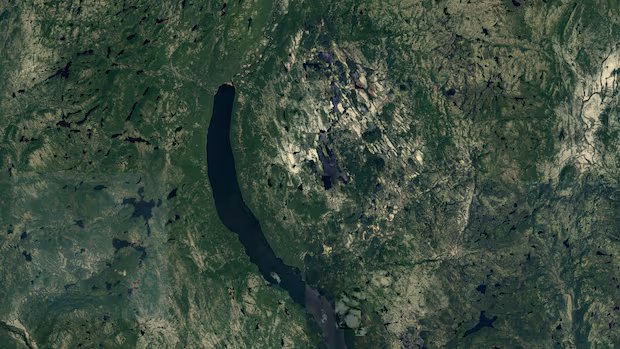

Listen to this article
Estimated 4 minutes
The audio version of this article is generated by AI-based technology. Mispronunciations can occur. We are working with our partners to continually review and improve the results.
Amateur astronomer Joël Lapointe stumbled upon what he thought looked like a suspicious pit in Quebec’s Côte-Nord region while he was wandering with his Google Maps cursor in 2024.
He was simply trying to plan his camping vacation when he spotted something unexpected on his screen — what researchers recently confirmed is a previously unidentified, 390-million-year-old meteor crater.
“It was quite an exciting discovery,” said Gordon Osinski, a planetary geology professor at Western University, who was among the four-person team that confirmed the crater by travelling to the site in 2025.
Osinski, who runs Impact Earth — a website dedicated to verified impacted sites — is used to getting a lot of emails from the public signalling potential new craters. Many are false alarms.
“It just goes to show, while nine out of 10, or 99 out of 100 might not be, there could always still be that one that will surprise you,” he said. “This is the first for me.”
Next month, in Germany, Osinski will present the team’s research abstract at the annual congress of the Meteoritical Society — an international organization dedicated to promoting research in planetary sciences.
A difficult, rugged, field expedition
Following Lapointe’s discovery which made headlines across the province in 2024, Osinski and Jérôme Gattacceca, a geologist at the European Centre for Research and Teaching in Environmental Geosciences, set out for the crater.
Over five days, the team gathered photos and samples to bring back to labs in both France and Ontario, for study.

But getting to the site was far from simple.
“It was one of the hardest field expeditions I’ve ever done,” said Osinski, who has worked “all over the world, six continents.”
The terrain was rugged and overgrown, he said. And the float plane bringing them in had to leave the team 50 metres offshore — forcing them to wade to land with their gear, said Osinski with a laugh.

Team discovered impact melt rock, shatter cones
There are only about 200 known meteor craters in the world, and at 25 kilometres in diameter, this one is likely among the biggest discovered in a number of years, said Osinski.
On the trip, the team found big cliffs of what Osinski said is impact melt rock – created from the temperature and pressure of an impact.
“You can melt literally tens of cubic kilometres of the Earth’s crust when you get a big enough asteroid hitting,” he said.

He had initially assumed the team wouldn’t find this kind of evidence in the eroded crater.
“But we found some really spectacular examples,” he said. “I’m still quite blown away.”
Another goal of the expedition was to identify shatter cones — traces left in the rock by shock waves that are found exclusively in impact craters or at nuclear bomb test sites, as explained by Jérôme Gattacceca in an interview with Radio-Canada.

The geologist found them on the second day of the group’s mission.
The field research allowed them to sample and identify rocks formed during the impact, enabling them to date the crater at 390 million years old — an age that’s relatively average in geology, said Gattacceca.
Discovery is a ‘beautiful lesson,’ said geologist
Gattacceca said this case is a “beautiful lesson that our planet, even though we have studied it a lot, still holds beautiful surprises and continues to amaze us.”
In an email sent to Radio-Canada, Lapointe, the amateur astronomer, said he was very happy with the news that the crater had been confirmed.
“It’s not every day that an ordinary citizen finds a 390-million-year-old crater,” he wrote to Radio-Canada. He also saluted the choice of the crater’s name, called Uhackatik, which was established in consultation with the Innu Council of Ekuanitshit.
“I encourage everyone to not ignore intuition or an observation, even if it isn’t part of your field of expertise,” he wrote.