dailynewsnblog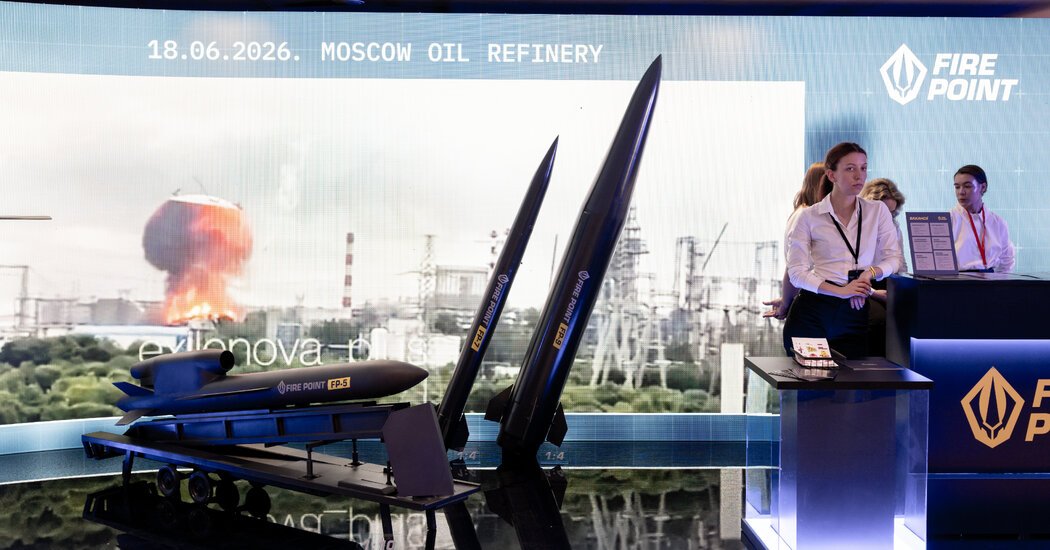
When President Trump announced last week that he would allow Ukraine to begin production of Patriot ballistic missile interceptors, at least one Ukrainian company had a head start on producing its own version of a desperately needed air-defense system.
The Ukrainian defense firm Fire Point is rolling missiles off assembly lines and stockpiling them with plans to shoot down Russian ballistic missiles. Never a particularly modest company, Fire Point has also declared a loftier intention for its interceptors to form the future backbone of missile defense across Europe.
“You can use our interceptor like the core element of a Pan-European, antiballistic missile shield,” Fire Point’s chief designer, Denys Shtilerman, said in an interview at the Eurosatory defense exhibition in Paris last month. The company is negotiating with European defense contractors for advanced components like ground radars.
After starting the war outnumbered, outgunned and seemingly outmatched, Ukraine has transformed itself into a war machine, fighting Russia to a virtual standstill. Its military increasingly strikes deep into Russian territory with weapons made by Fire Point and other companies. Fire Point has emerged as a national champion in the effort to take the fight to Moscow, producing drones as well as a cruise missile with a cheeky nickname, the Flamingo.
Knocking ballistic missiles out of the sky is a much harder task. Experts cautioned that building a missile defense like the U.S.-made Patriot system — the only weapon provided to Ukraine that is proved to regularly intercept ballistic missiles — is extremely complicated.
President Volodymyr Zelensky of Ukraine has said it could take 12 months to get the new system up and running. Between striking deals for components and integrating and testing the system, that could be optimistic.
“The most challenging type of missile you’ll ever build is a missile system meant to intercept high-velocity missiles,” said Fabian Hoffmann, a senior research fellow at the Norwegian Institute for Defense Studies in Oslo, a research group.
“Missile defense is the Champions League of missile manufacturing. This is where things are really difficult,” said Mr. Hoffmann, who also writes the newsletter Missile Matters. “If there’s any margin of error, your system will miss.”
While drone warfare has defined much of the conflict, military planners in Moscow appear to understand that Ukraine cannot reliably shoot down ballistic missiles and have ramped up production, and attacks, accordingly. Russia is on pace to set a monthly record for ballistic missile attacks, firing 70 ballistic missiles at Ukrainian cities so far in July. Only nine were intercepted, according to a New York Times data set based on numbers from Ukraine’s Air Force.
A Patriot battery — a mobile, surface-to-air defense system — includes not only interceptors but also advanced radar, a control van and missile launchers. Once radar detects an incoming missile, the Patriot battery fires interceptors to bring it down.
The system is expensive to operate. The most advanced Patriots can cost more than $3.7 million per missile. Air-defense doctrine calls for firing at least two interceptors at a target — known as shoot, shoot, look — though Ukrainian operators often fire just one to conserve their dwindling stockpiles.
Mr. Shtilerman sounded almost blasé about the technical challenges involved in manufacturing such a system. “Everything was done like 60 years ago,” he said, referring to the first Soviet ballistic missile intercepts.
Ukraine has begged the United States and other Western allies for more Patriots for years, with Mr. Zelensky issuing increasingly dire warnings about shortages. On July 6, Ukraine’s Air Force said it had failed to intercept all 23 ballistic missiles launched by Russia overnight.
But Ukraine apparently kept some Patriots in reserve. Overnight Monday into Tuesday, Ukraine managed to intercept five of eight Russian ballistic missiles.
Mr. Trump’s promise that Ukraine could begin making Patriot missiles was a significant goal for Mr. Zelensky, and could help ensure the country’s safety in the long run. But it will most likely take years to come to fruition.
Mr. Zelensky met in Paris on Monday with European leaders including President Emmanuel Macron of France. Mr. Zelensky said he discussed the proposed missile defense system spearheaded by Fire Point. “I believe Europe can provide itself with enough protection against any ballistic threat,” he wrote on X after the gathering. “And Europe can also become a strong contributor to global security.”
With a worldwide shortage of Patriot missiles after four years of war in Ukraine and the U.S. conflict with Iran, countries have begun to look for alternatives. When demand outstrips supply so completely, new companies will inevitably try to fill the gap.
Estonia’s Frankenburg Technologies, a weapons start-up, has plans to build its own antiballistic missile defense system. “This is a geographic, political, historic reality that also forces us to develop our capabilities that are tailored to the imminent threat that we have now,” said Kusti Salm, Frankenburg’s chief executive.
One South Korean air-defense system got its first combat test in the United Arab Emirates this year. Germany has spent billions of dollars buying Arrow-3 missile defense systems from Israel.
There is a growing sense among some European officials that, after Mr. Trump’s demands that they take responsibility for their own security, they cannot rely on the United States as the supplier of essential systems. Alternatively, putting too much faith in a Chinese supply chain poses risks as well.
Ukraine must aim for “technological sovereignty,” Fire Point’s chief executive, Iryna Terekh, said at an event on the sidelines of the Paris defense expo. “We do not want to rely on partners who show themselves as unreliable,” she added.
Ukrainian companies had the most visitors and buzz at their booths at the sprawling convention. Soldiers in camouflage posed in front of a Flamingo cruise missile, bathed in pink light. A winged attack drone hung from wires on the ceiling like a pterodactyl in a natural-history museum.
Slogans like “Love at ❤️ First Strike” and “Engineering at the Speed of War” were projected on the walls, along with shaky videos of attacks on Russia. On June 18, Fire Point screened footage in its booth that purported to be that day’s explosion at an oil refinery in Moscow.
Fire Point began operations in January 2023. The company said it had gone from 18 employees that year to 7,000 employees by June 2026.
As its sales topped $1 billion last year, Fire Point found itself embroiled in investigations over how the Ukrainian government is awarding military contracts. Mr. Shtilerman denied allegations of corruption.
To keep down costs, the Ukrainians improvise in a way that established military contractors are unaccustomed to. In the early days of the war, “you probably saw a lot of things flying on Ukraine in the frontline made of pipes for toilets, and it still works,” Ms. Terekh said.
She described looking for an alternative to the most expensive epoxy resins for aviation, and finding a version for boats in Britain that was cheaper, easier to acquire and performed as well in tests.
“You never know what kind of undiscovered technology could help you,” she said.
Fire Point said it hoped when produced at volume to keep the price per interceptor below $1 million. Mr. Shtilerman said the company’s interceptor would be more like the earlier iteration PAC-2 Patriot missiles rather than the PAC-3, which is the most effective for shooting down ballistic missiles.
“Maybe the next generation, but it’s OK, we must solve the existing problem,” Mr. Shtilerman said.
“They’re downplaying the challenge,” said Mr. Hoffmann of the Norwegian Institute for Defense Studies. “When it comes to ballistic missile defense, operational ingenuity can only get you so far. There’s a technological element to it.”
Mr. Shtilerman, in turn, saw it as the latest problem that would have to be solved. “You just need to sit and read the proper books,” he said. “That’s all.”
Kim Barker contributed reporting.