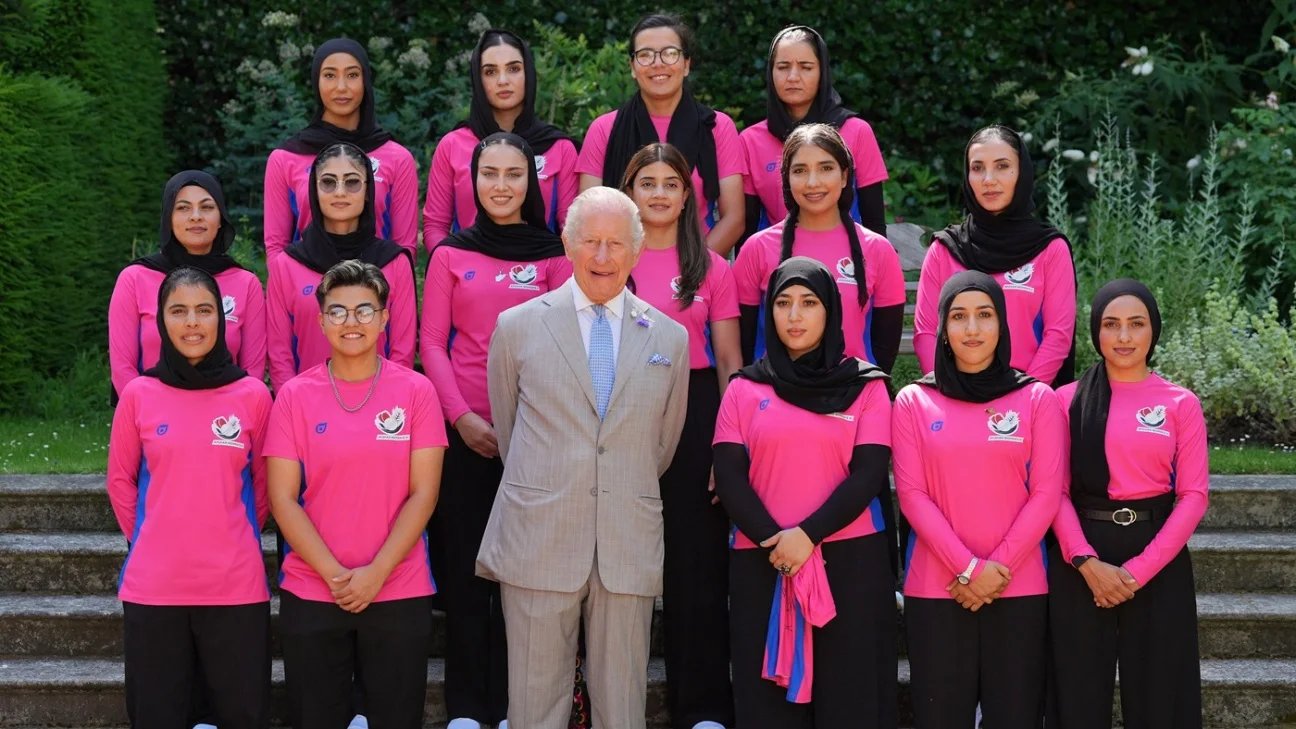
The ICC have, for the first time, put a timeline on the potential participation of an Afghan refugee women’s team in qualification pathways. The women, many of whom were first contracted by the Afghanistan Cricket Board (ACB) in 2020, could be part of ICC events by 2030 as the ICC re-constituted a Special Taskforce to oversee a roadmap for an Afghan refugee women’s team at its Annual Conference in Edinburgh.
The decision does not mean that the women can play as Afghanistan, as they remain without the backing of the ACB as the Taliban-led Afghan government continues to severely curtail women’s rights, but it will allow the team to play competitive cricket at the international level under a different name.
The ICC’s Special Taskforce includes representatives from the BCCI, the ECB and Cricket Australia who have not been joined by new ICC independent director Dr Ros Rivaz and ICC Chief Executives’ Committee member Sarah Keane, the CEO of Cricket Ireland. Together, these members will develop a plan to ensure the Afghan women’s refugee XI have a programme of training and fixtures to build towards 2030. Should it succeed, an Afghan women’s team could play international cricket for the first time.
Although the ACB had committed to developing a women’s team – in line with the conditions of their Full Membership in 2017 – and were on their way to doing so, the Taliban’s return to power in 2021 ended those plans. By that point, the Afghanistan women’s team had never played an international and over the course of the year, most of them fled Afghanistan and resettled in Australia, with a few living in Canada and the United Kingdom. An Afghanistan Women’s XI played together for the first time in January 2025 in Melbourne and have since been on two tours: to India in 2025 to coincide with the women’s ODI World Cup and to England in 2026, against the backdrop of the T20 World Cup.
Funding for these trips an ICC support initiative which included the BCCI, ECB and CA as well as the fund-raising campaign Pitch Our Future and will now continue through similar channels. The Special Taskforce will also oversee a development pathway programme for the Afghan refugee women which will include access to coaching and physiotherapy in the players’ home locations, where they will continue to play in local environments, and opportunities for the players to train and tour as a group.
For the players, the latter, especially, keeps them connected. “This programme has already made a real difference to us, not only by helping us continue playing cricket, but by enabling us to come together and play as a team,” Nahida Sapan, an Afghan refugee woman cricketer said in an ICC statement. “It’s very reassuring to hear that the ICC and the Task Force are making a long-term commitment to supporting our development. We appreciate the recognition that we have the same rights and opportunities as players of other countries.”
Firooza Afghan, another player, called their visits to India and England “some of the most memorable experiences in our lives” and said the team can now look forward to a future in the sport. “A long term view of participation in ICC qualification pathways gives us a clear goal to work towards, and we are determined to make the most of every opportunity along that journey.”
It is not yet known which regional pathway the Afghan women’s refugee team will be part of. The men’s team, recognised by the ACB, compete in Asia but with the bulk of the women’s refugee team based in Australia, the East Asia-Pacific region could be a viable alternative. Whichever it is, Mel Jones, the former Australia player-turned-commentator who assisted many of the Afghan women’s cricketers resettled in Australia is excited to see how they progress. “The continued support for these remarkable women, alongside a clear roadmap towards ICC qualification pathways by 2030, represents an important commitment to their future,” Jones said.
“It sends a powerful message that talent and determination deserve opportunity. These players are role models, inspiring women and girls around the world, and it’s exciting to see a long-term pathway that balances development with meaningful competition while recognising their unique journey. The progress they’ve made over the past year has been extraordinary, and I can’t wait to see what this team achieves by 2030.”
Source link


 dailynewsnblog