dailynewsnblog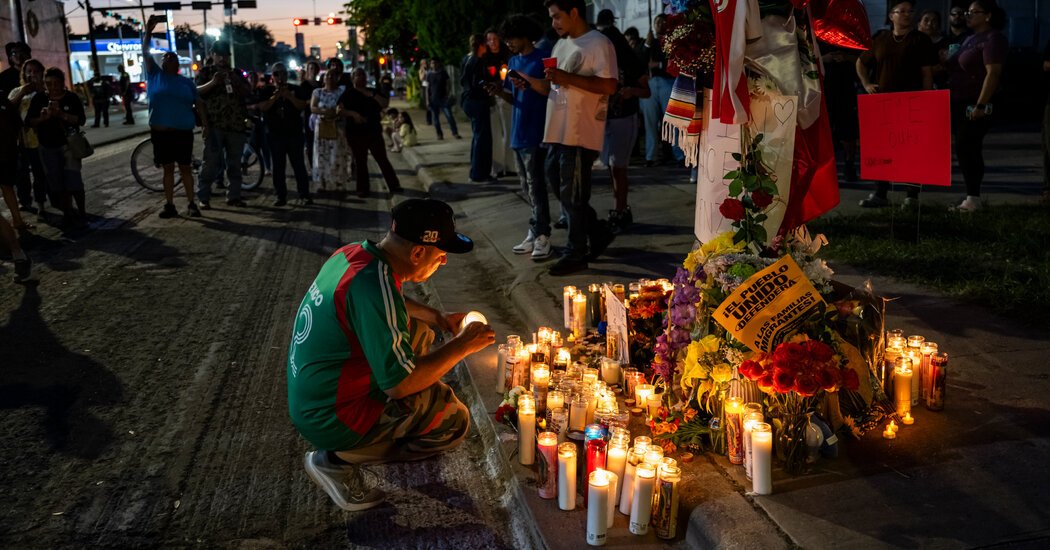
The killing of a Mexican man living in the United States by an Immigration and Customs Enforcement agent during a traffic stop in Houston has become the latest fatal encounter as the Trump administration continues its mass deportation campaign.
The man, Lorenzo Salgado Araujo, was killed while on his way to work. In recent weeks, President Trump has renewed the deportation effort, which had slowed in the spring.
“He wanted nothing else in life but to provide for his wife and see his sons become great people,” said Ronaldo Salgado, one of Mr. Araujo’s sons. “That’s how I want the world to know my father — not as someone who got shot and killed, but as a family man, a man who understood that good things come to those who put in hard work.”
Here’s what we know:
ICE agents were searching for a different person.
Details of the interaction between Mr. Araujo and immigration agents remain murky.
The federal authorities initially said that ICE agents stopped a vehicle around 6:50 a.m. on Tuesday and tried to arrest Mr. Araujo, whom they described as an “illegal alien.” On Friday, ICE said in a statement that Mr. Araujo had hit an ICE vehicle, had not followed orders and had tried to run over an officer. An ICE agent fired in self-defense, the statement said. Mr. Araujo was shot in the abdomen and taken to a hospital, where he died hours later, according to the Houston Fire Department.
But on Thursday, a spokeswoman for the Department of Homeland Security, which oversees immigration agents, said that Mr. Araujo was not the intended target of the operation. Federal officers had been looking for a different man.
Witnesses have disputed the authorities’ account.
At the time of the stop, Mr. Araujo was on his way to work at a construction site. Three men were in the car with him, including Victor Hugo Salgado Araujo, his younger brother. As of Friday, they remained in immigration detention in Conroe, Texas, outside Houston.
On Thursday, the three men told a lawyer, Hugo Balderas-Ibarra, that Mr. Araujo did not use his vehicle as a weapon or try to run over the immigration officers, and that no agent had been positioned in front of the vehicle, the lawyer said.
The authorities did not provide video footage of the encounter. The ICE agents were in unmarked vehicles and were not wearing body cameras, according to the area’s congresswoman, Representative Sylvia Garcia, a Democrat. Ms. Garcia said she had spoken to the acting director of ICE, David Venturella.
Surveillance and witness videos obtained by The New York Times show two ICE vehicles tailing Mr. Araujo’s white van and trying to cut it off. The van can be seen doing a U-turn before stopping alongside the road, with several immigration agents running toward the van as it comes to a halt. Video of the moments when shots were fired has not emerged.
There is tension over the investigations underway.
The Department of Homeland Security inspector general’s office is investigating the shooting. The F.B.I.’s Houston office is also investigating, but its inquiry will focus on the accusations that Mr. Araujo assaulted a federal officer.
City and county officials have said that federal investigators had so far been less cooperative than usual.
Mayor John Whitmire of Houston said that federal officials were “tightly controlling” the evidence and pledged to work aggressively alongside the city’s police department and the district attorney’s office to uncover the truth.
“We are not settling to wait for an F.B.I. report,” Mr. Whitmire said during a news briefing on Friday afternoon. “We want answers.”
The city’s police chief said that he would meet with the head of the F.B.I. Houston field office on Tuesday to discuss the evidence.
Mr. Araujo’s family and civil rights activists have called for an independent investigation and have asked the public for any new images or videos of the encounter.
Mr. Araujo lived in the United States for 35 years.
Mr. Araujo, 52, was a husband, father of three children and a business owner who had been in the country for more than three decades and was trying to obtain legal residency.
His sons said their father, a Mexico native, was most likely months away from obtaining a work permit after submitting fingerprints to immigration officials.
Mr. Araujo’s family said that he had followed his morning routine on the day he was killed. He got up at the crack of dawn, brushed his teeth, drank coffee and picked up his workers to head to a construction site. In evenings at the home he built, he would typically sit by the porch with his dog after eating the dinner his wife had made.
Ronaldo Salgado, 29, and his younger brother Lorenzo Salgado Jr., 27, described their father as a humble, hard-working man who had achieved his dream of running his own construction crew.
“He did not deserve to die,” the elder brother said.
At least 21 people have been fired on by federal agents since last year.
The Trump administration has recently revamped its goals to detain and deport immigrants after its efforts temporarily stalled in the spring when Kristi Noem resigned as homeland security secretary.
Ms. Noem stepped down after a tumultuous year of leading immigration operations in left-leaning cities, which were often furiously challenged by protesters — especially after several fatal shootings of immigrants and U.S. citizens.
Since last year, federal agents have fired on at least 21 people, many of whom were shot in their vehicles.
Federal agents shot and killed two U.S. citizens in January during a weekslong immigration enforcement operation in Minneapolis. One of those citizens, Renee Good, was killed in her vehicle, while the other, Alex Pretti, was kneeling and restrained in the street.
In February, revelations emerged that ICE agents had shot and killed a third U.S. citizen, Ruben Ray Martinez, in March 2025 during a traffic stop in Texas. And Silverio Villegas-Gonzalez, a Mexican immigrant, was killed in Chicago in October after officers fired at his vehicle as he drove away.
In many of these shootings, immigration agents have accused drivers of trying to assault a federal officer with their vehicles. Many people fighting those allegations in court have prevailed.
Federal immigration agents detained more than 10,000 people in a five-day period at the end of last month. And from Tuesday through Thursday, ICE officers arrested more than 6,000 people, internal records showed, a pace of about 2,000 arrests per day.
Reporting was contributed by Edgar Sandoval, Hamed Aleaziz, Pooja Salhotra and Allison McCann.