dailynewsnblog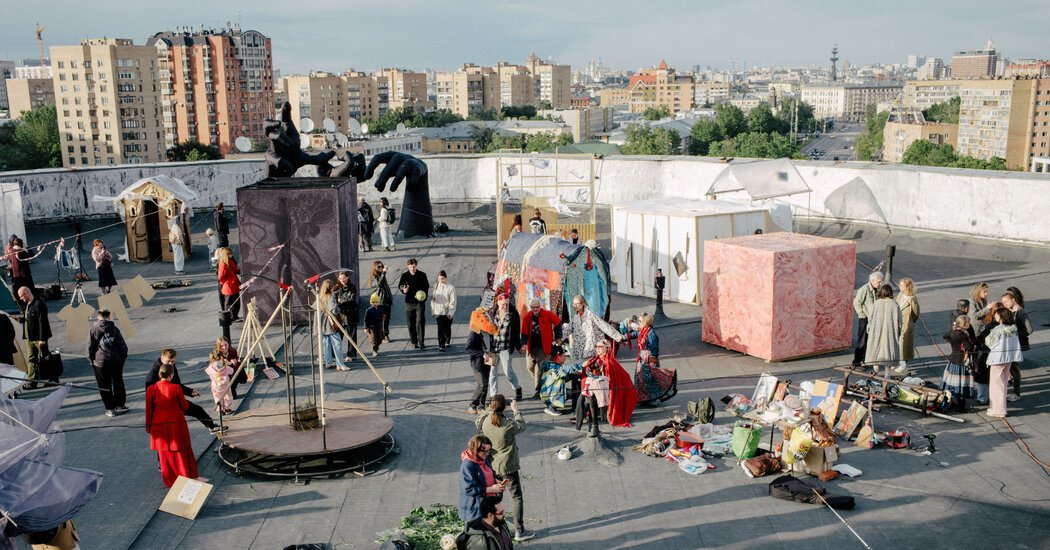
Art exhibitions tucked away in crammed apartments, in dusty studios open to “friends-only,” or in the glitzy offices of wealthy collectors who can no longer publicly exhibit artists effectively banned by the Kremlin.
Small theater companies where the style and tone of some productions are not explicitly critical of the government but do not follow the official narrative, either. Philosophy and political clubs gathering in people’s kitchens and living rooms, drawing stark parallels with the Soviet era.
At gatherings like this across Moscow, one topic is always present, but rarely mentioned openly — the war in Ukraine.
“There are these unwritten, intuitive rules of behavior: don’t discuss it out loud,” Andrei V. Kolesnikov, a Russian political analyst who still lives in Moscow, said of the war. “Better yet, don’t discuss it at all,” he added. “What’s there to talk about? You can’t change anything anyway.”
The recent spate of Ukrainian drone attacks in Moscow aims primarily to bring the war home to Russians. Cracks are appearing in the city’s placid facade, like long lines in front of gas stations this summer as Ukraine has targeted oil refineries. It’s a jarring sight in a place that in many ways is more modern than its European peers, with its spotless, manicured parks, superb transportation system and abundant digital services.
The attacks have fueled an anxiety in the air, particularly around its artists, writers, academics and other cultural figures, that has been there to some degree since the beginning of the war: Is the capital’s comfortable lifestyle a mirage that could vanish at any moment?
Living with this kind of tension, many people rely on an array of euphemisms used to discuss the war. Some call the conflict “it,” while economists refer to “elevated budgetary expenditures” and others simply say “because of the situation” when talking about anything affected by the fighting.
Although pristine subway trains are packed with passengers glued to their phones, they need to jump from one VPN to another to remain connected to the wider world, as the Kremlin has banned many international apps. The connection becomes especially difficult during peak hours.
Parents run around schools trying to find one that still offers a world-class education without propaganda. At one school meeting, the principal shared with pride how students practiced their democratic rights by drafting a formal petition with 120 signatures demanding that hot dogs be added to the cafeteria menu. The principal, who spoke for this article anonymously because of fears of reprisal, whispered to me how students can skip mandatory propaganda classes by arriving late.
Nina L. Khrushcheva, a professor of international affairs who divides her time between Moscow and New York, said Russia has once again revealed a split nature, perfectly captured by its coat of arms, the double-headed eagle.
“One head is in Europe and wants a flourishing, 21st-century civil administration, while the other wants to drag the country back to the Middle Ages and bow to Genghis Khan,” she said in an interview.
After Russia’s 2022 invasion of Ukraine, hundreds of thousands of Russians fled the country, including a number of high-profile artists and entertainers who spoke out against the war. Others stayed in Russia and remained silent, keeping their careers, and at times have faced criticism from those who left.
The most talked-about film in the city recently is “Pictures of Friendly Relations,” a textured drama about millennial theater and film professionals who hold a farewell party for their biggest star, who is leaving the country. It played in dozens of cinemas this spring, and is available for streaming on a leading Russian service.
The film does not directly explain why he is abandoning his dearest friends and his ex-girlfriend. Shot largely in black-and-white, with only two flashbacks in vibrant color, the cinematography marks a “before and after” that has become all too familiar to many Russians.
The film never once mentions the war in Ukraine, yet the ongoing conflict is the looming shadow that defines everything onscreen. We see a theater director trying to evade censorship by scrubbing seemingly innocuous references to freedom and prison from a play. Another character is forced to moonlight in delivery services just to get by. The overall atmosphere is one of profound displacement, where only friendship offers a temporary refuge.
According to one critic, the film “managed to capture an era in which you cannot speak of the ‘now,’ but you can show the present — without unnecessary words, so to speak.”
People have learned the rules about what is tolerated, which means not addressing the war. If you want to stay in Russia and engage in creative work, you must know where the red lines are and never cross them. There is a pervasive fear of getting it wrong, or of the lines shifting.
Several people I met in Moscow for this article refused to be quoted in any form. One asked me to delete our entire recording and burst into tears from the sheer tension. Another questioned the very value of reporting on something that might put people in harm’s way as a result.
Yet many independent gatherings take place right in the city center, vulnerable to whoever might want to disrupt them.
At the end of May, a group of Russian artists belonging to the Boloto group installed their works — including a carousel of scythes and even a full-sized catamaran — on the roof of the giant, late-Soviet Moscow Youth Palace. Part of what the organizers called the Bolotnoye, or Swampy, Biennale, its location was revealed only to invited guests, and the press was requested to refrain from writing about it before the three-day show closed.
Since its inception in 2020, the exhibition has tried to go against the grain of both commercial galleries and the official culture of state-run art institutions, said Olga Tumanova, 40, and Vasilisa Lebedeva, 42, its two curators.
“There are certain kinds of direct statements that are difficult to make in our context,” Ms. Tumanova said.
Ms. Lebedeva added: “As a result, many artists working here have turned to metaphor, symbolism and indirect forms of expression. That often gives the work a greater openness and complexity.”
This spring, deep inside the indoor parking garage of a cavernous Moscow shopping mall, a 90-minute performance featured Yevgeny Tsyganov, a leading Russian actor, sifting through dusty sets for a production of Thornton Wilder’s “Our Town” that opened in 2020. That production was abruptly closed in 2022 after its celebrated director, Dmitry A. Krymov, condemned Moscow’s invasion of Ukraine and stayed in New York.
In the recent performance, Mr. Tsyganov not only reminisced about the lost production but also about Mr. Krymov’s past theater work in Moscow and Russia’s life before the war.
Among the 300 spectators were top establishment figures like Elvira Nabiullina, the Central Bank chief, and Konstantin Ernst, the head of Russia’s influential, state-run Channel One broadcaster. In a perfect display of Moscow’s split reality, Mr. Ernst — the very man who oversees the state’s television propaganda — called the profoundly nostalgic play one of the best things he had seen in years.
Some artists who fled the country have returned, unable to settle in foreign and often unwelcoming countries. For those who stayed or have returned, navigating the city requires retreating into what some locals call “capsules of calm” or “islands of peace.”
These spaces — hidden art exhibitions, underground bookstores or alternative theaters — teleport people to another place or time, and offer temporary tranquillity.
Participants harbor no illusions about their ability to change the state’s trajectory. According to Mr. Kolesnikov, the analyst, this vibrant underground life is reminiscent of the “silent resistance” of the Soviet era. Today, gathering to watch a play or discuss a book is the only way civil society can function.
“It is a way of survival,” he said.