dailynewsnblog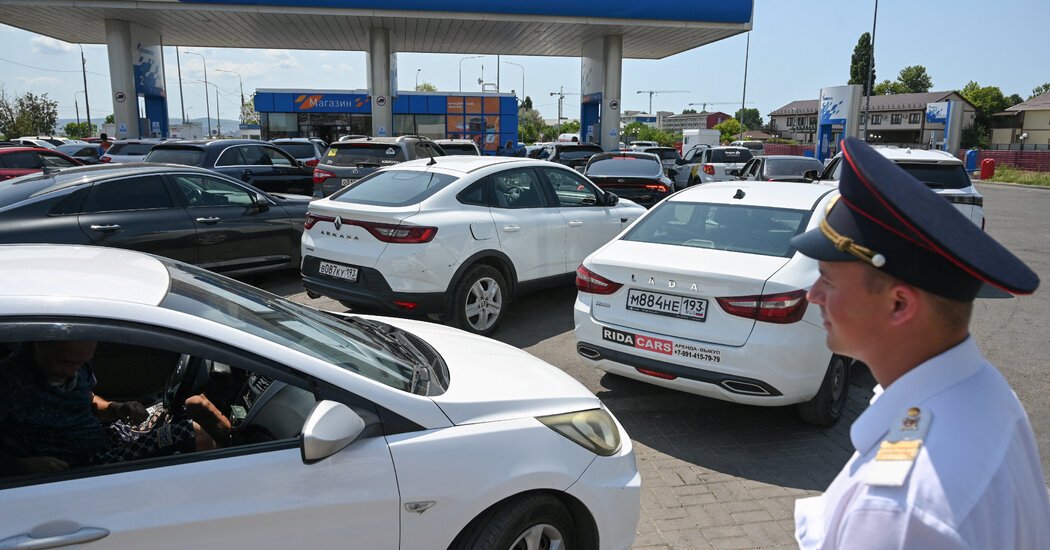
As a major producer of oil and gas, Russia has been one of the few countries to benefit from the U.S.-Israeli war against Iran, which constricted global fuel supplies and sent prices to peaks unseen in years.
But that windfall proved limited and short-lived. In late June, after prices receded amid easing tensions in the Persian Gulf, it became clear that the oil and gas bonus had failed to reverse Russia’s deepening budget crisis, according to the latest prices for Moscow’s crude and budgetary figures released by its Finance Ministry on Thursday.
In recent months, Russia has found it increasingly hard to finance its ballooning spending, driven largely by military expenses and the war against Ukraine. During the first six months of this year, the government spent $320 billion, or 55 percent of the amount it had budgeted for the entire year, the Finance Ministry said.
Aided by the surge in the price of fossil fuels that began in early March, the federal budget deficit decreased somewhat in June. But it still stood at $75 billion for the first half of the year — far more than anticipated when the budget was adopted, and more than $30 billion higher than in the first half of 2025.
Russian oil revenues rose sharply in the second quarter, but that trend is set to reverse unless the conflict in the Middle East reignites fully. According to Argus Media, a price reporting agency used by the Russian government to calculate its oil extraction taxes, by the end of June the price of Russian crude oil had retreated from the peaks reached in May to its prewar levels.
In addition, the second-quarter windfall failed to make up for poor revenue in the first quarter, when prices were low. Overall, Russia’s oil and gas revenues for the first six months of the year were more than 22 percent lower than the same period in 2025.
“The second quarter of 2026 will likely serve as a ‘breather’ before a new drop in oil and gas revenues, which will complicate the budget deficit problem,” Kirill Rodionov, a Russian economist, said in a post on Telegram, the messaging app.
Because of a fiscal mechanism designed to keep domestic fuel prices steady, Russia also had to transfer a large share of its fuel income to refineries, which desperately needed funding after being targeted by Ukrainian drones. All major Russian refineries, including facilities deep in Siberia, have come under attack, causing the worst fuel shortage the country has experienced in decades.
After years of war-related growth boosted by a massive fiscal stimulus and deficit spending, the Russian economy has been cooling down this year. But at the same time, the appetite of its military, struggling to advance on the battlefield, has grown.
Over the past year, signs of a looming crisis have become widespread. The country’s small businesses, such as bakeries and hair salons, have complained of higher taxes, while the country’s major real estate developer asked the federal government for a bailout. State-run monopolies have posted alarming levels of debt, and one of them, Russian Railways, was forced by the government to try to sell its shining new skyscraper in Moscow.
The situation has increased pressure on the country’s Central Bank. At the end of June, President Vladimir V. Putin said he expected the bank to reduce its benchmark interest rate, which has remained high to keep spiraling inflation under control.
But Elvira Nabiullina, the head of the Central Bank, lowered the rate by only 0.25 percentage points at the latest meeting. Last week, speaking at a conference, Ms. Nabiullina blamed the country’s increased expenditures and widening deficit for continued high interest rates.
“We could conduct an experiment and just lower the key interest rate,” said Ms. Nabiullina, who has been widely praised for keeping Russia’s economy stable after the invasion of Ukraine.
“If we did, I am simply certain that we would get a sharp rise in inflation and find ourselves in stagflation,” she said. “I am categorically against this because it would be an experiment on our own country.”
Some Russian economists and business leaders have begun to talk openly about the need to end the fighting in Ukraine.
“I think we are all worried about the same thing,” German Gref, the head of Sberbank, the country’s largest lender, said at an annual shareholders’ meeting at the end of June.
“I don’t think there is a person in the country who has any worries other than the speediest possible conclusion of the hostilities, that is obvious.”