dailynewsnblog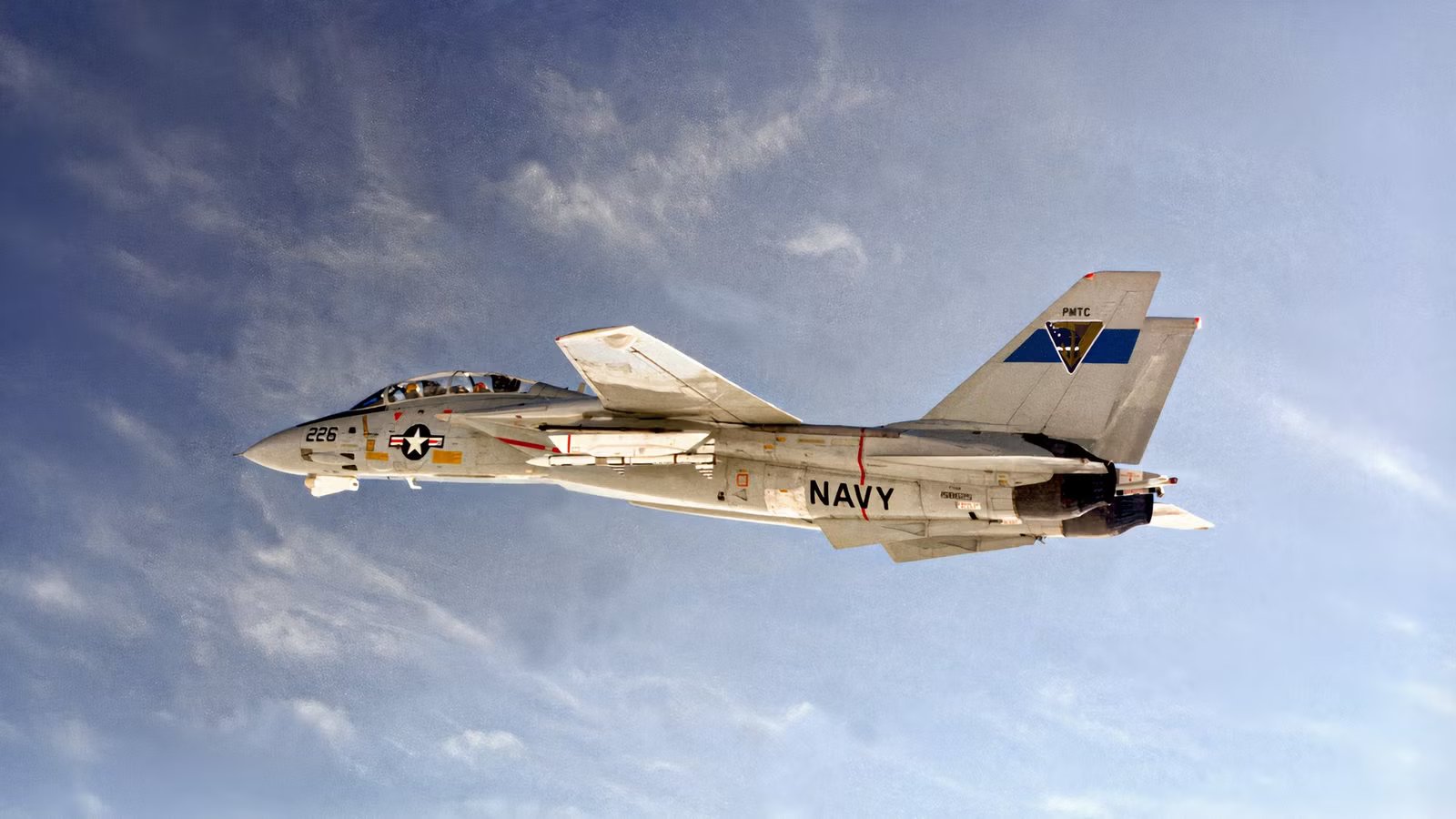
Competition during the Cold War took various forms and encompassed all domains. The United States Navy (USN) generally contended with continually evolving surface and subsurface threats posed by the Soviet military. In terms of Soviet aviation, US fleets maintained a constant watchful eye on the strategic risk posed by Soviet medium and long-range supersonic bombers such as the Tupolev Tu-22M Backfire and the Tupolev Tu-160 Blackjack.
The threat posed by these aircraft was made manifest by the fact that they not only had great range, but they were also armed with missiles capable of flying hundreds of miles. These challenges led the USN to develop a multi-layered fleet defense strategy that incorporated dedicated interceptors, highly capable radar, and long-range missiles.
The outermost layer of this defensive shell consisted of fleet interceptors; these aircraft were designed to push the defensive perimeter of a carrier strike group outward. These aircraft were the antidote to the long-range threat posed by the Soviet bomber dilemma. The premier Cold War interceptor was the Grumman F-14 Tomcat, armed with powerful Phoenix missiles. While the latter was undeniably the apex predator of the USN at the time, the Douglas F6D Missileer is a little-known conceptual design that reflected an earlier approach to the long-range fleet defense concept later embodied in the Tomcat.
The Missileer, An Aircraft That Never Left The Drawing Board

By the 1950s, missile technology was steadily advancing, and the USN began exploring new concepts for fleet defense aircraft that differed from the high-speed interceptors then entering service, such as the F4H Phantom II. In 1959, while the Phantom was still in development, the Navy issued the requirement that led to Douglas’s short-lived F6D Missileer program.
The Missileer was envisioned as a large, heavily armed, subsonic jet operating at the outer reaches of the fleet’s defensive perimeter. The aircraft would be equipped with the Hughes AN/ASG-18 fire-control system and six long-range Bendix XAAM-10 Eagle air-to-air missiles (nuclear-capable), which were designed for Mach 4 flight and an estimated range of around 80 miles (129 km), effectively making the aircraft an airborne missile battery. While lacking the speed of the F-4 Phantom II, the heavily armed aircraft would loiter on station in advance of the fleet, using its advanced radar to detect and engage incoming bombers from beyond visual range.
Powered by two non-afterburning Pratt & Whitney TF30-P-2 turbofans, each producing 10,000 lbf (44.5 kN) of thrust, the F6D was designed to remain on station for up to six hours. This extended endurance would provide continuous fleet coverage, allowing it to destroy enemy bombers before they could launch anti-ship missiles while conventional interceptors responded to any aircraft that penetrated the outer defensive screen.
In the end, the Navy considered the F6D program too expensive and the aircraft too specialized for its intended role. It was also believed to be too slow to defend itself once it had expended its missiles. As a result, both the Missileer and its proposed Eagle missiles were canceled in December 1961 by Secretary of Defense Robert McNamara, during the early months of the Kennedy administration.
The Throughline Connecting The Missileer To The F-14 Tomcat

Following the collapse of the Missileer program, Hughes continued to develop advanced radar technology. The result was the AN/AWG-9 radar and the AIM-54 Phoenix missile, an integrated long-range weapon system that carried forward many of the concepts first explored under Missileer. This radar and fire control system was developed for and would eventually be installed in the Navy’s Grumman F-111B, which was intended to fulfill the same fleet air defense mission as the canceled F6D.
The F-111B, which was under development between 1963 and 1968, featured a strengthened airframe, longer wings, and other modifications to improve low-speed handling during carrier launch and recovery operations. Although testing demonstrated that the aircraft was capable of long-range interception, it proved too heavy and insufficiently agile for carrier operations, raising concerns about deck handling and air combat performance. Combined with the Navy’s growing emphasis on maneuverability and multirole capability, these shortcomings led to the program’s cancellation in 1968.
Following the cancellation of the F-111B program, the AWG-9 weapon system was adapted for Grumman’s new F-14A Tomcat. Although substantially refined in both hardware and software, the F-14’s AWG-9 remained a direct descendant of the F-111B system. In 1972, the first F-14A Tomcats equipped with the AWG-9/Phoenix weapon system were delivered to the US. Navy.
How The Tomcat Carried The Ghost Of The Missileer

Inheriting the strategic objectives of the Missileer program, the F-14 provided the USN with a fleet defense and air superiority fighter, yet the Tomcat was much more maneuverable and powerful. The F-14B/D variants were equipped with two General Electric F110-GE-400 afterburning turbofans, which could produce ~27,000–29,000 lbf (~120–129 kN) of thrust per engine with afterburner.
Depending on the mission profile and loadout, the Tomcat had a combat radius of 400–500 nautical miles (741–926 km). This wide combat radius allowed it to operate at the outer edge of the carrier’s defensive bubble (a role conceptually descended from the earlier F6D Missileer program) while searching for and, if necessary, engaging Soviet bombers before they could threaten the fleet.
While on patrol, the Tomcat could use its AN/AWG-9 radar and associated mission computer to generate up to 24 target track profiles at distances of approximately 195 miles (314 km). Once the most pressing threats were identified, the aircraft could engage up to six targets simultaneously with its AIM-54 Phoenix missiles. The earliest variant of the missile had a range of roughly 100 nautical miles (185 km), while the later AIM-54C had an approximate range of up to ~120–150 nautical miles (~220–278 km) in ideal conditions.
The Gulf Of Sidra Incident: The Tomcat’s First Engagement

In August 1981, elements of the United States Sixth Fleet were conducting a carrier battle group exercise in the Mediterranean Sea, including air defense and live-fire training operations near the northern boundary of Libya’s claimed Gulf of Sidra exclusion zone. This area had been used in prior exercises due to its ideal location for safe operations in the Mediterranean, and the exercise had been carefully planned with a focus on safety and professional conduct.
On August 18, the first day of the exercise, more than 60 Libyan military aircraft were intercepted within or approaching the training zone, where missiles were to be fired. In each case, the intercepts were successful, with Libyan pilots being warned of the danger and subsequently departing the area without further incident.
However, on the morning of August 19 at 7:18 am, two F-14s from Fighter Squadron 41, deployed with the USS Nimitz (CVN-68), detected and intercepted two Soviet-built Su-22 Libyan fighters at the northern extremity of the Gulf of Sidra, operating approximately 60 nautical miles (111 km) from the Libyan coast. As in previous encounters, the F-14s maneuvered to position themselves in a way that would warn the Su-22s that their current trajectory would place them in danger. At that point, one of the Libyan pilots launched an Atoll missile at the lead Tomcat. Maneuvering to evade the Soviet missile, the American pilot fired a Sidewinder missile, which struck and destroyed the Libyan aircraft.
While this demonstration of the F-14’s combat capability might have ended the hostile activity, it did not. Moments later, the second Libyan Su-22 maneuvered in a way that was interpreted as continuing the attack rather than disengaging; as such, it was assessed as a threat, and a second Sidewinder missile was launched with similarly destructive results. The entire engagement lasted approximately one minute.
The Tomcat: An Interceptor That Assured Fleet Safety In A Fluid Threat Environment

Deployed US naval forces must maintain constant readiness and situational awareness in order to confront potential threats. This was particularly evident during the Cold War, when the Soviet Union continually developed new methods of challenging—and, where possible, eroding—US naval power and influence. A key element of this strategy was the development of capable supersonic bombers armed with long-range anti-ship missiles that could potentially saturate a fleet’s defenses and render it combat ineffective.
The counter to this challenge was the development of increasingly capable fleet interceptors. While the Missileer would have filled this role, it was ultimately deemed too specialized and poorly aligned with the Navy’s operational requirements, and the program was canceled. Its cancellation contributed to the requirements that eventually led to the Grumman F-14 Tomcat, which provided the Navy with the long-range interception capabilities needed to help safeguard its widely deployed carrier forces.
Catch what other trackers miss
Emergency squawks, holds, NOTAMs — live signals, no signup.
Open tracker
Catch what other trackers miss
Emergency squawks, holds, NOTAMs — live signals, no signup.
Open tracker