dailynewsnblog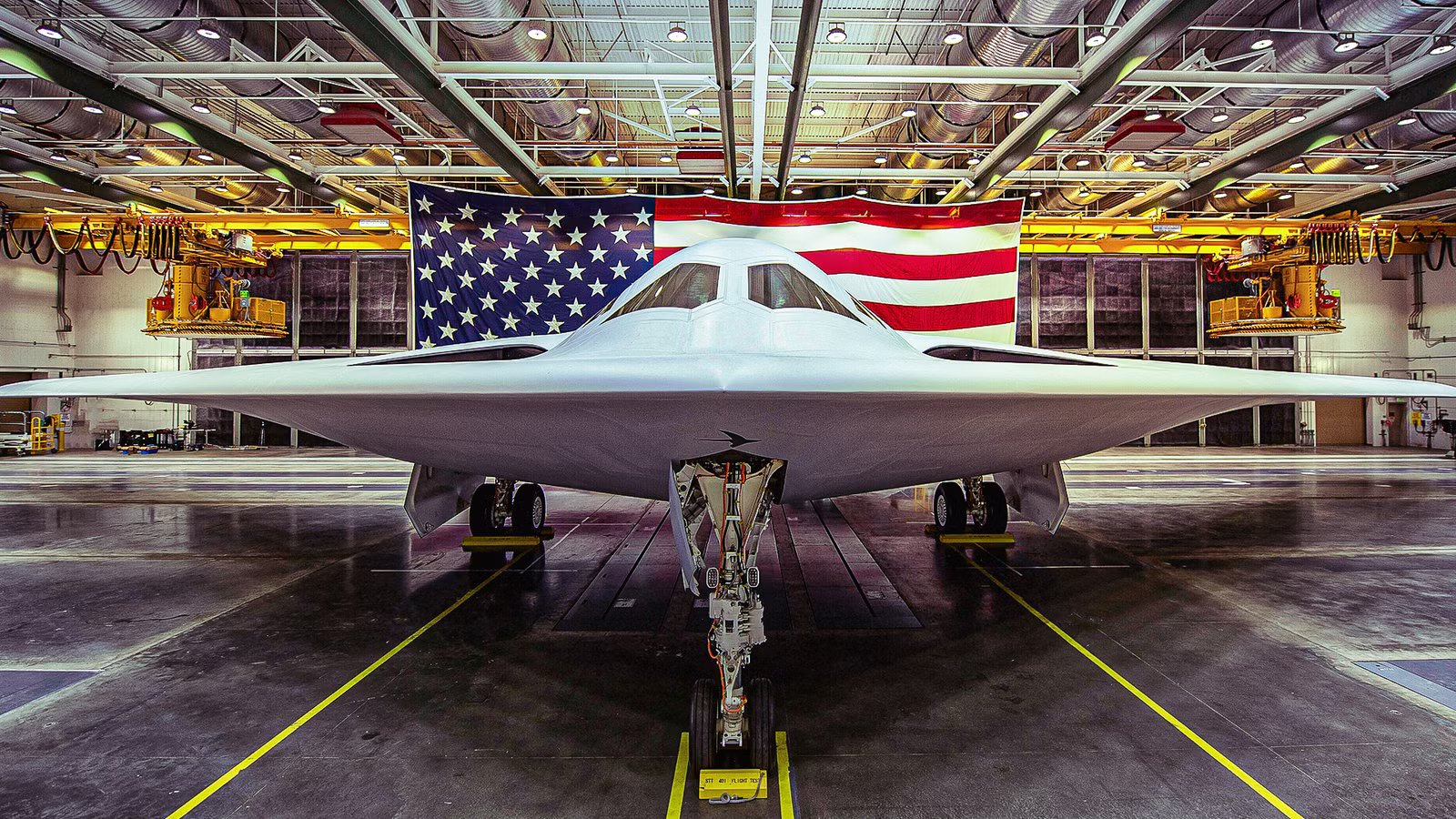
Before the first Northrop Grumman B-21 Raider touches down at Ellsworth Air Force Base in South Dakota in 2027, the United States will have spent approximately $2 billion preparing the ground beneath it, and that is for just one of three planned home bases. Dyess Air Force Base in Texas requires a separate $1.6 billion buildout across 24 construction projects.
Whiteman Air Force Base in Missouri, where the NorthropB-2 Spirit Bomber has been the resident stealth bomber for three decades, gets away with a comparatively modest outlay because it already has the specialized infrastructure that the other two must build from scratch. Combined, the base network supporting the B-21 fleet represents a capital investment that exceeds the entire annual defense construction budget of most NATO allies, and it has to be built before a single production aircraft is delivered. That figure, $1.5 to $2 billion for the whole stealth bomber base, is the number this article is about. It is also the reason no US ally on earth can replicate the system the USAF is building.
The conventional conversation about the B-21 focuses on the aircraft’s unit cost, approximately $692 million per airframe at planned production rates, and its classified capabilities. Both are real barriers to allied acquisition. But the binding constraint is the real estate footprint: a specialized campus of climate-controlled hangars, radio-frequency testing facilities, stealth-coating restoration bays, weapons generation vaults, and secured mission-planning facilities that the aircraft requires simply to remain operationally ready. This article breaks down each category of infrastructure, the cost attached to it, and why the network of bases functions as a strategic moat that the aircraft’s unit price alone cannot fully explain.
Per-Base Cost: What $1.5 Billion Actually Buys At A Stealth Bomber Hub

Ellsworth Air Force Base sits on the plains of western South Dakota, roughly 60 miles (97 km) east of the Badlands and well isolated from any major population center. Stealth bomber operations require perimeter security that is far easier to maintain at a remote installation than at a base near a city, and the prairie provides the kind of unobstructed radar environment that low-observable aircraft testing demands.
According to Simple Flying’s recent analysis of the Ellsworth transformation, the base is absorbing what amounts to a total investment of approximately $2 billion, for nearly three dozen individual projects covering hangars, runways, fueling infrastructure, simulators, housing, and classified operational facilities. The base’s 28th Bomb Wing commander, Brigadier General Derek Oakley, confirmed to the South Dakota legislature that the construction program alone encompasses almost three dozen projects at a cost of at least $1.5 billion, with additional investment flowing from the FY2027 budget request separately.
The completed phase of Ellsworth’s transformation already includes a $129.5 million runway reconstruction, completed in December 2025, which placed more than 106,000 tons of concrete to ensure the airfield can sustain continuous heavy stealth bomber operations across the temperature extremes of a South Dakota winter without the surface degradation that would compromise taxiing tolerances for the B-21’s sensitive radar-absorbing material coatings.
Contracts underway include a $135.5 million Phase Maintenance Hangar spanning approximately 80,000 square feet (7,432 square meters), a $33.5 million contract for five Environmental Protection Shelters, and a separate Radio Frequency Facility covering 64,500 square feet (5,991 square meters). According to the Defense One analysis of the FY2025 continuing resolution, Congress added more than $850 million in flexible spending specifically for B-21 and Sentinel ICBM construction in late 2025, with the Air Force statement explicitly naming Ellsworth, Whiteman, Dyess, and Tinker Air Force Bases as recipients.
The Six Facility Types That No Standard Air Base Possesses

The infrastructure cost per B-21 base is driven by six specialized facility categories that exist nowhere in the allied air forces inventory and cannot be built without classified design specifications that the US does not share even under the closest treaty frameworks. Each category addresses a specific operational or maintenance requirement of the B-21 that has no parallel in conventional aircraft operations.
The Low Observable Restoration (LOR) facility is the most expensive single building. The Ellsworth LOR, a two-bay, 90,000-square-foot (8,361-square-meter) structure, costs approximately $130 million and functions as a combination of aircraft hangar, paint booth, and clean room. According to the US Army Corps of Engineers, the facility was developed to preserve low visibility characteristics.
The B-21’s radar-absorbing material coatings, which determine the aircraft’s operational stealth signature, degrade with every flight cycle through abrasion, moisture ingress, UV exposure, and thermal cycling. They must be repaired, reapplied, and tested to precise electromagnetic specifications after every maintenance event that touches the aircraft’s skin.
The Radio Frequency (RF) Facility at Ellsworth, 64,500 square feet (5,991 square meters), provides a shielded test environment in which the aircraft’s complete radar cross-section signature can be measured and verified after coating work, using antenna arrays and signal processing equipment that must themselves be secured at classified levels. Environmental Protection Shelters (EPS), costing $33.5 million for a set of five at Ellsworth, are pre-engineered metal structures providing climate-controlled storage that protects parked aircraft from UV degradation, freezing precipitation, and temperature cycling that would otherwise compromise the coatings between sorties, as stated on the Ellsworth Air Force Base official website.
The remaining three facility types address the B-21’s nuclear mission and classified avionics architecture. Mission Planning Facilities (MPF) are secured SCIF-grade buildings in which crews plan nuclear and conventional strikes using classified targeting data, communication architectures, and threat databases that cannot be accessed from standard network infrastructure. Weapons Generation Facilities (WGF) are hardened structures that handle the assembly, mating, and upload of nuclear weapons, operations requiring physical separation from the flight line, specialized lifting equipment, and two-person access controls at every stage.
Field Training Detachments (FTD) at Ellsworth, which serves as the Formal Training Unit for the entire fleet, provide the simulator bays and schoolhouse infrastructure through which every B-21 pilot in the Air Force must pass. According to Air Force Civil Engineer Center planning documents, the training mission substantially increases personnel requirements and creates additional demands for housing, utilities, schools, and community infrastructure in the surrounding region.
Why Whiteman Costs $1 Billion Less, And What That Reveals

The contrast between Whiteman and the other two primary bases provides the clearest illustration of what specialized stealth infrastructure costs when it does not already exist. As Simple Flying has documented in its analysis of Whiteman’s relative advantage, the Missouri base requires only 16 new facilities totaling approximately 600,000 square feet (55,742 square meters) plus renovations to 26 existing facilities covering approximately 1.7 million square feet (157,935 square meters), changes described by military strategists as “minor effects” compared to the decade-long rebuilds at Ellsworth and Dyess.
Whiteman’s adaptation costs approximately $1 billion less than either of the other two bases specifically because it has operated the B-2 Spirit for three decades and already possesses LOR capacity, RF testing infrastructure, climate-controlled storage, nuclear weapons facilities, and the secure mission-planning complex required for a stealth nuclear bomber wing. None of those facilities existed at Ellsworth or Dyess.
A country attempting to build a stealth bomber base without existing infrastructure would face the full Dyess or Ellsworth bill, $1.5 to $2 billion, for a single installation, without the benefit of decades of institutional knowledge, existing contractor relationships and cleared maintenance workforces. Even the US found that starting from scratch at Dyess and Ellsworth is meaningfully more expensive than operating from a facility already adapted for stealth operations. An ally beginning with no equivalent baseline would face the greenfield figure with no offsets of any kind.
The Whiteman comparison also clarifies what the B-2 program’s 30-year basing footprint represents as a capital base. The US has been building and refining stealth bomber infrastructure at Whiteman since the late 1980s. The B-21’s ability to move into Whiteman at substantially reduced marginal cost is only possible because the Air Force and its predecessors invested continuously in that infrastructure for three decades. An ally that had not made equivalent investments during the B-2 era would not inherit that advantage. They would inherit the Ellsworth problem: a base that was not designed for stealth operations, at a price that reflects the full scope of adapting one that was not.
The Allied Budget Comparison: What $1.6 Billion Per Base Means In Context

The $1.5 to $2 billion per-base figure acquires its strategic weight when set against what peer allies spend on military construction annually. The entire Canadian Department of National Defence infrastructure program runs at approximately $300 to $500 million per year in construction and infrastructure spending. The Netherlands, Denmark, and Norway each maintain annual defense construction budgets of similar magnitude.
Even the United Kingdom spent approximately £1.9 billion ($2.4 billion) across its entire defense infrastructure portfolio in the most recent fiscal year, covering all services, all bases, and all capital works. A single B-21-standard bomber base can represent several years’ worth of annual military infrastructure spending for many NATO allies.
As previously detailed on Simple Flying’s analysis of the B-21 program’s scale relative to the B-2, the combination of a minimum 100-aircraft production run with three dedicated main operating bases represents a qualitative shift in how the US maintains penetrating stealth capability as a genuine wing-strength capability distributed across multiple hardened installations. That distribution model requires the full infrastructure investment at each base. The total MILCON commitment across the three primary bases, conservatively estimated at $4 to $5 billion before the program is complete, exceeds the annual defense budget of a majority of NATO members in its entirety.
According to the Air & Space Forces Magazine analysis of the FY2027 defense budget, the Department of the Air Force is requesting approximately $26.7 billion in combined construction and sustainment funding, more than double the 2026 figure. The US is accelerating. The FY2027 request represents a construction commitment that has no precedent in post-Cold War American military infrastructure spending, and it is being funded in an environment where every major ally is simultaneously trying to rebuild its own conventional force structure after decades of post-Cold War underspending.
The June 2026 Snapshot: Where The Buildout Actually Stands

As of June 2026, the B-21 infrastructure buildout is under active construction at three bases simultaneously. Ellsworth’s Phase Maintenance Hangar is under construction with completion targeted for May 2027, aligning with the base’s scheduled receipt of its first production aircraft later the same year. The five Environmental Protection Shelters are under separate contract with a 2027 completion date, according to SAM.gov. The RF Facility is in procurement.
At Dyess, the fuels’ admin lab and refuel truck yard broke ground in December 2025, described by the base as the opening projects of what will be a decade-long construction sequence. At Whiteman, the FY2027 budget requests $329 million in new B-21 facilities, including weapons and training facilities in the first tranche of the base’s B-21 adaptation work.
The aircraft itself is advancing in parallel. The second B-21 test aircraft arrived at Edwards Air Force Base in September 2025, doubling the test fleet’s capacity. According to reporting by Aerospace Testing International on the program’s June 2026 status, operational test pilots from AFOTEC Detachment 5 flew alongside developmental test pilots for the first time in June 2026, an unusually early integration of operational personnel into the test process that reflects the program’s stated strategy of compressing certification timelines through digital engineering. One test campaign was completed in 73 days against a planned 180-day schedule.
Tinker Air Force Base in Oklahoma adds a fourth facility dimension not often included in coverage of the B-21 base network. According to the FY2025 continuing resolution, Tinker received authorization for a four-dock depot maintenance hangar to service both B-21 Raiders and  BoeingB-52Js — the industrial rear echelon that supports the operational bases and without which no stealth bomber wing can sustain itself over time. The Tinker facility represents yet another category of specialized construction that any allied operator would have to independently fund and build: heavy depot infrastructure capable of conducting major scheduled overhauls on aircraft whose maintenance procedures are themselves classified.
Three Hardened Bases And $4–5 Billion Beyond Any Ally Possibility

The USA does not export nuclear-capable stealth bombers, and the B-21’s classified avionics and low-observable material specifications are not shared under any treaty framework. Those are the obvious barriers. The less-discussed one is the infrastructure: the $4 to $5 billion in stealth-specific construction required before a B-21 wing is operational cannot be licensed, donated, or short-cut.
It must be built from the ground up, using facility design specifications that are themselves classified, at a per-base cost that exceeds the entire annual defense construction budget of most NATO countries. According to the B-21 Environmental Impact Statement, the basing model requires each Main Operating Base to operate as a self-contained stealth campus — every category of facility described in this article present and certified before the first aircraft arrives.
The B-2 Spirit showed what the alternative looks like. For three decades, every B-2 flew from Whiteman alone — a model that concentrated infrastructure expertise but left the entire penetrating stealth fleet at one geographic point. As documented by Simple Flying, the B-21 program is designed at a scale, at least 100 aircraft across three hardened hubs, that has no precedent in post-Cold War American airpower.
According to Air & Space Forces Magazine’s reporting on the B-21 basing decision, the three-base model was explicitly chosen to force an adversary to defeat three separate hardened campuses rather than one. The cost of that resilience is three full infrastructure buildouts. No ally has the budget, the land mass, or the three decades of stealth-operations institutional knowledge that made even Whiteman’s cheaper adaptation possible.