Keeping cool: How Meta plans to cut down on water use at its Alberta data centre


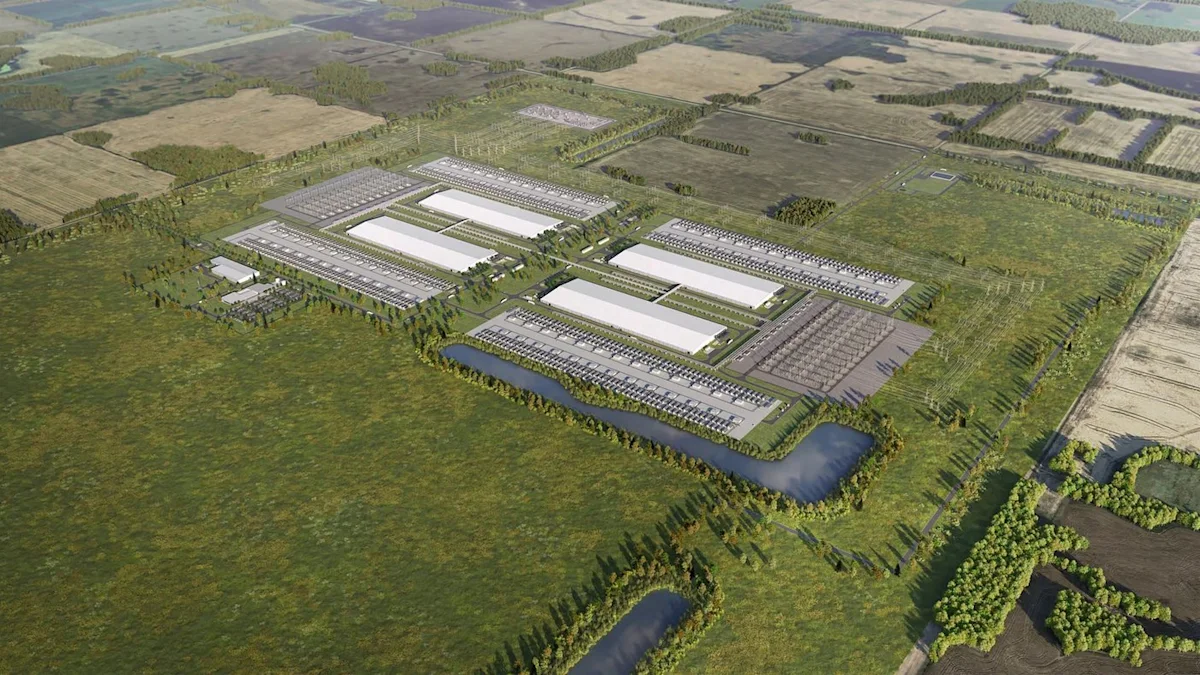
Meta, the tech giant behind Facebook and Instagram, says it’s building a new AI date centre in Sturgeon County, Alta. The facility, shown in this rendered image, will be a one-gigawatt, nearly 270,000-square-metre data centre powered by a natural gas-fired plant. THE CANADIAN PRESS/Handout – Sturgeon Data Centre (Mandatory Credit) – The Canadian Press

CALGARY — A Meta Platforms Inc. executive garnered applause at a news conference this week after he boasted that a gargantuan data centre planned for north of Edmonton would use less water annually than a typical Alberta golf course.

The tech behemoth was announcing a $13-billion-plus investment in a complex the size of 33 Canadian Football League fields. It will be powered by a new natural gas plant that could eventually produce more electricity than what the City of Edmonton uses, to be built by Pembina Pipeline Ltd., Morgan Stanley Infrastructure Partners and Kineticor Asset Management.

The data centre in Sturgeon County, like other hyperscale proposals in Canada, is to use what’s known as a closed-loop cooling system to keep servers from overheating. That differs from an evaporative cooling system, which requires enormous amounts of cool water that is not re-used.

Gary Demasi, vice-president of data centre strategy and development at Meta, told a news conference Wednesday that no water will be needed for regular cooling operations.

“The onsite water use is limited to domestic uses, fire protection systems and some equipment maintenance applications,” he said.

Marina Freire-Gormaly, an associate professor of mechanical engineering at York University, said the closed-loop technique works well in cooler climates like Alberta’s. Data centres in hotter places tend to use the evaporative cooling because there’s not as much of a temperature difference between the chips inside and the air outside.

Meta would likely use a coolant similar to the fluids used in vehicles, which would run through pipes overtop of the hottest parts of the chips and absorb the heat, she said. The loop would then run to the outside of the building, where the air is cooler, and a series of fans would move the heat away. The cooled-down fluid would head back to the servers.

Freire-Gormaly said the closed-loop system would work best in the winter and she’s curious how Meta’s designs would account for how hot it can sometimes get in the Edmonton area during the summer.

A recent blog post from AI chipmaker Nvidia, one of Wall Street’s most valuable names, said its latest servers can use coolant that’s not so cool at all: up to 45 C, which is more sweltering than a hot tub. The fluid exits the server rack at 55 C. Nvidia said that cooling alone has historically accounted for up to 40 per cent of a data centre’s electricity consumption, so its ability to use higher-temperature coolant marks a great efficiency leap. The coolant Nvidia uses is three-quarters water, one-quarter propylene glycol.


These newer data centres, they should always use closed-loop cooling,” Freire-Gormaly said.

“These evaporative cooling approaches are really harmful to the environment. And the reason they’re relying on it is because they don’t have that natural temperature difference between the environment and the temperature that they’re trying to cool from.”

For that reason, she sees how Canada can be an attractive location for hyperscalers like Meta to set up shop.

“But I think it’s also important that we realize what power source we’re using.”

It’s not clear what kind of cooling system the adjacent power plant — called the Greenlight Electricity Centre — will have and if that component will have its own hefty water footprint, Freire-Gormaly said. It’s also not clear whether there will be some form of carbon capture and storage facility required to offset the greenhouse gas emissions the power plant would produce.

Freire-Gormaly also wonders if the companies might consider ways to use the data centre’s waste heat.

“It could be used for things like district heating in the community instead of just running fans and then blowing it into the atmosphere,” she said. “Why not use that waste heat for things like warming buildings or having a secondary heat transfer loop?”

A study led by University of Cambridge researchers earlier this year looked at what they call the “heat island effect” in areas surrounding AI data centres. The study estimates the land surface temperature increases by an average of 2 C after the start of operations. The study found that some increase in temperature could be detected up to 10 kilometres away.

This report by The Canadian Press was first published July 9, 2026.

Lauren Krugel, The Canadian Press


Source link

  • Related Posts

    Saskatchewan grounding 3 wildfire planes that are same model as one in N.W.T. crash

    The southeast flank of the Fort Simpson wildfire, designated as FS016 by the government of the Northwest Territories, is seen in a Sunday, June 28, 2026, handout photo published to…

    Dog trainer sentenced to nearly 12 years in prison after dogs die in hot van

    A Southern California trainer who had 11 dogs die in a hot van, tried to have them cremated and lied to owners was sentenced to more than 11 years in…

    Leave a Reply

    Your email address will not be published. Required fields are marked *

    You Missed

    Should Toronto bars stay open until 6 a.m.? One city councillor is proposing just that

    Should Toronto bars stay open until 6 a.m.? One city councillor is proposing just that

    New Fashion and Beauty Stores in Los Angeles and Southern California

    New Fashion and Beauty Stores in Los Angeles and Southern California

    All the Canadian Politics!

    Apple Sues OpenAI, Claiming Employees Stole Trade Secrets

    Apple Sues OpenAI, Claiming Employees Stole Trade Secrets

    Saskatchewan grounding 3 wildfire planes that are same model as one in N.W.T. crash

    Saskatchewan grounding 3 wildfire planes that are same model as one in N.W.T. crash

    Dog trainer sentenced to nearly 12 years in prison after dogs die in hot van

    Dog trainer sentenced to nearly 12 years in prison after dogs die in hot van