dailynewsnblog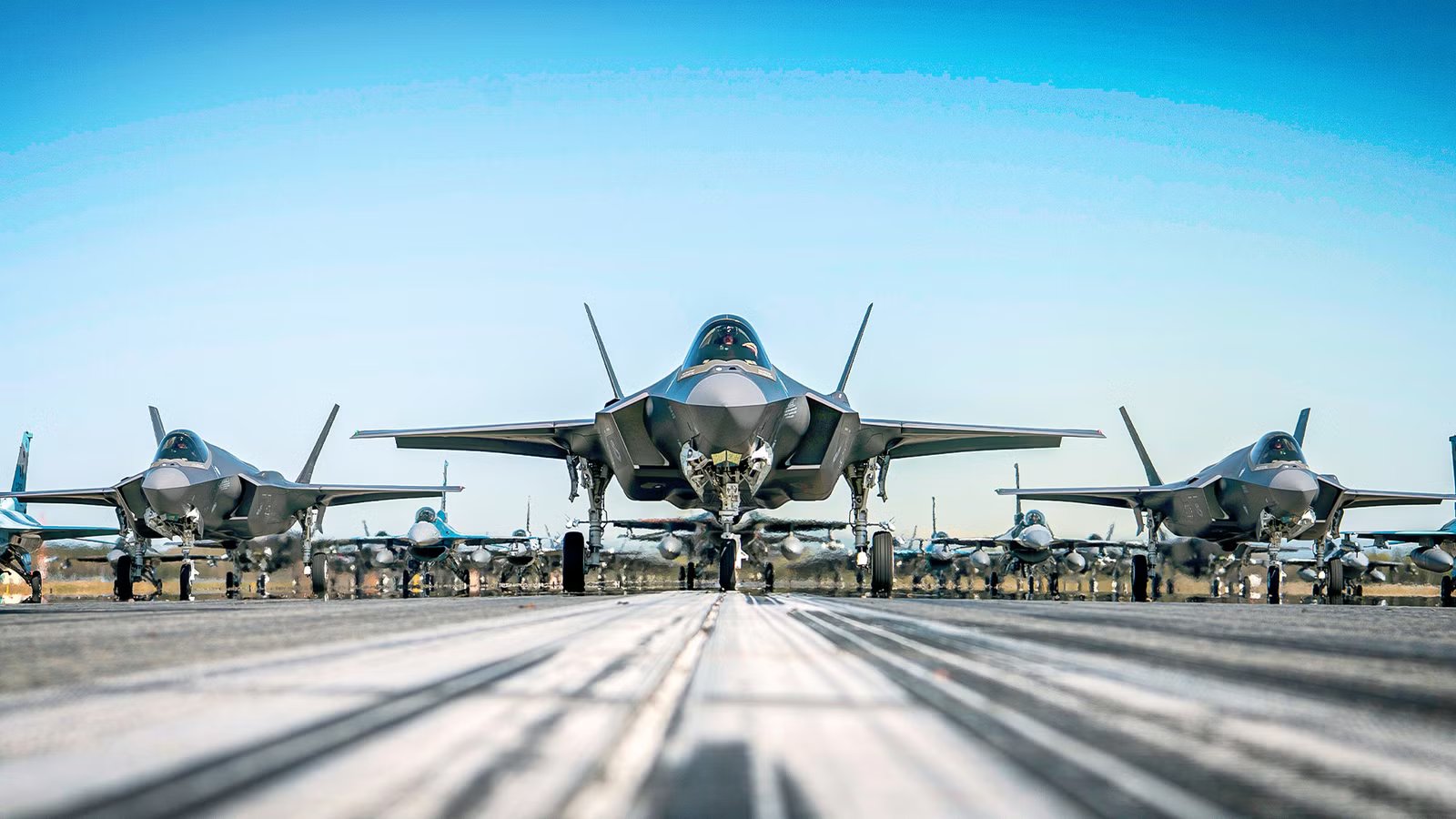
The Royal Australian Air Force announced on June 19 that it had successfully conducted the world’s first joint weapon fill measurement vehicle flight with a Lockheed Martin F-35A Lightning II stealth fighter. The Air Combat Systems Program Office of the US Air Force Seek Eagle Office collaborated with RAAF No. 75 Squadron to execute the research flight that provided a wealth of flight data. This will greatly help improve the current situation with the software bottleneck impacting the rollout of the Technology Refresh Three Block Four improvements.
Although the flight itself did not test a new missile or bomb, the WFMV represents an engineering breakthrough that could potentially shave years off of weapon integration and certification in the future. This represents a massive savings in time and money for every one of the 20 nations that are members of the Joint Strike Fighter program, all around the world, for the entire duration of the fleet service life.
This is a particularly important development as the F-35 fleet is currently hemorrhaging combat-capable aircraft with full mission capability rates as low as 25%, according to Air and Space Forces Magazine. Lockheed Martin is aggressively working to overcome the prolonged software issues and roll out upgrades to the fleet. As the weapons systems and power plants achieve their full potential over the next few years, the WFMV will allow every operator to integrate a virtually endless list of munitions and systems to further enhance their jets.
Aussies On Point: The Pivot To The Pacific

Australia is one of the earliest and most aggressive adopters of the F-35, with its fleet rapidly being stood up to take over deterrence patrol, intelligence surveillance, and reconnaissance operations in the Pacific Theater. The joint initiative falls under the bilateral Aircraft Stores Compatibility Project Arrangement. Defense officials emphasized that rapidly cutting the time required to field new weapons is a high priority given the fast-evolving security environment in the Indo-Pacific region.
Although the F-35 program has had a strong start with over 1,300 jets delivered today, the People’s Liberation Army Air Force is building a strong force of its own stealth fighters that do not have to be spread around the globe. There are currently over 300 of the Chengdu J-20 Mighty Dragon fifth-generation fighter jets, but the production line is continuing to ramp up, with hundreds expected to roll out the doors every year and an estimated fleet size to exceed 1,000 aircraft by the end of the decade.
Unlike the JSF fleet that is dispersed across many operational theaters, every single one of these J-20s is assigned to patrol the borders of China and project power over the East China Sea. The US Air Force, Navy, Marines, RAAF, and Japanese Air and Maritime Self-Defense Forces all operate different variants of the F-35 in this theater in order to counter the encroachment of China’s Air Force and Navy. The WFMV strengthens the joint capability of all of these operators in the Pacific Theater through rapid, iterative, and shared fleet upgrades.
Skunk Works’ Troubled Stealth Fighter

Despite the success of the test flight, it took place against a backdrop of deep strategic concern among global allies regarding the overall F-35 program. TR-3 was designed as a $1.9 billion “brain upgrade” to give the F-35 25 times more processing power. It is an absolute prerequisite for the upgrades, the modernization package that enables the jet to carry next-gen weapons, advanced electronic warfare, and new radar arrays.
The WFMV will act as a shortcut for the fleet’s weapons integration to get the global program back on track as software issues are resolved. The initial goal was to have the full TR-3 modernization package finalized and fielded by 2026. Now, the Pentagon has officially pushed the completion of Block Four to 2031 at the earliest. To protect the timeline from slipping further, the F-35 Joint Program Office recently slashed the scope of TR-3, dropping or deferring many of the 66 capabilities under the scope of TR-3.
The WFMV will help gather universal aerodynamic and environmental baseline data from the inside and outside the F-35 weapons bay to help accelerate integration of munitions in parallel with the rollout of TR-3. It maps out exactly how the F-35 behaves physically when carrying and releasing internal stores. Engineers can then take that data and plug it into the digital ‘twins’ created by Lockheed Martin for every F-35, which eliminates much of the physical work and drastically reduces the timeline to integrate.
The Needs Of The Navy

In terms of more immediate impact, unlike the Air Force, the US Navy and Marines are pushing more money into their F-35 fleet in order to avoid a critical capability gap right now. Carrier air wings and amphibious ready groups are completely locked into the F-35B and C variants; the F-35C deployed aboard super carriers around the world, and the F-35B that serves on the flight deck of American assault carriers are critical to US military operations all over the planet.
Because of the problems with the TR-3 rollout, the Navy and Marines have had to accept dozens of TR-3 aircraft in a truncated state. The Navy can’t wait until 2029 or 2031 for its aircraft to be mission capable. The Navy and Marine Corps can leverage the data from WFMV testing to protect their current fleet readiness and offset their surging program costs. Just this May, the Navy awarded Lockheed Martin $991 million for electronic warfare modification kits, in an unplanned additional cost for its F-35 fleet.
One of the primary concerns of the Navy and Marines is that delays to the broader Block Four software package will leave them flying a next-gen jet that only meets the combat performance of a fourth-generation legacy airframe. The Navy and Marine Corps cannot afford to divert frontline carrier aircraft into engineering test wings to ensure that next-gen systems and weapons upgrades are fully functional because they are desperately trying to match or exceed the deployment tempos of legacy airframes.
Next Level Beast Mode

Because the global F-35 program is built on identical physical frames across nations, the JSM is rapidly becoming the universal standard maritime and deep-land strike weapon for the entire alliance. The primary weapons set to benefit from the WFMV’s data are next-generation long-range, standoff, and maritime strike munitions that require heavy internal or external carriage configurations.
Catch what other flight trackers miss
Emergency squawks, holds, NOTAMs — live signals, no signup.
Open tracker
Catch what other flight trackers miss
Emergency squawks, holds, NOTAMs — live signals, no signup.
Open tracker
For example, the Navy and Lockheed Martin just wrapped up initial flight-science testing to clear the heavy AGM-158C Long Range Anti-Ship Missile for the F-35C. The US Air Force is pursuing the Hypersonic Attack Cruise Missile and joint development with Australia as a top priority as well.
The air-breathing HACM will be a game-changing stand-off munition, but it is an unprecedented missile for deployment on a single-engine fighter jet airframe. The incredible speed and power of the violently fast munition require an exceptionally precise and meticulously careful implementation for integration with the F-35 weapons bay.
It’s not enough to simply fire and forget; the JSF needs to stay stealthy before and after to ensure its survivability on every strike run. Another highly anticipated weapon and development for the F-35 is the Joint Strike Missile being built by Kongsberg of Norway. The JSM is a stealth, precision-guided cruise missile being jointly developed with Raytheon in the US.
The long-range fifth-generation weapon is intended to deliver a major capability boost to the F-35 fleet by putting a missile that is typically carried on an external hardpoint inside the internal weapons bay. In keeping with the overarching intent of the JSF program, rather than individual countries spending billions to build their own unique missiles, they are pooling their resources into the JSM. So far, the partners that have already ordered or expressed serious intent to purchase the JSM, besides the US and Norway, include: Australia, Belgium, Canada, Germany, and Japan.
JSF: A Unified Front

Considering the total number of aircraft deployed by all the joint operators in the theater, the F-35 fleet in the Pacific represents the greatest concentration of jets from one area as well as the largest force of stealth fighters in one geographic command. Because the WFMV program fast-tracks weapons like the JSM and LRASM, it will rapidly deliver game-changing mission capability to all of these fleets at the same time. While their shared facilities and arsenals will allow every F-35 to pull from the same depots, regardless of the livery it bears.
This revolutionary interoperability between global allies is one of the fundamental principles that was the overarching strategic purpose of the JSF program. By bringing macroeconomics to the stealth fighter production line, it made it possible to put this exquisite airframe into the hands of as many allies as possible, with the greatest capability technically feasible.
The US Air Force is the top operator of the F-35 globally, with over 1,700 in total expected to be delivered over the full order backlog. The US Navy is the sole operator of the F-35C, and with its world-leading fleet of 11 super carriers, brings a massive force of mobile, stealth airpower to the Pacific. The US Marines operate the largest number of F-35B stealthy ‘jump jets’of the JSF operators in the world, and many of their assault carriers patrol the Pacific as ‘lightning carrier force.’
Japan has the second-largest order, ranking operators by nation, with its total of 147 split between the land-based F-35A and F-35B variants for its Izumo class assault carrier. While the RAAF is the fifth-largest operator of the F-35 in the world, with 72 land-based F-35A examples.