dailynewsnblog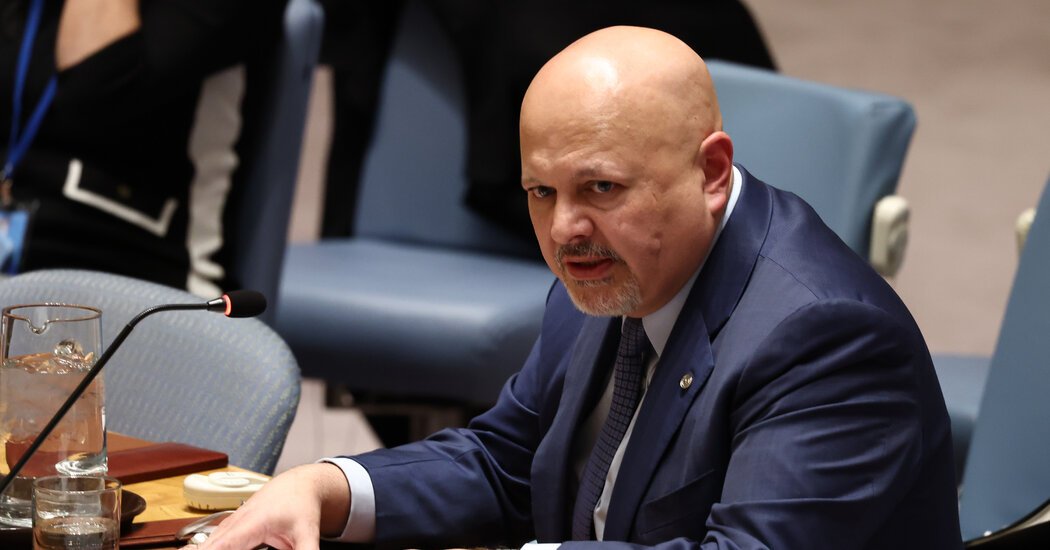
Members of the International Criminal Court are preparing to meet this month to decide whether to remove its chief prosecutor over allegations of sexual misconduct. Under consideration will be an internal court report, obtained by The New York Times, concluding that the prosecutor, Karim Khan, had abused his authority by conducting a sexual relationship with a subordinate.
The case has presented the court, known as the I.C.C., with one of its worst crises since it was founded 24 years ago, threatening to further weaken the body as it faces sanctions from President Trump over its investigations of Israelis and Americans.
The confidential findings by a 21-member executive body, the Bureau of the Assembly of States Parties, concluded after a lengthy investigation that:
Mr. Khan committed sexual harassment when he engaged in sexual activity with a junior member of his staff.
Mr. Khan later sought to dissuade his accuser from pursuing her allegations of misconduct against him.
Mr. Khan never clearly denied a sexual relationship with his subordinate, though he was given 30 opportunities to do so, telling an investigating U.N. team that “the main issue” for him was the possibility that his accuser might have made recordings implicating him.
His later denials, once the evidentiary record showed no recordings, were “devoid of credibility,” the bureau’s report said.
After reaching its conclusions earlier this month, the bureau suspended Mr. Khan while the court’s member states considered disciplinary measures against him.
A lawyer for Mr. Khan, Dominic Garner, said in a statement that the conclusions were “unlawful, procedurally unfair and unsupported by evidence,” and that Mr. Khan had denied “every specific allegation of sexual interaction of any kind” to the U.N. investigator. An I.C.C. spokesperson did not immediately respond to a request for comment.
Removing Mr. Khan would be an unprecedented move for the court. However, leaving him in place, analysts and experts said, would potentially be deeply damaging to its functioning and reputation.
“It is hard to see how Khan can continue in the job, which demands complete adherence to the truth, when at least two thirds of the bureau’s member states found his credibility to be utterly lacking,” said Kenneth Roth, the former executive director of the nonprofit Human Rights Watch.
In interviews with the U.N. investigators, the woman who made the allegations against Mr. Khan described escalating sexual overtures from him.
First, she said, there was overfamiliarity during a work trip to London, then incidents in his office in which “he would grab and paw at her breasts, try to access her pelvic area, and suck on her ear or neck,” according to a summary of the U.N. investigation’s findings obtained by The Times.
Eventually, she said, the advances progressed to unwanted sexual activity. She told investigators that “the power dynamic between them meant that she could not say no.”
The bureau’s conclusions are the latest development in a lengthy disciplinary process that began after the allegations surfaced in May 2024.
The United Nations Office of Internal Oversight Services investigated the allegations at the court’s request and produced a summary report in February.
A panel of judges selected by the I.C.C. bureau then reviewed the U.N. investigators’ report, and issued its own report in March. The Times obtained copies of both of those reports, as well as of the bureau’s conclusions.
Although the U.N. investigators found evidence that Mr. Khan had engaged in “nonconsensual sexual contact” with the accuser, the panel of judges determined unanimously that the evidence did not meet the “beyond a reasonable doubt” legal standard for a finding of misconduct.
The I.C.C.’s bureau then reviewed both the U.N. report and the judicial panel’s report to reach its own conclusions.
The bureau found that the U.N. investigation had established the accuser’s credibility and that there was no evidence that her allegations had brought her any personal or professional gain. Instead, it found, there was considerable evidence that accusing Mr. Khan had caused her significant personal and professional harm.
The bureau found “beyond a reasonable doubt” that the prosecutor had engaged in a sexual relationship with the accuser, and that “in the context of that power imbalance a sexual relationship could never be appropriate.”
That sexual relationship, the bureau found, was “extremely harmful” to the proper functioning of the court and was inconsistent with the statutory requirements of Mr. Khan’s role, which state that the chief prosecutor must be “a person of high moral character.”
The bureau did not reach a conclusion about whether Mr. Khan retaliated against other court employees who reported the allegations of sexual misconduct, which the U.N. investigation said it had found.
Mr. Khan’s lawyer, Mr. Garner, said that it was unfair for the bureau to rest its conclusions on a finding of “a consensual sexual relationship rendered inappropriate by a power imbalance,” because that was not a claim put forward by the accuser, who had alleged a nonconsensual relationship.
On July 24, the full Assembly of States Parties — a body made up of all of the I.C.C. member states — will vote on whether Mr. Khan should keep his job.