dailynewsnblog
When President Donald Trump walked into the Oval Office on March 21, 2025, flanked by Defense Secretary Pete Hegseth and United States Air Force Chief of Staff Gen. David Allvin, the designation he announced for the 6th Generation Fighter Jet told informed observers something far more interesting than the name itself: “F-47.” Not X-47, nor Y-47. The prefix “F,” which in US military aviation shorthand simply means fighter, as in a production-ready aircraft the Air Force is committing to buy, instantly revealed that  Boeing‘s Next Generation Air Dominance (NGAD) platform had bypassed one of the most grueling phases in modern weapons acquisition.
Understanding why the Air Force chose “F-47” therefore provides a window not only into the NGAD program’s technical progress, but also into how the service presents its most important next-generation combat aircraft to Congress, industry, allies, and the public. This article explains exactly what that two-letter prefix signals about a program’s maturity, why it matters, and what the number “47” carries with it beyond the obvious political symbolism.
What A Prefix Actually Means In US Military Aviation

In the US military’s Mission Design Series (MDS) nomenclature system, the first letter of an aircraft’s designation defines its primary mission category. “B” is bomber, “C” is cargo, “T” is trainer — and “F” is fighter, meaning a production-intended platform. The letters that typically precede the mission designation in a development program are “X” for experimental aircraft used to test unproven concepts, and “Y” for a prototype built specifically to compete for a production contract.
If you had seen “XF-47” or “YF-47” in an official document, you would know the aircraft was still running the pre-acquisition phase, where programs test out aerodynamics, propulsion, and survivability before the government commits to buying the real thing.
The drop of both “X” and “Y” from the F-47’s designation signals that, in the Air Force’s official judgment, the technology underpinning the new fighter has already been tested to a degree sufficient to proceed directly to an EMD contract, the phase where a contractor builds and tests the version of the aircraft the military actually intends to field. According to the Air Force’s own announcement, the EMD contract requires Boeing to “mature, integrate, and test all parts of the NGAD crewed fighter”, language that presupposes an existing mature foundation, rather than a program starting from a blank sheet. The contrast with a program like the Joint Strike Fighter, where the YF-22 and YF-23 flew a public fly-off competition before Lockheed Martin won the F-22 Raptor contract, is stark and deliberate.
The F-22 Raptor was selected in 1991 after the Advanced Tactical Fighter competition, and its first proper operational prototype flew in 1997, a six-year journey from contract to first flight. The Lockheed Martin F-35 took even longer, entering service more than a decade after the JSF contract was awarded in 2001. The F-47 is targeting its first flight in 2028, just three years after its EMD contract was signed. As Simple Flying has previously reported, that pace has no parallel in modern US fighter history, and the prefix “F” is, in a single letter, the program’s explanation for how it gets away with it.
The Secret X-Planes That Made “F” Possible

The central reason the F-47 could skip the public prototype phase is that it already ran a covert one. In March 2025, Gen. Allvin stated that:
for the past five years, the X-planes for this aircraft have been quietly laying the foundation for the F-47 — flying hundreds of hours, testing cutting-edge concepts, and proving that we can push the envelope of technology with confidence.
On the same day, the Defense Advanced Research Projects Agency (DARPA) publicly confirmed that Boeing and Lockheed Martin had each built competing NGAD demonstrators under research-and-development contracts, with The War Zone reporting that DARPA stated both X-planes flew “several hundred hours each.” Boeing’s demonstrator first flew in 2019; Lockheed’s followed in 2022. Although the identities of the NGAD demonstrators remain classified, several earlier experimental aircraft provide clues about the technologies that may have influenced them.
Boeing’s Bird of Prey demonstrated advanced low-observable shaping and low-cost stealth manufacturing techniques, while NASA’s X-36 and the proposed X-44 MANTA explored tailless flight-control concepts that could reduce both drag and radar signature. Analysts have also pointed to the YF-23 as a possible conceptual ancestor because of its blended fuselage, buried exhausts, and emphasis on stealth and range rather than extreme maneuverability.
Those X-planes were not the F-47 in disguise. Their role was to validate aerodynamic concepts, stealth geometry, manufacturing techniques, and systems architecture before the Air Force knew what the production fighter would ultimately look like. But the data they generated were priceless: they allowed Boeing to build a comprehensive digital twin of its F-47 design, a virtual model so detailed that engineers could analyze radar cross-section, maintainability, and manufacturing processes entirely in software before a production representative article was ever cut.
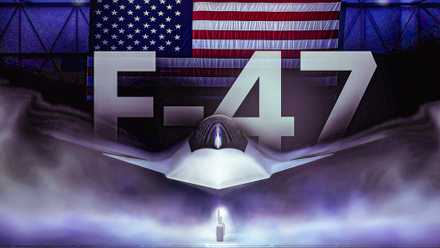
The Real Reason Why Boeing Is Building The F-47 Stealth Fighter And Not Lockheed
The jet will be built on stealth, speed, and strategy.
Three Reasons For “47” — And The One That Came First

The official Air Force justification for the “47” designation layers three separate historical references. According to The War Zone, Gen. Allvin posted a statement the day of the Oval Office announcement, explaining that the number is a tribute to the Republic P-47 Thunderbolt and its service, to the establishment of the Air Force as an independent branch in 1947, while also recognizing the 47th President’s interest and support for the world’s first sixth-generation fighter.
The P-47 Thunderbolt connection is the most aeronautically interesting of the three. The Republic P-47 was one of the most produced American fighters of World War II — a massive, radial-engined heavyweight that earned the nickname “Jug” among its pilots. The Fairchild Republic A-10 Warthog , itself an unofficial heir to the Thunderbolt’s ground-attack legacy, carries the official nickname “Thunderbolt II” in homage to the P-47.
What the official three-part rationale does not address is that internal Air Force emails showed officials scrambling to construct that historical framing after Trump had already announced the name. According to National Security Journal’s reporting on those emails, the P-47 lineage and the 1947 Air Force founding were retroactively assembled into a “talking paper” once the designation became public. The Air Force itself has never commented on that characterization.
What is publicly confirmed is that Trump himself raised the specter of removing the “47” from the designation at the World Economic Forum in Davos in January 2026 — saying, in front of assembled global leaders, “If I don’t like it, I’m going to take the 47 off it.” For a program whose nomenclature is partly built on a president’s personal preference, that was a pointed reminder of how political the naming actually is.
Edwards AFB And The Infrastructure Already In Place

The transition from X-plane phase to formal “F” acquisition also triggered immediate institutional changes at the Air Force’s primary flight test hub. At Edwards Air Force Base in California, the 412th Test Wing stood up a dedicated Air Dominance Combined Test Force (CTF) specifically for the F-47. The Aviationist reported that Brig. Gen. Douglas “Beaker” Wickert, the 412th Test Wing commander, confirmed the CTF’s existence in a May 2025 podcast interview, marking the first time a senior official at Edwards had publicly discussed the F-47 in an operational context. The structure mirrors how the 412th handled Northrop Grumman B-21 Raider integration, a parallel that is telling, given that the B-21 is the program most often cited as the model for how the Air Force wants to run NGAD.
Meanwhile, Boeing began manufacturing the first F-47 fuselage at its St. Louis, Missouri, facility — the same plant that currently builds the Boeing F-15EX Eagle II and T-7A Red Hawk. As reported by TWZ, in September 2025, Allvin confirmed this had begun, saying:
“In the few short months since we made the announcement, they [Boeing] are already beginning to manufacture the first article. We’re ready to go fast. We have to go fast.”
That urgency was a direct reference to China’s accelerating sixth-generation programs. The Chengdu J-36 and the J-50, two aircraft observed in flight tests near Chinese facilities from late 2024 onward, represent a peer competitor that is not waiting for the American program to sort out its budgetary politics.
The fiscal picture reinforces the urgency. Congress appropriated approximately $8.2 billion annually for NGAD development between fiscal years 2022 and 2025. The Trump administration then requested $2.58 billion for FY2026, with a steeper ramp to more than $5 billion in FY2027 and a projected peak of $5.25 billion in FY2028, precisely the financial signature of a program moving through its most hardware-intensive development phase and approaching a first-flight milestone. As stated by Holland & Knight, the One Big Beautiful Bill Act, passed in July 2025, added another $400 million to accelerate F-47 production. For context: the F-47’s total development and production spending is expected to run into hundreds of billions of dollars over its lifetime.

6 Aircraft That Represent The Future Of Air Combat
Discover six aircraft redefining modern air warfare, from stealth fighters to missile trucks, shaping the balance of air power in 2026 and beyond.
What The Performance Numbers Actually Mean For The Indo-Pacific

The publicly confirmed performance targets for the F-47 are sparse but strategically revealing. Air & Space Forces Magazine confirmed that the aircraft is designed for a combat radius exceeding 1,000 NM (1,850 km) and speeds above Mach 2. On paper, those two numbers sound modest; the F-22 can already exceed Mach 2, and 1,000 NM (1,850 km) is not a revolutionary figure in isolation. But context is everything: the F-22 Raptor’s combat radius is widely cited at roughly 590 NM (1,090 km) in typical fighter configurations. The F-47’s stated figure is nearly double that. In a potential Indo-Pacific conflict scenario, where the distances between US air bases and plausible targets in the Taiwan Strait or the South China Sea routinely exceed 500 NM (926 km), that delta is the difference between an aircraft that needs a tanker escort to reach the fight and one that can penetrate a contested threat environment without it, and return.
Aerial refueling tankers are among the most vulnerable assets in any high-end air campaign. They are large, slow, non-stealthy, and must operate within range of the fight to be effective. China’s anti-access/area-denial (A2/AD) architecture, built around systems such as the HQ-9 surface-to-air missile and increasingly capable carrier-based fighter aviation, is specifically designed to push US tankers out of useful range. The F-47’s range figure is, in that framing, the program’s entire strategic rationale expressed in nautical miles.
The propulsion technology enabling that range is the Next Generation Adaptive Propulsion (NGAP) engine, either Pratt & Whitney’s XA103 or GE Aerospace’s XA102, which features a three-stream adaptive cycle design. Unlike conventional turbofans, these engines can open a third bypass stream to maximize fuel efficiency during cruise (dramatically extending range) or close it to redirect airflow through the core for maximum combat thrust at Mach 2-plus. Pratt & Whitney has stated its XA103 is engineered for up to 25% greater fuel efficiency and up to 20% more thrust versus conventional fixed-cycle engines, numbers that, if borne out, explain much of the F-47’s range advantage over the F-22 without requiring a physically larger fuel capacity. The NGAP engine selection remains an open competition as of mid-2026, with both vendors continuing development.
On Track, But The Real Test Starts In 2028

As of late February 2026, the program’s status report from the Air Force’s most senior acquisition official was unambiguous. Gen. Dale White, the Direct Reporting Portfolio Manager for Critical Major Weapon Systems — a new role created specifically to oversee programs of the F-47’s strategic importance — told reporters at the AFA Warfare Symposium in Aurora, Colorado, that the F-47 is “doing exceptionally well” and remains “on time and on target” for its 2028 first-flight milestone. According to Air & Space Forces Magazine, White also praised Boeing’s personnel ramp-up, saying “Boeing has done a really good job of ramping up the personnel piece”, an early-stage metric that program managers watch closely because staffing gaps in the first 12 to 18 months of an EMD program are one of the most reliable leading indicators of schedule risk.
The “F” in F-47 made a promise: that this aircraft would enter the acquisition system as a mature program, not as an experimental idea in search of a mission. Everything that has happened since the March 2025 contract award has been consistent with that promise being honored.
That does not mean the program is without risk. The NGAP engines remain behind schedule, with supply chain constraints expected to push final engine selection toward 2030. Congressional skepticism about cost has not disappeared. And as Simple Flying has noted, Boeing’s record on fixed-price defense contracts gives auditors and program oversight bodies legitimate reasons to watch closely.
But the most important thing the “F” prefix reveals is not about what the aircraft can do at Mach 2 over the South China Sea. It reveals what the Air Force had already done, invisibly, for the better part of a decade — funding classified X-planes, accumulating hundreds of flight hours of data nobody outside a handful of cleared facilities could see, and building the evidentiary foundation that justified skipping two letters in an alphabet most programs cannot afford to abbreviate. When you strip away the political theater of the Oval Office announcement and the layered symbolism of the number “47,” that is the real story of the F-47’s designation. The “F” is not just a letter. It is a receipt for work already completed.